
The Muslim caliphate’s Turkish military leaders, having …
Years: 870 - 870
The Muslim caliphate’s Turkish military leaders, having murdered or deposed each of the three caliphs they have installed from 861, install al-Mu'tamid as caliph in 870.
Having emptied the imperial treasuries to maintain the army and the court, and now deriving scant income from the caliphate’s increasingly restive provinces, the Turks finally end their murderous rule within the caliphate and allow al-Mu'tamid to govern without interference.
Locations
People
Groups
Topics
Commodoties
Subjects
Regions
Subregions
Related Events
Filter results
Showing 10 events out of 53936 total
Bukhara-born Arabic scholar Muhammad Ibn Ismail al-Bukhari, after making a pilgrimage to Mecca as a teenager, had subsequently spent sixteen years traveling through Asia.
Having listened to Muslim authorities, gathering traditions and sayings of the prophet Muhammad, he had then compiled these in an “Al-Jami al-sahih,” which has become enormously influential.
Following al-Bukhari’s death on August 31, 870, his tomb at Samarkand becomes an important shrine for pilgrims.
Boris, Khan of Bulgaria, although baptized by Constantinopolitan Rite, approaches the pope with a proposal to establish an independent Bulgarian church with Roman rites.
Receiving no response, he turns back to Constantinople and in 870 achieves his goal of a Bulgarian archbishopric within the imperial sphere.
Emperor Basil, seeking to confirm his deposition of Photios, patriarch of Constantinople, convenes the Fourth Council of Constantinople in 869-870, which issues no new dogmatic decisions and whose principal action is to restore Ignatius by deposing Photi0s for usurping his ecclesiastical position.
Bulgaria is formally placed under the nominal ecclesiastical jurisdiction of the patriarch of Constantinople but receives an independent archbishopric.
This has significant results both for the Balkan principalities and for the Orthodox Church, as well as greatly strengthening imperial Greek influence in the south Slav world.
The council greatly contributes to the growing rift between the Eastern and Western churches.
(The Roman church will eventually recognize it as the eighth ecumenical council, but the Eastern church for the most part will deny its ecumenicity and continue to recognize only the first seven ecumenical councils.)
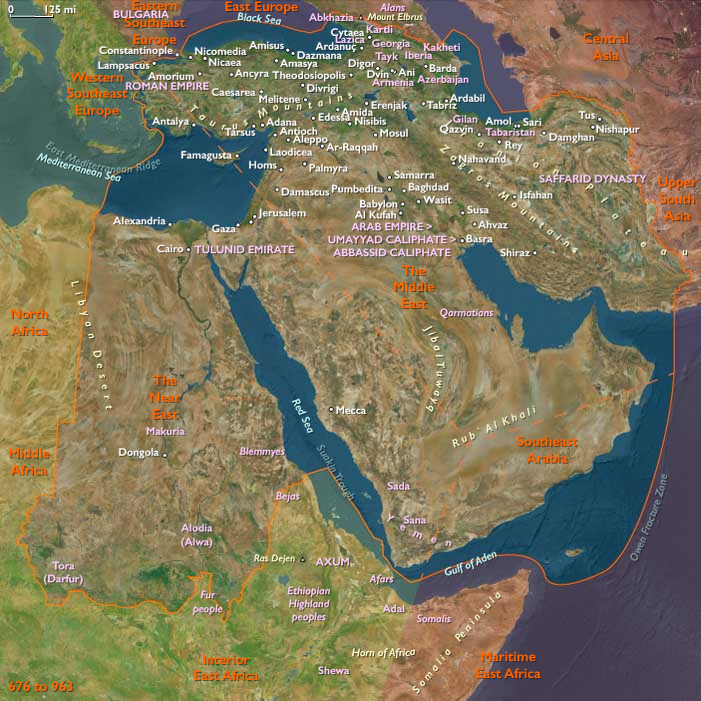
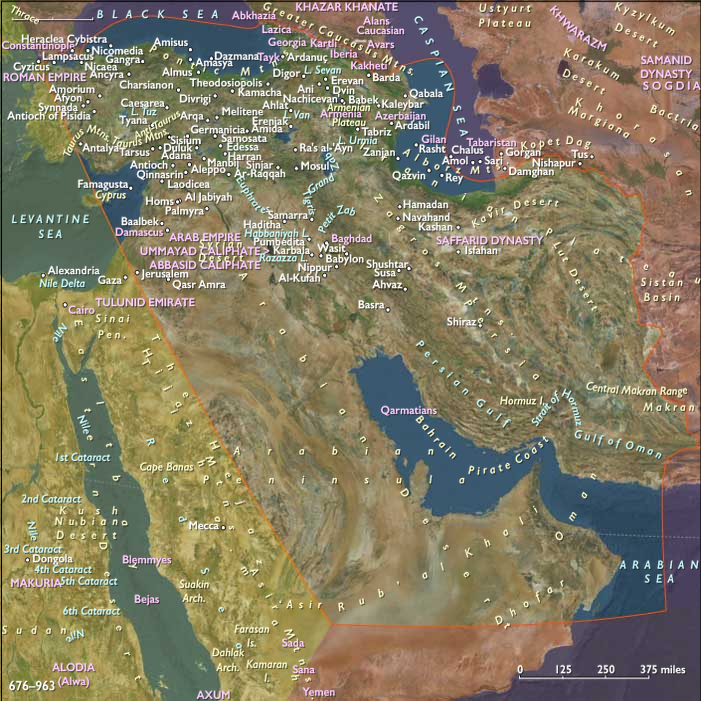
The Zanj rebels gain control of southern Iraq by June 870, capturing al-Ubullah, a seaport on the Persian Gulf, and cutting communications to Basra, a few miles downstream, then …
…seize Ahvaz in Khuzestan (southwestern Iran).
Ya'qub ibn al-Layth al-Saffar captures the Tahirid city of Herat in 870.
His campaign in the Badghis region had led to the capture of Kharijites who will later form the Djash al-Shurat contingent in his army.
Ya'qub now turns his focus to the west and began attacks on Khorasan, Khuzestan, Kerman and Fars.
These attacks forces the Abbasid caliphate to recognize him as governor of Kerman.
The librarian Anastasius had been sent in 869 by Louis II, Holy Roman Emperor as envoy to Constantinople, with two men of high rank in the Frankish Empire, to negotiate a marriage between Louis's only child, Ermengard, and Leo VI the Wise (who is either the illegitimate son of Emperor Michael III or the second son of his successor, Basil I the Macedonian; his mother, Eudokia was both Michael III's mistress and Basil’s wife).
When the envoys arrived at Constantinople, the Fourth Council of Constantinople was still in session, and Anastasius, who attended the last session (February, 870), zealously defended the papal cause and was of much service to the papal legates.
On their way home the papal legates were robbed, and the "Acts" of the council were carried off.
However, they had given most of the declarations of obedience of the Greek bishops to Anastasius, who also had a copy of the "Acts", and is thus able to bring these documents to the pope.
At the pope's order, he translates the "Acts" into Latin.
The Greek originals are lost.
The Treaty of Meerssen (870): The Final Partition of Lotharingia
Following the death of Lothair II on August 8, 869, the fate of his kingdom, Lotharingia, becomes a matter of contention among the remaining Carolingian rulers. Although Lothair’s elder brother, Emperor Louis II of Italy, was his rightful heir, he is engaged in a military campaign against the Emirate of Bari and unable to defend his claim. Seizing the opportunity, Louis the German (East Francia) and Charles the Bald (West Francia) divide Lotharingia between themselves, formalizing the Treaty of Meerssen in 870.
Background: The Fragmentation of Middle Francia
- 843 - Treaty of Verdun: Lothair I receives Middle Francia, a long, narrow kingdom stretching from the North Sea to Italy.
- 855 - Treaty of Prüm: After Lothair I’s death, Middle Francia is divided among his three sons:
- Louis II → Italy (Imperial Crown).
- Lothair II → Lotharingia (Austrasia, Frisia, and Upper Burgundy).
- Charles of Provence → Lower Burgundy and Provence.
- 863 - Death of Charles of Provence: His lands are split between Lothair II and Louis II, further complicating territorial claims.
- 869 - Death of Lothair II: Lotharingia becomes a target for division between his uncles Louis the German and Charles the Bald, excluding Emperor Louis II from any inheritance.
The Partition of Lotharingia (870)
The Treaty of Meerssen effectively replaces the Treaty of Verdun (843) by dividing the northern half of Middle Francia between East and West Francia:
-
Charles the Bald (West Francia) receives:
- The western part of Lower Burgundy, including Lyon, Vienne, Vivarais, and Uzès.
- A small portion of Upper Burgundy, including Portois and Varais (Besançon), securing a route toward Italy.
- The western half of Lotharingia, forming a new Frankish frontier against Viking incursions.
-
Louis the German (East Francia) receives:
- Most of Austrasia, including the key cities of Aachen and Metz.
- Most of Frisia, though large portions remain under Viking control and are only claimed on paper.
- Most of Upper Burgundy, joining it with Louis the Younger’s subkingdom of eastern Austrasia.
- Preventing Charles the Bald from reclaiming his family’s ancestral holdings in Lotharingia, reinforcing East Frankish dominance in the region.
-
Lothair II’s illegitimate son, Hugh, is granted the Duchy of Alsace, but his claim to power remains tenuous.
Impact of the Treaty of Meerssen
- The dissolution of Lotharingia → The treaty permanently fragments Lotharingia, making it a contested region between East and West Francia for centuries.
- Exclusion of Emperor Louis II → The fact that Louis II of Italy receives no part of his brother’s landsweakens his imperial claim, ensuring that Italy remains separate from Francia.
- Strengthening of East Francia → With the addition of Austrasia, Frisia, and Upper Burgundy, Louis the German’s realm grows significantly, consolidating the foundations of what will become Germany.
- Charles the Bald’s expansion into Burgundy → Although weaker than his brother, Charles now secures an Alpine route to Italy, a move that will later aid his imperial ambitions.
- Rise of Regional Power Struggles → The Carolingian rulers’ inability to maintain unity leads to increased feudal fragmentation, paving the way for the rise of independent duchies and local rulers.
Conclusion: The Carolingian Empire Moves Toward Disintegration
The Treaty of Meerssen (870) marks the last major territorial division of the Carolingian Empire, further weakening its imperial structure. With Lotharingia divided and contested, East and West Francia become separate political entities, setting the stage for the eventual formation of medieval France and Germany. Though nominally still part of the Carolingian realm, the empire continues to unravel, as Viking invasions, feudal decentralization, and dynastic disputes erode central authority.
Otfried von Weissenburg and the Introduction of End-Rhyme in German Poetry (870)
In 870, Otfried von Weissenburg, a monk from the Weissenburg Abbey in Alsace, composes the Evangelienbuch("Book of Gospels"), the first known German literary work by an identifiable author. His innovative use of end-rhyme marks a major linguistic and poetic shift, shaping the development of medieval German Christian literature.
The Evangelienbuch: A Landmark in Early German Literature
- The Evangelienbuch is a biblical paraphrase, retelling the life of Christ in vernacular Old High German.
- Unlike earlier Germanic poetry, which relied on alliteration (as seen in Beowulf and Hildebrandslied), Otfried abandons alliterative verse in favor of end-rhyme.
- This innovation is likely influenced by Latin hymnody and Christian poetic traditions, which had begun using rhyming patterns in liturgical texts.
The Impact of Otfried’s End-Rhyme Innovation
- Establishes a precedent for a new German Christian literature, moving away from pagan heroic poetry to biblical and religious themes.
- Influences later medieval German poets, including those writing in the Middle High German period, such as Hartmann von Aue and Wolfram von Eschenbach.
- Aligns German poetry with Latin literary traditions, reinforcing Carolingian cultural reforms that sought to standardize Christian education and literary expression.
The Role of the Evangelienbuch in Carolingian Intellectual Culture
- Otfried dedicates his work to Louis the German, ruler of East Francia, showing the close ties between religious scholarship and royal patronage.
- The text serves as an educational and devotional tool, helping to spread Christian teachings among Germanic-speaking populations.
- The use of vernacular Old High German reinforces the Carolingian emphasis on using regional languages for religious instruction, complementing Latin theological works.
Legacy of Otfried von Weissenburg
- His use of end-rhyme becomes the dominant feature of medieval and later German poetry, replacing alliterative verse.
- The Evangelienbuch represents one of the earliest attempts to create a distinctly German Christian literary tradition, paving the way for future vernacular biblical literature.
- Otfried's work embodies the cultural and literary transformation occurring in the Carolingian Renaissance, linking Latin and Germanic traditions within the broader Christian literary canon.
Thus, Otfried von Weissenburg’s Evangelienbuch (870) not only introduces end-rhyme into German poetry but also plays a crucial role in the transition from oral, heroic traditions to written, religious literature, shaping the trajectory of German literary history.
Louis the German works in vain after the 870 Treaty of Meersen to acquire for his son Carloman the imperial crown and Italy.
