
The multitiered Pont du Gard, a splendid …
Years: 52 - 63
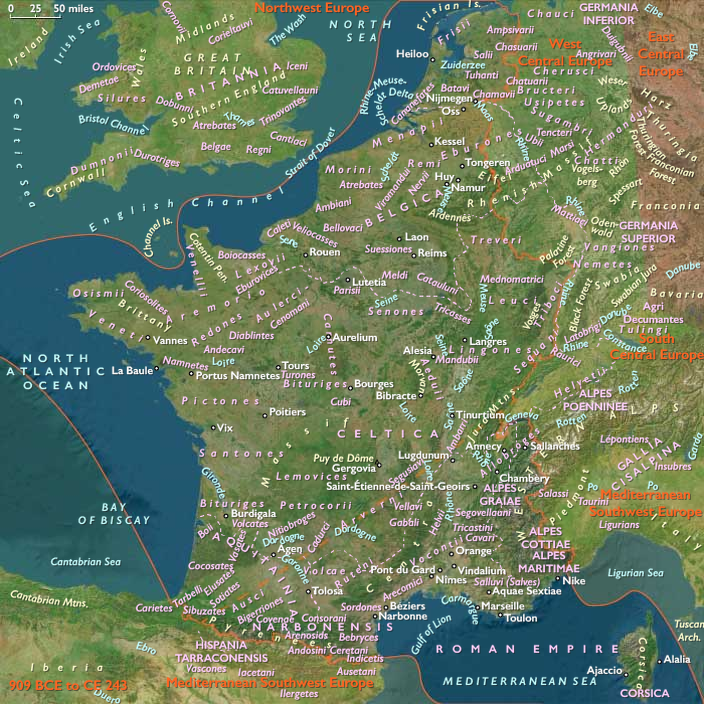
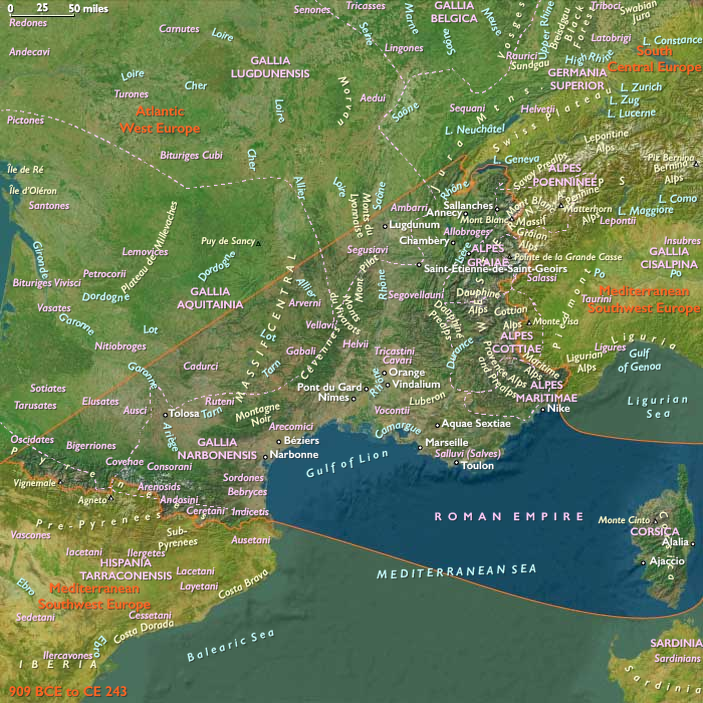
The multitiered Pont du Gard, a splendid example of Roman aqueduct engineering, is constructed over a gorge located just outside Nimes to carry the aqueduct channel to a freshwater source about fifteen miles (twenty-five kilometers) away.
Three tiers of stone arches support a water channel, and a footbridge runs among the first tier.
The construction of the aqueduct has long been credited to Augustus' son-in-law and aide, Marcus Vipsanius Agrippa, around the year 19 BCE.
At the time, he was serving as aedile, the senior magistrate responsible for managing the water supply of Rome and its colonies.
Émile Espérandieu, writing in 1926, linked the construction of the aqueduct with Agrippa's visit to Narbonensis in that year (Bromwich, James [2006].
Roman Remains of Southern France: A Guide Book.
Routledge.
p.
110.).
Newer excavations, however, suggest the construction may have taken place between 40 and 60 CE.
Tunnels dating from the time of Augustus had to be bypassed by the builders of the Nîmes aqueduct, and coins discovered in the outflow in Nîmes are no older than the reign of the emperor Claudius (41-54 CE).
On this basis, a team led by Guilherm Fabre has argued that the aqueduct must have been completed around the middle of the first century CE (Fabre, G, Fiches, J.-L., and Paillet, J.-L. 1991.
"Interdisciplinary Research on the Aqueduct of Nimes and the Pont du Gard."
Journal of Roman Archaeology 4, 63-88).
It is believed to have taken about fifteen years to build, employing between eight hundred and one thousand workers.
Locations
People
Groups
Topics
Commodoties
Subjects
Regions
Subregions
Years: 52 - 63
Locations
People
Groups
Topics
Commodoties
Subjects
Regions
Subregions