
The most commonly held perspective on the …
Years: 11277BCE - 9550BCE
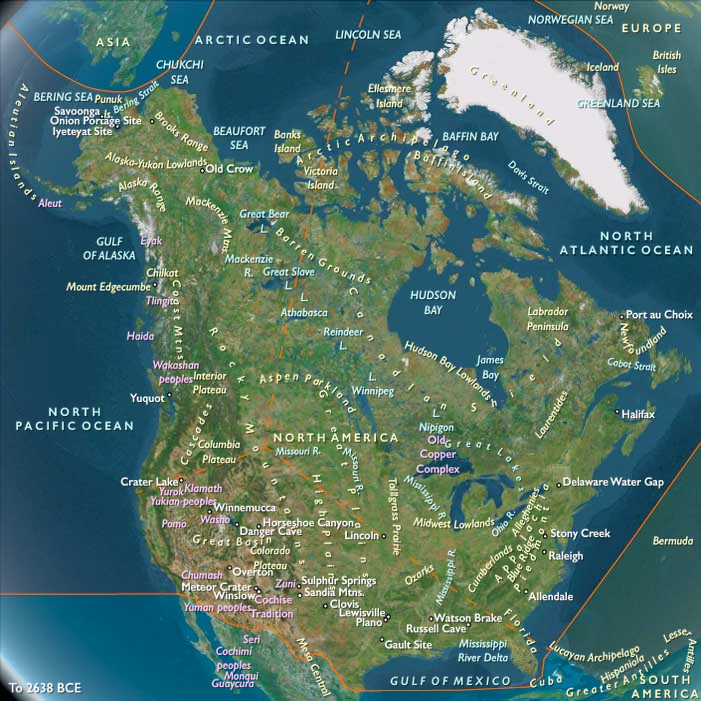
The most commonly held perspective on the end of the Clovis culture is that a decline in the availability of megafauna, combined with an overall increase in a less mobile population, led to local differentiation of lithic and cultural traditions across the Americas.
After this time, Clovis-style fluted points were replaced by other fluted-point traditions (such as the Folsom culture) with an essentially uninterrupted sequence across North and Central America.
An effectively continuous cultural adaptation proceeds from the Clovis period through the ensuing Middle and Late Paleo-Indian periods.
It has also been argued that Clovis ended in a very abrupt fashion.
Whether the Clovis culture drove the mammoth, and other species, to extinction via overhunting—the so-called Pleistocene overkill hypothesis—is still an open, and controversial, question.
Climate change, coupled with human predation, disease, and additional pressures from newly arrived herbivores (competition) and carnivores (predation) and isolation, may have made it impossible for many species to reproduce and survive.
It has also been hypothesized that the Clovis culture saw its decline in the wake of the Younger Dryas cold phase.
This 'cold shock', lasting roughly fifteen hundred years, affected many parts of the world, including North America.
It appears to have been triggered by a vast meltwater lake—Lake Agassiz—emptying into the North Atlantic, disrupting the thermohaline circulation.
The end of the Younger Dryas, about eleven thousand years ago, was an interval when the temperature of Greenland warmed by over 5°C in less than a few decades.
A recent hypothesis suggests that one or more extraterrestrial bodies caused the mass extinction and triggered a period of climatic cooling.
Known as the Clovis Comet, or the Younger Dryas impact event, this hypothesis proposes that an extraterrestrial object such as a comet exploded in Earth's atmosphere above North America's Great Lakes region about twelve thousand nine hundred years ago, and significantly affected the human Clovis culture.
Research published in January 2009 argues that there was no extraterrestrial impact, but fails to explain the high levels of metal and magnetic spherules found deep inside the tusks and skulls of mammoths.
Additional evidence of comet impact is the widespread occurrence of microdiamonds and black mats in a layer of sedimentary rocks of that era, but is not reflected in the extinction record.
Groups
Topics
- Paleolithic
- Pleistocene Epoch
- Last glacial period
- Lithic Stage (Americas)
- The Upper Paleolithic
- Allerød Oscillation
- Late Glacial Maximum
- Younger Dryas
- Preboreal Period
Commodoties
Subjects
Regions
Subregions
Years: 11277BCE - 9550BCE
Groups
Topics
- Paleolithic
- Pleistocene Epoch
- Last glacial period
- Lithic Stage (Americas)
- The Upper Paleolithic
- Allerød Oscillation
- Late Glacial Maximum
- Younger Dryas
- Preboreal Period
Commodoties
Subjects
Regions
Subregions