The Mossi tribe enters the Upper Volta …
Years: 1072 - 1083
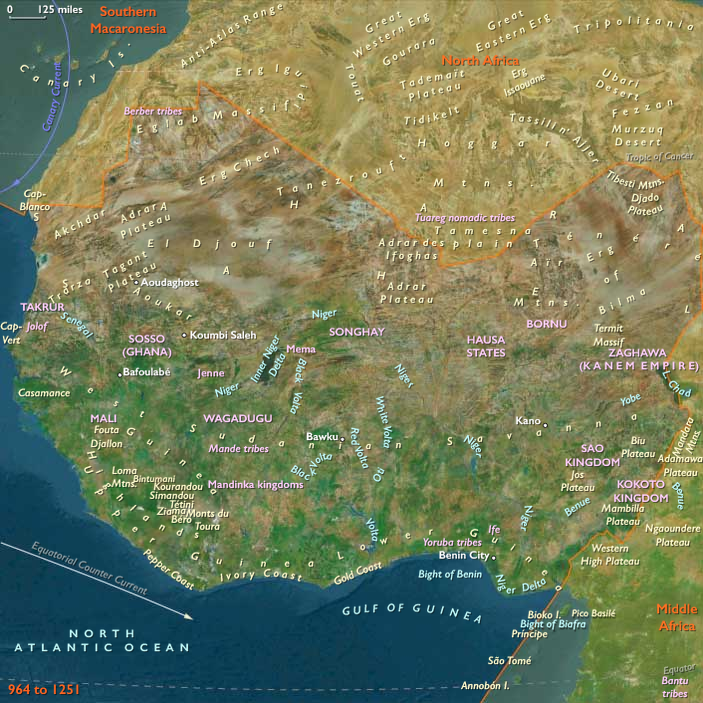
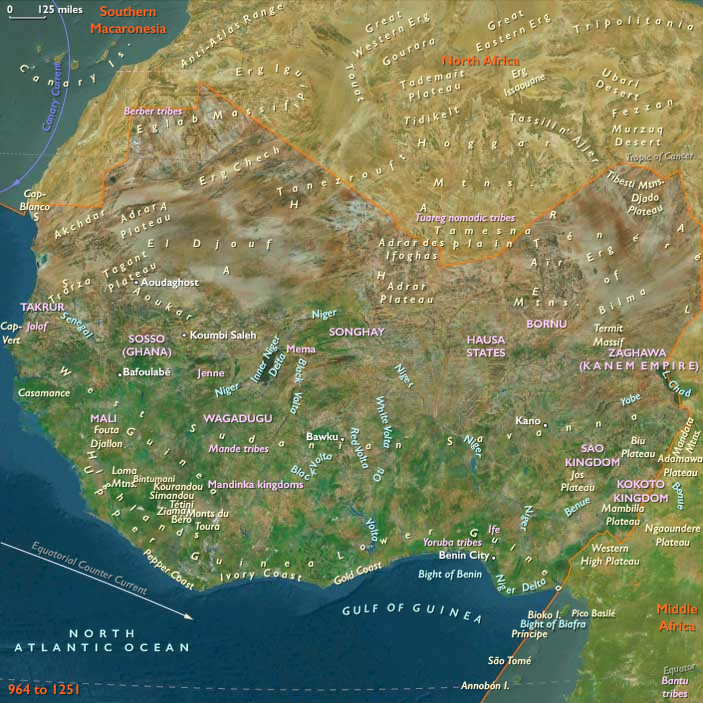
The Mossi tribe enters the Upper Volta region around this time, and begins to assert their authority in the region.
Locations
Groups
Topics
Subjects
Regions
Subregions
Related Events
Filter results
Showing 10 events out of 11 total
Slav insurgencies against the Ottoman Empire rock the Balkans.
Turkey viciously crushes a Christian revolt in eastern Rumelia.
Russia invades Rumelia and defeats Turkey, gaining influence in the Balkans by creating the independent state of Greater Bulgaria.
Britain and Austria-Hungary intervene, Britain's fleet checking a second Russian drive for a warm water port; the British take Cyprus to prevent further Russian advances.
The Great Powers hold the Congress of Berlin to impose a redesigned order upon the Balkan states, limiting Russian gains at British insistence.
The Principality of Bulgaria is created in 1878 as a result of war waged in the territory of modern Bulgaria between the Russian and Ottoman empires, in which Russia is joined by the Romanians, the Serbs, and the Montenegrins.
The peace settlement, imposed on the Ottoman government by Russia at this high point of its influence on Balkan affairs, provides for a new disposition of the European provinces of the Ottoman Empire that ends any effective Turkish control over the Balkans.
The independence of the Kingdom of Romania is recognized, together with that of the principalities of Serbia and Montenegro, the boundaries of which are extended so as to be contiguous.
Romania is compelled to cede southern Bessarabia to Russia, receiving the Dobruja from Turkey in exchange.
Sultan Abdülhamid has had reasonable success in preserving the empire after 1878. (Apart from eastern Rumelia, he will lose no further territories until 1908.)
The principalities of Romania and Serbia gain recognition from the Great Powers as kingdoms in 1881 and 1882, respectively.

Political parties had emerged in Serbia after 1868, and aspects of Western culture had begun to appear.
A widespread uprising in the Ottoman Empire prompts an unsuccessful attack by Serbia and Montenegro in 1876, and a year later these countries ally with Russia, Romania, and Bulgarian rebels to defeat the Turks.
The subsequent treaties of San Stefano and Berlin make Serbia an independent state and add to its territory, while Montenegro gains a seacoast.
Austria-Hungary, alarmed at Russian gains, the growing stature of Serbia, and irredentism among Vojvodina's Serbs, presses for and wins the right to occupy Bosnia, Herzegovina, and Novi Pazar in 1878.
Serbia's Prince Milan Obrenovic, a cousin of Mihajlo, becomes disillusioned with Russia and fearful of the newly created Bulgaria.
He therefore signs a commercial agreement in 1880 that makes Serbia a virtual client state of Austria-Hungary.
Milan becomes the first king of modern Serbia in 1882, but his pro-Austro-Hungarian policies undermine his popularity, and he will abdicate in 1889.
The Ottoman sultan, faced with growing international pressure to "pacify" the refractory Albanians, dispatch a large army under Dervish Turgut Pasha to suppress the Prizren League and deliver Ulcinj to Montenegro.
Albanians loyal to the empire support the Sublime Porte's military intervention.
In April 1881, Dervish Pasha's ten thousand men capture Prizren and later crush the resistance at Ulcinj.
The Prizren League's leaders and their families are arrested and deported.
Frasheri, who originally receives a death sentence, is imprisoned until 1885 and exiled until his death seven years later.
In the three years it survives, the Prizren League effectively makes the Great Powers aware of the Albanian people and their national interests.
Montenegro and Greece receive much less Albanian-populated territory than they would have won without the league's resistance.
The Congress of Berlin ignores the league's memorandum, and Germany's Otto von Bismarck even proclaims that an Albanian nation does not exist.
The congress cedes to Montenegro the cities of Bar and Podgorica and areas around the mountain villages of Gusinje and Plav, which Albanian leaders consider Albanian territory.
Serbia also wins Albanian-inhabited lands.
The Albanians, the vast majority loyal to the empire, vehemently oppose the territorial losses.
Albanians also fear the possible loss of Epirus to Greece.
The Prizren League organizes armed resistance efforts in Gusinje, Plav, Shkoder, Prizren, Prevesa, and Janina.
A border tribesman at the time describes the frontier as "floating on blood."
The Congress of Berlin orders a commission to trace a border between the Ottoman Empire and Montenegro in August 1878.
The congress also directs Greece and the Ottoman Empire to negotiate a solution to their border dispute.
The Great Powers expect the Ottomans to ensure that the Albanians will respect the new borders; they ignore the fact that the sultan's military forces are too weak to enforce any settlement and that the Ottomans can only benefit by the Albanians' resistance.
The Sublime Porte, in fact, arms the Albanians and allows them to levy taxes, and when the Ottoman army withdraws from areas awarded to Montenegro under the Treaty of Berlin, Roman Catholic Albanian tribesmen simply take control.
The Albanians' successful resistance to the treaty forces the Great Powers to alter the border, returning Gusinje and Plav to the Ottoman Empire and granting Montenegro the mostly Muslim Albanian-populated coastal town of Ulcinj, but the Albanians there refuse to surrender as well.
Finally, the Great Powers blockade Ulcinj by sea and pressures the Ottoman authorities to bring the Albanians under control.
The Great Powers decide in 1881 to cede Greece only Thessaly and the small Albanian-populated district of Arta.
The 1877-78 Russo-Turkish War deals a decisive blow to Ottoman power in the Balkan Peninsula, leaving the empire with only a precarious hold on Macedonia and the Albanian-populated lands.
The Albanians' fear that the lands they inhabit will be partitioned among Montenegro, Serbia, Bulgaria, and Greece fuels the rise of Albanian nationalism.
The first postwar treaty, the abortive Treaty of San Stefano signed on March 3, 1878, assigns Albanian-populated lands to Serbia, Montenegro, and Bulgaria.
Austria- Hungary and Britain block the arrangement because it awards Russia a predominant position in the Balkans and thereby upsets the European balance of power.
A peace conference to settle the dispute is held later in the year in Berlin.
The Treaty of San Stefano triggers profound anxiety among the Albanians meanwhile, and it spurs their leaders to organize a defense of the lands they inhabit.
In the spring of 1878, influential Albanians in Constantinople—including Abdyl Frasheri, the Albanian national movement's leading figure during its early years—organize a secret committee to direct the Albanians' resistance.
In May the group calls for a general meeting of representatives from all the Albanian-populated lands.
On June 10, 1878, about eighty delegates, mostly Muslim religious leaders, clan chiefs, and other influential people from the four Albanian-populated Ottoman vilayets, meet in the Kosovo town of Prizren.
The delegates set up a standing organization, the Prizren League, under the direction of a central committee that has the power to impose taxes and raise an army.
The Prizren League works to gain autonomy for the Albanians and to thwart implementation of the Treaty of San Stefano, but not to create an independent Albania.
The Ottoman authorities support the Prizren League at first, but the Sublime Porte presses the delegates to declare themselves to be first and foremost Ottomans rather than Albanians
Some delegates support this position and advocate emphasizing Muslim solidarity and the defense of Muslim lands, including present-day Bosnia and Hercegovina.
Other representatives, under Frasheri's leadership, focus on working toward Albanian autonomy and creating a sense of Albanian identity that will cut across religious and tribal lines.
Because conservative Muslims constitute a majority of the representatives, the Prizren League supports maintenance of Ottoman suzerainty.
The Prizren League sends a memorandum to the Great Powers at the Congress of Berlin, which had been called in July 1878 to settle the unresolved problems of the Russo-Turkish War.
The memorandum demanded that all Albanians be united in a single Ottoman province that would be governed from Bitola by a Turkish governor, who would be advised by an Albanian committee elected by universal suffrage.
Britain and Austria-Hungary, alarmed by the Russian gains contained in the Treaty of San Stefano, intervene to force a revision of the treaty at the Congress of Berlin.
The Congress ignores the Prizren League's memorandum, however, and Germany's chancellor Otto von Bismarck even proclaims that an Albanian nation does not exist.
The new Treaty of Berlin, signed on July 13, 1878, severely restricts Russia's military-political gains from the war.
Bismarck and Britain's Benjamin Disraeli impose upon Serbia, Bulgaria, and Greece the emancipation of the Jews of those countries.