The Moors in the Aurès Mountains (in …
Years: 484 - 484
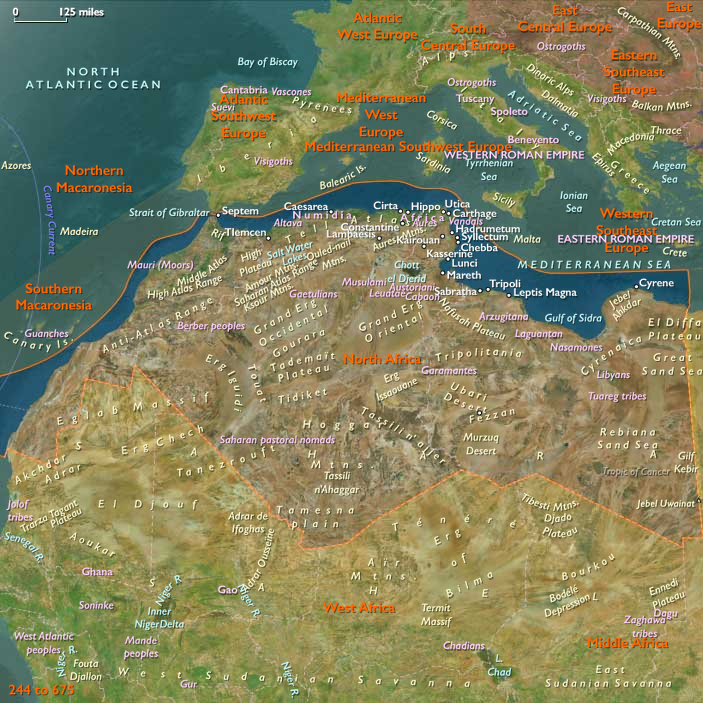
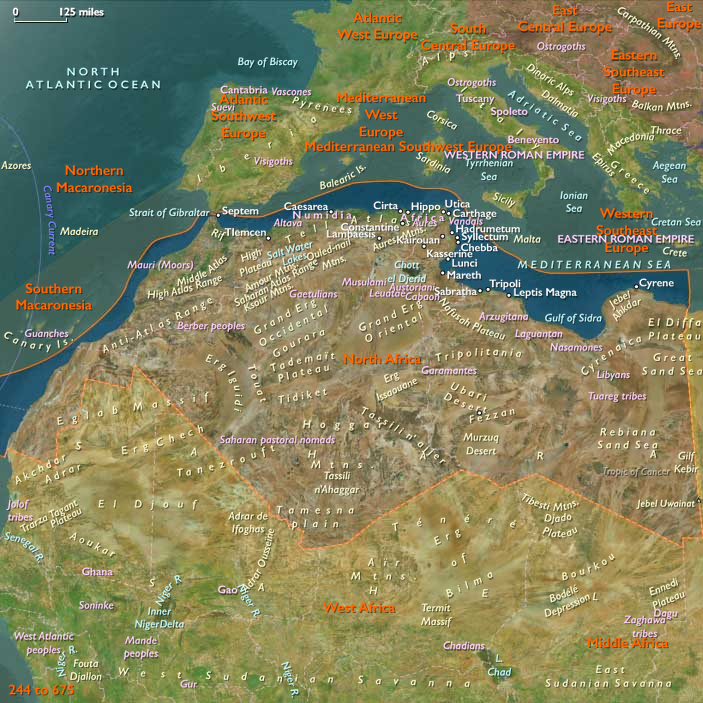
The Moors in the Aurès Mountains (in modern-day Algeria) successfully rebel from Vandal rule towards the end of Huneric’s reign.
The Vandals remain ardent Arian Christians, and their persecutions of the Latin church in Africa are at times fierce, particularly during the last years of the reign of Generic's successor, Huneric.
Not long after the ordination of Eugenius as the new Catholic bishop of Carthage, Huneric had reversed himself and began to once again persecute Catholics.
Furthermore, he tried to make Catholic property fall to the state, but when this caused too much protest from the Eastern Roman Emperor, he chose to banish a number of Catholics to a faraway province instead.
A few are martyred, including the former proconsul Victorian along with Frumentius and other wealthy merchants, who are killed at Hadrumetum after refusing to become Arians.
Locations
People
Groups
- Hasdingi
- Silingi (East Germanic tribe)
- Manicheanism
- Christianity, Arian
- Moors
- Vandals and the Alans, Kingdom of the
- Christianity, Chalcedonian
- Roman Empire, Eastern: Leonid dynasty
Topics
Commodoties
Subjects
Regions
Subregions
Related Events
Filter results
Showing 10 events out of 58465 total
East Central Europe (484–495 CE): Theodoric’s Migration to Italy and Gepid Ascendancy
Between 484 and 495 CE, East Central Europe—including Poland, Czechia, Slovakia, Hungary, and those portions of Germany and Austria lying east of 10°E and north of a line stretching from roughly 48.2°N at 10°E southeastward to the Austro-Slovenian border near 46.7°N, 15.4°E—underwent significant geopolitical shifts following the departure of Theodoric the Great and his Ostrogothic followers for Italy in 488 CE. This migration reshaped regional power dynamics, leading to increased dominance by the Gepids, who rapidly expanded into territories vacated by the Ostrogoths. Amid these transitions, the Rugii maintained their diplomatic neutrality and autonomy along the upper Tisza, while the region's proto-Slavic communities continued their enduring cultural stability and careful adaptation to shifting power balances.
Political and Military Developments
Theodoric the Great’s Departure (488 CE)
-
In 488 CE, Theodoric the Great, encouraged by the Eastern Roman Empire, led his Ostrogothic followers from East Central Europe to Italy, drastically altering regional power structures and leaving a substantial political and territorial vacuum behind.
Gepid Expansion and Dominance
-
Following the Ostrogothic exodus, the Gepids, already influential in modern Hungary and the Carpathian Basin, swiftly moved to consolidate control over the newly vacated territories, greatly expanding their sphere of influence and firmly establishing regional dominance.
Continued Autonomy of the Rugii
-
The Rugii adeptly navigated these shifting alliances and regional changes, preserving their autonomy and regional stability through continued diplomatic engagement with the Gepids and other neighboring powers.
Economic and Technological Developments
Economic Reorientation and Stability
-
The Gepid ascendency provided stability in previously Ostrogoth-controlled territories, allowing a modest economic revival through renewed trade networks, particularly along routes linking major settlements like Augusta Vindelicorum (Augsburg) and the former Roman frontier towns.
Infrastructure and Settlement Maintenance
-
Existing infrastructure, including roads, bridges, and settlements, saw modest maintenance efforts, reflecting the Gepids' intent to sustain trade and military mobility throughout the region.
Cultural and Artistic Developments
Gepid Cultural Flourishing
-
With Gepid consolidation came renewed expressions of cultural identity, as evident in refined metalwork, decorative jewelry, pottery, and weaponry. These cultural artifacts displayed distinctively Gepid motifs blended with remnants of Roman, Ostrogothic, and Hunnic artistic influences.
Proto-Slavic Cultural Continuity
-
Proto-Slavic communities maintained traditional cultural and social practices, carefully integrating limited external influences without compromising their core communal and cultural identities.
Settlement and Urban Development
Strengthened Regional Settlements
-
Strategic settlements such as Augusta Vindelicorum (Augsburg) continued to flourish as essential regional centers, benefiting from increased stability and restored trade under Gepid authority.
-
Former Roman towns, notably Carnuntum, Vindobona, and Aquincum, persisted as fortified centers and administrative hubs within Gepid-dominated regions, albeit on a smaller scale.
Stability and Prosperity of Rugian Settlements
-
Rugian communities along the upper Tisza remained economically and politically stable, anchoring local prosperity and providing continuity during regional realignments.
Social and Religious Developments
Gepid Tribal Consolidation
-
Gepid society became increasingly organized around strong warrior elites and chieftains, consolidating their regional authority by emphasizing traditional Germanic cultural practices, rituals, and governance structures.
Continued Rugian Diplomatic Success
-
Rugian leaders preserved their autonomy through careful diplomatic interactions, ensuring their continued regional independence despite the changing geopolitical landscape.
Proto-Slavic Social Resilience
-
Proto-Slavic communities continued their stable social structures and religious traditions, facilitating strong internal cohesion amid external shifts in political control.
Long-Term Consequences and Historical Significance
The era 484–495 CE represented a critical period of transition following the departure of Theodoric and the Ostrogoths, significantly reshaping East Central Europe's geopolitical landscape. The rapid Gepid expansion filled the resulting power vacuum, stabilizing parts of the region and laying the groundwork for subsequent tribal and political arrangements. Concurrently, the continued autonomy of the Rugii and the enduring resilience of proto-Slavic communities provided crucial continuity, profoundly influencing East Central Europe's historical trajectory toward early medieval configurations.
Eastern Southeast Europe (484–495 CE): Strengthening Foundations and Emerging Challenges
Settlement and Migration Patterns
Continued Regional Stability
Between 484 and 495 CE, Eastern Southeast Europe continued enjoying relative stability, allowing settlements to consolidate further after earlier migrations, particularly among expanding Slavic populations settling the Balkans. Moderate population growth reinforced urban expansion and bolstered rural communities, gradually reshaping demographic and social structures.
Strategic Fortifications
Urban centers such as Constantinople and Philippopolis continued enhancing defensive fortifications. Strategic expansions and infrastructure improvements reinforced urban security, ensuring resilience against ongoing threats and facilitating continued regional stability.
Economic and Technological Developments
Sustained Economic Activity
The region’s economy displayed sustained growth and resilience, driven by stable agricultural production, active trade routes, and consistent urban commerce. Constantinople maintained its pivotal role as the regional economic hub, facilitating trade throughout Eastern Southeast Europe and beyond.
Military and Defensive Innovations
Advancements in military technology further refined fortifications, weaponry, and logistical capabilities. These ongoing developments ensured sustained military preparedness, bolstered regional defenses, and safeguarded economic activities amid evolving challenges.
Cultural and Artistic Developments
Flourishing Artistic Traditions
Cultural vitality remained robust, with continued artistic production blending classical heritage with Christian themes. Public monuments, religious architecture, and decorative arts flourished, reinforcing regional cultural identity and societal cohesion.
Intellectual Vitality
Educational institutions and scholarly communities actively preserved and expanded classical and theological knowledge. Scholarly activities adapted effectively to contemporary socio-political contexts, sustaining cultural continuity and maintaining intellectual vibrancy.
Social and Religious Developments
Efficient Governance and Administration
Provincial administration further strengthened, improving local governance, civic oversight, and administrative efficiency. These enhancements supported ongoing regional stability, ensuring coherent responses to external pressures and internal developments.
Deepened Christian Integration
Christianity’s integration intensified, increasingly shaping social, cultural, and political dynamics. Continued establishment and expansion of religious institutions, such as churches and monasteries, reinforced societal cohesion and provided moral continuity amid change.
Long-Term Consequences and Historical Significance
The period from 484 to 495 CE was marked by strengthened regional foundations, sustained economic resilience, and robust cultural and administrative frameworks. These developments significantly influenced Eastern Southeast Europe's historical trajectory, laying essential groundwork for ongoing regional stability and cultural prominence in the emerging Byzantine era.
The Survival of the Eastern Empire and the Acacian Schism (484–519 CE)
While imperial rule collapses in the West, the Eastern Roman Empire, centered in Constantinople ("New Rome"), continues to thrive. As the last remnants of Western Roman authority disappear, "Old Rome" transforms into a primarily ecclesiastical center, maintaining its spiritual prestige while losing many of its former imperial characteristics.
The Acacian Schism and the Struggle for Religious Unity
In 484 CE, the Acacian Schism erupts between the Eastern and Western Christian Churches, reflecting a deepening theological and political rift between the two halves of the former Roman Empire.
The dispute originates from tensions over the Council of Chalcedon (451 CE), which had defined Christ as possessing two natures (divine and human)—a doctrine rejected by many in the Eastern Christian world, particularly in Egypt and Syria, where Monophysitism gained influence.
Emperor Zeno’s Henotikon: A Failed Attempt at Reconciliation
- In 482 CE, Emperor Zeno issues the Henotikon, an imperial decree attempting to bridge the divide between:
- Chalcedonian Christians, who accepted the Council of Chalcedon’s ruling, and
- Monophysite Christians, who insisted on Christ’s single, unified nature.
- The Henotikon avoids explicitly endorsing Chalcedonian Christology, instead attempting to create a compromise formula.
Excommunication and Schism (484 CE)
- The compromise satisfies neither side. Chalcedonian Christians view it as a betrayal of orthodoxy, while Monophysites see it as insufficient.
- Pope Felix III in Rome rejects the Henotikon, excommunicating Patriarch Acacius of Constantinople, the leading proponent of the policy.
- In response, Acacius retaliates, severing ties with the Roman Papacy, thus beginning the Acacian Schism.
Thirty-Five Years of Religious Division (484–519 CE)
The schism endures for thirty-five years, symbolizing:
- The widening rift between Eastern and Western Christendom, a precursor to later divisions.
- The growing autonomy of the Eastern Roman Church, as emperors in Constantinople take an increasingly active role in theological disputes.
- The political and religious isolation of Rome, which now exists in a world dominated by Germanic rulers in the West and Byzantine emperors in the East.
Resolution Under Emperor Justin I (519 CE)
The schism finally ends in 519 CE, when Emperor Justin I—a staunch Chalcedonian—seeks to restore unity with Rome. The Henotikon is abandoned, and Patriarch John II of Constantinople formally reconciles with Pope Hormisdas, restoring communion between East and West.
Legacy of the Acacian Schism
Although the schism is healed, it highlights:
- The growing theological tensions that will later culminate in the Great Schism of 1054.
- The increasing political divergence between Rome and Constantinople, as the Eastern Roman (Byzantine) emperors continue to shape Christian doctrine through imperial intervention.
- The consolidation of Constantinople as the true center of Roman imperial power, as Old Rome declines into a city defined by religious, rather than political, authority.
This period marks a turning point in Christian history, reinforcing the notion that the Western and Eastern Churches are evolving along increasingly separate paths, despite their shared Roman heritage.
The Middle East: 484–495 CE
The Isaurian War and Eastern Roman Conflict
The period from 484 to 495 CE is dominated by significant military conflict within the Eastern Roman Empire, particularly the Isaurian War, which begins in 492 CE. This war is fought between the forces of the Eastern Roman Empire and the rebellious inhabitants of Isauria, a mountainous and isolated region in southern Asia Minor.
Background of the Conflict
Isauria, historically a rugged and remote district, has frequently resisted central authority, fostering a strong tradition of local autonomy and martial independence. The Isaurians had previously been influential within the Eastern Roman Empire, even providing emperors such as Zeno (r. 474–491 CE). However, after Zeno's death, the political climate shifts dramatically, resulting in tensions and eventual conflict as the empire seeks to curtail Isaurian influence.
Course and Impact of the War
The war is characterized by intense guerrilla-style fighting, reflecting both the difficult terrain and the fierce resistance of the Isaurians. Despite the harsh conditions, Eastern Roman forces gradually suppress the rebellion through persistent military campaigns. The conflict significantly drains imperial resources and attention but ultimately reasserts central authority over this challenging region.
Broader Imperial Implications
The suppression of the Isaurian rebellion symbolizes the Eastern Roman Empire’s efforts to maintain internal stability and central control in the face of peripheral challenges. The conclusion of the war consolidates imperial authority, strengthens the empire's military capabilities, and reduces the influence of regional power bases, thereby contributing to a period of relative internal stability.
Thus, the era from 484 to 495 CE highlights the complexities of imperial governance and military strategy in the Eastern Roman Empire, illustrating both the fragility of central authority and the empire's capacity for maintaining cohesion through determined and sustained efforts.
The Isaurian War, a conflict that begins in 492, is fought between the army of the Eastern Roman Empire and the rebels of Isauria, a rugged isolated district in the interior of southern Asia Minor.
India’s population stands by 500 at fifty million, of an estimated total world population of one hundred and ninety million.
Mediterranean Southwest Europe (484–495 CE): Theodoric’s Conquest, Ostrogothic Kingdom, and Vandal Administration
The era 484–495 CE in Mediterranean Southwest Europe is defined by the decisive emergence of the Ostrogothic Kingdom under Theodoric the Great, the definitive removal of Odoacer, and a major shift from Roman to Gothic authority in Italy.
Theodoric's March into Italy
By the late 480s, Theodoric, leader of the Ostrogoths, prepares his campaign into Italy. Historical sources vary regarding whether this action is prompted by Emperor Zeno or Theodoric himself. Nonetheless, in 489 CE, Theodoric invades Italy, challenging Odoacer, the Germanic ruler who had previously deposed Romulus Augustulus.
Rapid Ostrogothic Victories
Theodoric swiftly gains major victories, forcing Odoacer into retreat at Ravenna and capturing key cities like Verona and Milan. In Milan, Theodoric is warmly welcomed by civic and ecclesiastical leaders, as well as Odoacer’s former troops, including his commander-in-chief Tufa, who briefly joins Theodoric before betraying him.
Gothic Solidarity and Ravenna Siege
Facing renewed resistance in 490 CE, Theodoric receives vital support from Visigothic King Alaric II, highlighting rare Gothic unity. Theodoric resumes his offensive, besieging Ravenna for about two years (490–493 CE) and successfully imposes a blockade with naval forces.
Peace Agreement and Odoacer’s Death
In 493 CE, a peace agreement mediated by John, Bishop of Ravenna, results in a short-lived joint rule agreement between Theodoric and Odoacer. This arrangement ends abruptly when Theodoric personally kills Odoacer at a banquet shortly thereafter.
Establishment of the Ostrogothic Kingdom
With Odoacer's death, Theodoric establishes the Ostrogothic Kingdom, ruling from Ravenna. Combining Roman administrative methods and Gothic leadership, this kingdom represents a significant shift, lasting until 553 CE.
Vandal Administration in Sardinia
Concurrent with Ostrogothic developments, the Vandals in Sardinia maintain a structured administrative system closely resembling Roman governance. Sardinia is governed by a praeses, a trusted member of the royal family stationed in Caralis, overseeing both civil and military matters. This official is supported by numerous auxiliary officers, including procurators, tax collectors, and real estate managers known as conductors.
The island’s territory is subdivided between crown possessions and lands allocated to Vandal warriors. Strong Vandal garrisons remain in Sardinia and Corsica, ensuring secure maritime routes between North Africa and the Mediterranean. Some local Sardinian-Roman landowners retain their estates by making lump-sum payments. Meanwhile, the mountainous central-eastern region of Barbagia continues as a semi-independent duchy, maintaining the autonomy it had during the Roman period and continuing through the early Byzantine era.
Cultural Continuity and Christian Influence
Despite political upheavals, cultural life continues to thrive under strong Christian influence. Ravenna becomes renowned for its exceptional mosaics and ecclesiastical architecture, blending classical and early medieval styles.
Legacy of the Era
The era 484–495 CE marks a profound reshaping of Mediterranean Southwest Europe’s political landscape, firmly establishing Gothic dominance in Italy and Vandal administrative continuity in Sardinia. These developments set the stage for the distinctive cultural synthesis and political structures of the medieval period.

The island territory is subdivided into many parts that are assigned partially to the crown and partially to the Vandal warriors. According to historian Hermann Schreiber, strong Vandal contingents were present in Sardinia and Corsica with the aim of garrisoning the two islands.
The Sardinian-Roman landowners manage to keep their lands in certain cases, in exchange for the payment of lump sums. Barbagia, the central-eastern mountain area of the island, remaines a semi-independent duchy, as it had been in the Roman period and will remain in the first part of the Byzantine period.
Theodoric, who has by the late 480s become leader of the most dominant Gothic force, finds himself leading his people into Italy against Odoacer.
There is much debate as to whether this was ordered by the Emperor Zeno or whether it was Theodoric’s own decision; primary sources conflict on this score.
In any case, Theodoric and his Goths march on Italy in 489 and wage war on Odoacer.
Theodoric’s forces quickly force Odoacer to flee to Ravenna and in short succession they captured both Verona and Milan.
In Milan, both secular and ecclesiastical leaders, as well as Odoacer’s commander-in-chief Tufa—though he will later betray Theodoric—and many of the defeated troops who join Theodoric, welcome him into the city as a representative of the emperor.
With Odoacer back on the offensive in the summer of 490, Alaric II of the Visigoths, in a rare moment of Gothic solidarity, sends troops to aid Theodoric in his efforts to remove Odoacer from power.
Odoacer is forced to retreat once again into Ravenna, where Theodoric besieges him for two more years until Theodoric is finally able to gather the ships necessary to mount an effective blockade of Ravenna, which can only be effectively attacked from the sea.
Theodoric and Odoace finally reach a peace agreement in 493.
Negotiated by John, Bishop of Ravenna, it states that Theodoric and Odoacer are to both occupy Ravenna and jointly rule over Italy.
Odoacer is killed ten days later at a banquet held jointly with Theodoric.
From this point on, Theodoric becomes the undisputed king of Italy, establishing the Ostrogothic Kingdom, headed at Ravenna, that will last until 553.
North Africa (484–495 CE)
Vandal Religious Persecution, Dynastic Instability, and Frontier Conflict
Between 484 and 495 CE, North Africa endures profound internal turmoil marked by intensified religious persecution, dynastic instability within the Vandal Kingdom, and continued frontier tensions.
In 484 CE, King Hunneric dramatically escalates his campaign against the region’s orthodox Christian majority. He convenes the notorious Council of Carthage (484 CE), intending to impose Arian doctrine upon orthodox clergy. When the orthodox bishops steadfastly refuse, Hunneric initiates severe punitive measures: orthodox clergy are systematically imprisoned, exiled, or executed; churches are seized or destroyed; and widespread persecution spreads across urban and rural communities. This violent repression profoundly reshapes North Africa’s religious landscape, driving orthodox Christianity underground yet inadvertently solidifying its adherents’ resistance and unity.
The death of Hunneric in 484 CE ushers in rapid dynastic succession and instability. His successors—Gunthamund (484–496 CE) among them—attempt cautious moderation in religious policies, slightly easing repression against orthodox communities in efforts to restore stability. Gunthamund notably adopts a more pragmatic approach, allowing limited restoration of orthodox worship and reducing open persecution, though still clearly maintaining Arian dominance.
Economically, North Africa maintains relative stability through continued Mediterranean trade, with Carthage still serving as the vibrant capital and commercial heart of the Vandal Kingdom. The region’s agricultural economy, particularly grain and olive oil production, remains crucial despite the social upheavals, supporting ongoing economic activity in key cities such as Leptis Magna and Caesarea (Cherchell).
Nevertheless, persistent dynastic uncertainty within the Vandal royal house weakens central governance, emboldening local elites and fostering regional decentralization. Roman cultural influence and orthodox Christianity persist covertly, subtly resisting complete Vandal assimilation, particularly within urban populations and among dispossessed Roman aristocratic families.
Frontier areas experience continuous tensions as autonomous Berber tribes capitalize on weakened central authority, regularly challenging Vandal control through raids and localized rebellions. The Vandals' attempts at asserting tighter territorial authority often falter against resilient Berber resistance, resulting in ongoing instability and periodic conflicts in rural and frontier regions.
By the end of 495 CE, North Africa remains economically active but politically fragile, with religious persecution temporarily lessened but not resolved. Persistent dynastic uncertainties and frontier conflicts continue to undermine the region’s stability, foreshadowing further volatility as the century draws to a close.
Years: 484 - 484
Locations
People
Groups
- Hasdingi
- Silingi (East Germanic tribe)
- Manicheanism
- Christianity, Arian
- Moors
- Vandals and the Alans, Kingdom of the
- Christianity, Chalcedonian
- Roman Empire, Eastern: Leonid dynasty