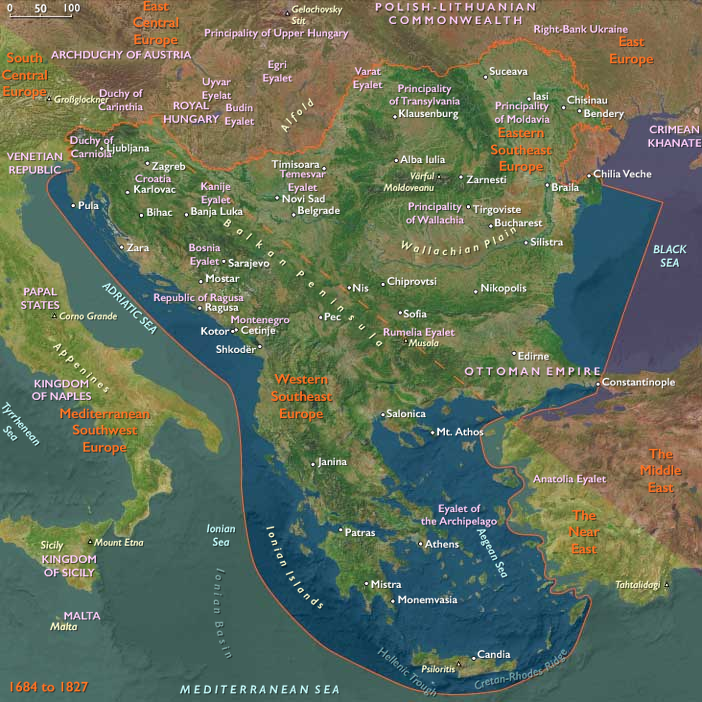
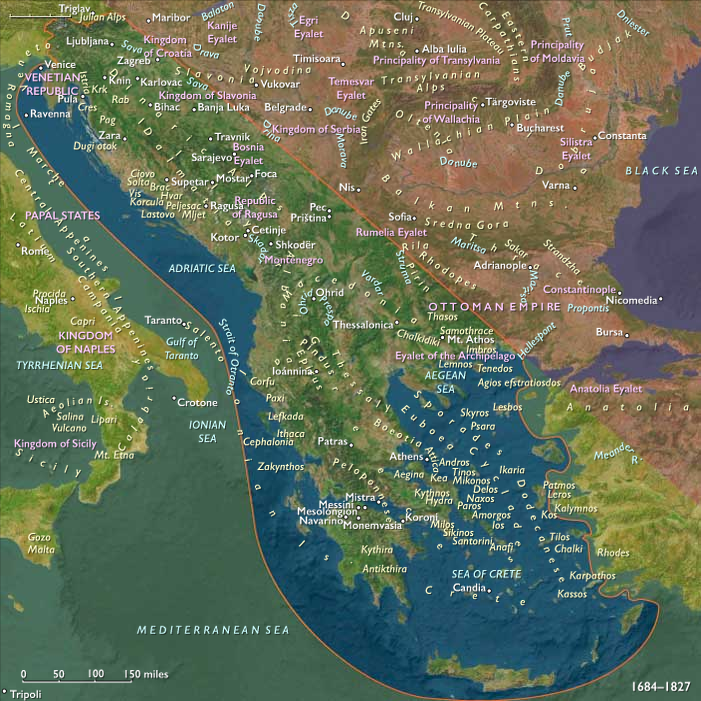
The Montenegrins constantly battle the Turks and …
Years: 1692 - 1692
The Montenegrins constantly battle the Turks and Albanians.
Cetinje is overrun by Turkish forces in 1692, on which occasion the defendants of the monastery fire the gunpowder supply, destroying the monastery, themselves, and many Turks.
Locations
Groups
Commodoties
Subjects
Regions
Subregions
Related Events
Filter results
Showing 10 events out of 29220 total
Effective control of the government passes under Sultan Ahmed III (r. 1703-30) to the military leaders.
His reign is referred to as the "tulip period" because of the popularity of tulip cultivation in Istanbul during these years.
The Korean vernacular fiction—commonly called sosol (“small talk”)—that emerges during this era consists of stories, romances, and fables.
The first work of the genre had been Hong Kiltong chon (“Tale of Hong Kiltong”), written in the early seventeenth century by the scholar Ho Kyun.
Kim Manjung, building on this style, writes two major works: Kuun mong (1687–88; “Dream of Nine Clouds”), the story of a Buddhist monk's search for Enlightenment, and Sassi namjong ki (c. 1689–92; “Story of Lady Sa's Journey to the South”), a satire against the institution of concubinage.
The most popular stories of the eighteenth century are all anonymous: Ch'unhyang chon (“Story of Spring Fragrance”), Shim Ch'ong chon (“Story of Shim Ch'ong”), Changhwa hongnyon chon (“Tale of Rose Flower and Pink Lotus”), and Hungbu chon (“Story of Hungbu”).
These stories, written in a simple and natural style, their characters being modeled on common people, are to become deeply rooted in Korean consciousness.
The Society of Jesus (Jesuits) has been successful in penetrating China and serving at the Imperial court.
They have impressed the Chinese with their knowledge of European astronomy and mechanics, and in fact run the Imperial Observatory.
Their accurate methods allow the Emperor to successfully predict eclipses, one of his ritual duties.
Other Jesuits function as court painters.
The Jesuits in turn are impressed by the Chinese Confucian elite, and adapt to that lifestyle.
The primary goal of the Jesuits is to spread Catholicism, but here they have a problem.
The Chinese elite are attached to Confucianism, while Buddhism and Taoism are mostly practiced by the common people and lower aristocracy of this period.
Despite this, all three provide the framework of both state and home life.
Part of Confucian and Taoist practices involve veneration of one's ancestors.
The Kangxi Emperor had at first been friendly to the Jesuit Missionaries working in China, as he is highly grateful for the services they have brought to him, in the areas of astronomy, diplomacy and gun manufacture.
The contribution of the Jesuits to artillery had allowed the Chinese Emperor to reconquer Taiwan.
Jesuit diplomacy, through the negotiations of Jean-François Gerbillon and Thomas Pereira, had allowed him to stop Russian expansionism in the East through the Treaty of Nerchinsk in 1689.
The Jesuits will also have made many converts by the end of the seventeenth century,.
The Kangxi Emperor on March 22 ssues the Edict of Toleration recognizing all the Roman Catholic Church, not just the Jesuits, and legalizing missions and their conversion of Chinese people.
Kosovo-Metohijais is gradually converting into a predominantly Albanian region, as Albanians begin to fill the space left by the displaced Serbs during the time of the great migration of 1691.
The Ottoman Turks in Albania had first focused their conversion campaigns on the Roman Catholics of the north, then on the Orthodox population of the south.
For example, the authorities have increased taxes, especially poll taxes, to make conversion economically attractive.
During and after the Christian counteroffensive against the Ottoman Empire from 1687 to 1690, when Albanian Catholics revolted against their Muslim overlords, the Ottoman pasha of Pec had retaliated by forcing entire Albanian villages to accept Islam.
Albanian beys now move from the northern mountains to ...
...the fertile lands of Kosovo, which had been abandoned by thousands of Orthodox Serbs fearing reprisals for their collaboration with the Christian forces.
The Venetians attack Crete in 1692.
With the imminent formation of a single Hanoverian state, and the Hanoverians’ continuing contributions to the Empire's wars, Ernest Augustus is made elector of Brunswick-Lüneburg (i.e., Hanover), in 1692 in return for lavish promises of assistance.
Indignant protests follow this proceeding.
A league is formed to prevent any addition to the electoral college; France and Sweden are called upon for assistance.
This agitation, however, soon dies away, and his son is confirmed as elector by the imperial diet.
George's prospects are now better than ever, as the sole heir to his father's Electorate—the ninth of the Holy Roman Empire—and his uncle's duchy.The Welf family has divided into several branches over the past five centuries.
Chief among these are those of Brunswick-Luneburg and Brunswick-Wolfenbuttel.
Ernest Augustus had in 1679 become reigning Duke of Lüneburg-Calenburg (which becomes known as the duchy of Brunswick-Lüneburg or, more popularly, because of its capital city, the duchy of Hanover).
His wife, Sophia of the Rhineland Palatinate, is the last surviving offspring of the marriage between Frederick V, elector Palatine, and Elizabeth (Stuart) of Bohemia, daughter of James I of England.
Two of Ernest Augustus’s three brothers had died childless and the third, George William of Celle, had married his mistress in order to legitimize his only daughter, Sophia Dorothea of Celle, but looked unlikely to have any further children.
Under Salic law, where inheritance of territory was restricted to the male line, the succession of Ernest Augustus’s sons to his father's and uncle's territories now seemed secure.
The family had agreed in 1682 to adopt the principle of primogeniture, meaning George, the eldest, would inherit all the territory, and not have to share it with his brothers.
The same year, George married his first cousin, Sophia Dorothea, thereby securing additional incomes that would have been outside Salic laws requiring male inheritance.
The marriage of state was arranged primarily as it ensured a healthy annual income, and assisted the eventual unification of Hanover and Celle.
Sophia was at first against the marriage, looking down on Sophia Dorothea's mother (who was not of royal birth) and concerned by Sophia Dorothea's legitimated status, but was eventually won over by the advantages inherent in the marriage.
George and his brother, Frederick Augustus, served in the Great Turkish War at the Battle of Vienna in 1683, and Sophia Dorothea had borne George a son, George Augustus.
Frederick Augustus had been informed the following year of the adoption of primogeniture, meaning he would no longer receive part of his father's territory as he had expected.
It led to a breach between father and son, and between the brothers, that lasted until Frederick Augustus's death in battle in 1690.
Sophia Dorothea had borne a second child, a daughter named after her, in 1687, but there have been no other pregnancies.

Merchants, bankers, and seafarers had begun assembling to transact business informally rom 1688, when Edward Lloyd kept a coffeehouse in Tower Street and, from 1692, in Lombard Street.
Lloyd's has also becomes a popular meeting place for underwriters—those who will accept insurance on ships for the payment of a premium.
Charles Montagu, a Whig elected to the House of Commons in 1689, had argued in favor of a law to grant the assistance of counsel in trials for high treason.
He became flustered in the middle of his speech, and upon recovering himself, observed "how reasonable it was to allow counsel to men called as criminals before a court of justice, when it appeared how much the presence of that assembly could disconcert one of their own body."
He has risen quickly, becoming one of the Commissioners of the Treasury and a member of the Privy Council.
England has incurred great expense in the War of the Grand Alliance.
Montagu finances British participation in the war by devising a system of guaranteed government loans and initiating the national debt.
A piece of 1692 legislation pledges the receipts from beer and liquor taxes as security for a loan of one million pounds.
Sir Edward North's Discourses, though brief and aphoristic, are probably the most thoroughgoing statement of free-trade theory made in the seventeenth century.
Although the older mercantilist view was that trade was the exchange of goods not needed by the producing country, the Discourses insist “that the whole world as to trade, is but as one nation or people, and therein nations are as persons.”
North, an early advocate of what would later come to be called laissez-faire, denounces sumptuary laws and legal restrictions on interest rates as harmful and ineffective.
Subsequent monetary doctrines are anticipated in the insistence that the supply of money can be left to free market forces “without any aid of politicians.”
The fame of North, an English merchant and confirmed Tory who had retired from public affairs shortly after the Glorious Revolution, rests on the contribution to political economy made in his Discourses Upon Trade: Principally Directed to the Case of the Interest, Coynage, Clipping, Increase of Money, published anonymously in 1691 or possibly 1692.