
The monk Dionysius Exiguus, a member of …
Years: 525 - 525
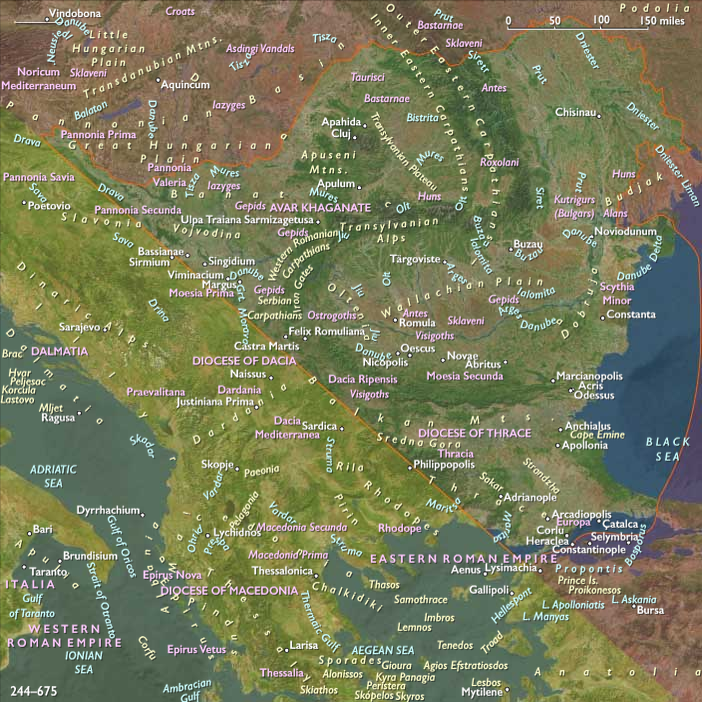
The monk Dionysius Exiguus, a member of the the Scythian monks community concentrated in Tomis, the major city of Scythia Minor, had collected thirty-eight papal decretals that, along with his Latin translation of canons, become widely circulated in western Europe.
A quarter-century later, he suggests that years be counted from the birth of Christ, which he designates AD (anno Domini, "the year of the Lord") 1.
He used it to identify the several Easters in his Easter table, but did not use it to date any historical event.
When he devised his table, Julian calendar years were identified by naming the consuls who held office that year — he himself stated that the "present year" was "the consulship of Probus Junior", which he also stated was five hundred and twenty-five years "since the incarnation of our Lord Jesus Christ".
How he arrived at that number is unknown but there is evidence of the system he applied.
He invented a new system of numbering years to replace the Diocletian years that had been used in an old Easter table because he did not wish to continue the memory of a tyrant who persecuted Christians.
The Anno Domini era will become dominant in Western Europe only after it is used by the Venerable Bede to date the events in his Ecclesiastical History of the English People, completed in 731.
Locations
People
Groups
- Scythia Minor (Roman province)
- Thrace, Diocese of
- East, or Oriens, Praetorian prefecture of
- Christianity, Chalcedonian
- Roman Empire, Eastern: Justinian dynasty
Topics
Subjects
Regions
Subregions
Related Events
Filter results
Showing 10 events out of 31 total
...Yathrib, inhabited by three Jewish clans as well as several pagan Arab tribes.
The Jews had settled among the original Arabs, developed agriculture there, and control the best lands.
Later Arab immigrants belonging to the tribes of al-Aws and al-Khazraj are, however, in a stronger position.
The effective units among the Arabs are eight or more clans, but nearly all of these had become involved in serious feuds.
Much blood had been shed in the Battle of Bu'ath, fought in 617 between Banu Aus and Banu Khazraj, the Arab tribes of Yathrib in the south-eastern quarter of the oasis, belonging to the Jewish tribe of Banu Qurayza.
The Aws are supported by the Jewish tribes of Banu Nadir and Banu Qurayza, and by the Arab Bedouins of the Muzayna tribe; the leader of the alliance was Hudayr ibn Simak.
The opposing force, led by Amr ibn al-Numan, consisted of the majority of the Khazraj tribe and the Bedouin tribes of Juhayna and Ashja.
The Awsite clan of Haritha and the Khazrajite chief Abdullah ibn Ubayy remained neutral.
In the course of the battle, the Aws and their allies initially had to retreat, but then they counterattacked and defeated the Khazraj; both leaders of the opposing forces were killed.
Despite the victory of the Aws, the outcome of the battle was an uneasy truce rather than a definite settlement.
Ttwelve men of Yathrib, visiting Mecca in the summer of 621 for the annual pilgrimage to the Ka'bah (at this time a pagan shrine), secretly declare themselves Muslims to Muhammad, the founder of the religion of Islam and of the Muslim community, and return to make propaganda for him at home.
In inviting Muhammad to Yathrib, many of the Arabs there probably hope that he will act as an arbiter among the opposing parties.
Possibly, their contact with the Jews has prepared them for a messianic religious leader, who will deliver them from oppression and erect a just kingdom.
Muhammad and his followers, in what will come to be called the hegira, or hijra (an Arabic word meaning “breaking off relations”, “abandoning one's tribe”, or “migrating”), accept an invitation to move north to the oasis in 622 to settle the disputes that have paralyzed civil life there.
He renames this year "Year One" of the Anno Hegirae (AH).
He continues to preach and recite the words which Allah reveals to him.
It is these passages, together with the earlier revelations at Mecca, which will eventually be written down in the Arabic script by his followers and collected to become the Qur'an—the word (often transliterated as Koran).
Muhammad takes as his third wife Aisha, an adolescent daughter of Abdullah ibn Abi Quhafa, an early convert and loyal follower who becomes known as Abu Bakr (Father of the Virgin).
Muhammad soon becomes a religious, political and even military leader.
From 622, Muhammad's followers, probably influenced by Jewish tradition, had apparently faced toward Jerusalem five times each day when performing the salat (daily ritual prayer), but relations between Jews and Muslims no longer seem promising.
He had at first treated the Jews with indulgence, but during the early phase of the coming war with Mecca, he and his followers clash with the Jewish clans.
At this time, instead of making concessions to the Jews in the hope of gaining recognition of his prophethood, Muhammad asserts the specifically Arabian character of the Islamic religion.
A revelation to Muhammad in 623 causes him to change the qibla, the sacred direction, to that of the shrine of the Ka'aba in Mecca.
The Ka'aba, according to the Koran, had been built by Abraham and his son Ishmael and has therefore to be reintegrated in Muslim society.
Muhammad also abandons Saturday as the Sabbath.
Perhaps garnering additional support from among the Medinans because of this change in policy, Muhammad is now able to enlist a much larger force.
The Meccans fear the growing influence of the Muslims, due to the hospitality Muhammad has received in Medina, and thus contrive to safeguard their trade routes by eliminating the religion of Islam.
The Muslims of Medina are aware of such activities and begin to make preparations for self-defense.
In 624, Abu Sufyan is the appointed leader of a large merchant caravan carrying a fortune of the Quraysh's goods to Syria for trade.
The caravan is escorted by a force of around forty or fifty soldiers.
Muhammad, having learned that the caravan will pass close to Medina en route to Syria, organizes a Muslim force of three hundred men to intercept it and repossess the goods that the Quraysh had stolen from the Muslims due to their absence in Mecca.
Muhammad fills the wells along its route with sand in order to lure Abu Sufyan into battle.
Around this time, it is related that God revealed to Muhammad that his people were now given permission to go after those who had oppressed them, driven them from their homes (in Mecca) and confiscated their property (some of which the Quraysh put on this same caravan).
However, the Muslim contingent Muhammad had assembled fails to intercept the caravan.
They arrive after the caravan has already passed by Medina.
Abu Sufyan had learned of the Muslims plan from scouts he had deployed, and in response, had sent a crier to Mecca to rally the Quraysh to arms against the Muslims.
Some persons in Yathrib, who had satirized Muhammad in verse, speaking of his cruelties, are assassinated, possibly with his connivance, following the Muslim victory over the Meccans at Badr.
Asma Bint Merwan, a married woman with five children, and reputedly Median's most popular poetess, is stabbed to death by a group of Muslims who break into her house at night as she lies in her bedroom breast-feeding her newborn child, who is then hacked to pieces.
Soon afterward, Abu Afek, an elderly poet respected for his sense of fairness, meets a similar fate.
Another, a renowned Arab poet named Kaab Ibn Ashraf of the Tribe of Tai, who resides with the Jewish clan Banu Nadir, had composed a lament for the Quraysh leaders of who had been massacred in the battle of Badr.
Four Muslims drag ibn Ashraf from his bed and stab him to death in full view of his family.
Muhammad also uses a minor disturbance as a pretext for expelling the Jewish clan that operates the market.
This weakens his most serious opponent there, the “hypocrite” (munafiq), or nominal Muslim, 'Abd Allah ibn Ubayy, who is allied with the local Jews.
As the remaining fence sitters among the Arabs of Yathrib probably become Muslims about this time, the victory of Badr greatly strengthens Muhammad.
Concurrently, he employs marriage relationships to bring greater cohesion to the emigrants.
His daughter Fatimah is married to Abu Talib's son Ali (later fourth caliph), and Umm Kulthum to Uthman (third caliph).
Muhammad himself marries the newly widowed Hafsah, daughter of 'Umar (later second caliph), whose previous husband was one of the Muslims killed at Badr.
He continues, with some success, to lead larger Muslim forces on razzias against hostile nomadic tribes.
Abu Sufyan, meanwhile, has energetically mobilized vengeful Meccan forces, who declare their intention to make the Muslims pay several times over for Badr.
On March 11, 625, with Abu Sufyan at the helm, the Meccans—anxious to avenge their defeat at Badr—raise another force numbering three thousand and set out for the Muslim base in Medina.
Rather than attacking Medina itself, which is populated by numerous strongholds that would require long sieges to overcome, they camp on the pastures north of the city, hoping that the Muslims will come out to meet them.
According to the early Muslim historian Ibn Ishaq, a number of Meccan women are said to have accompanied Abu Sufyan's army to provide vocal support, including Hind bint Utbah, his wife.
A scout alerts Muhammad of the Meccan army's presence and numbers late on Thursday March 21.
The next morning, a Muslim conference of war convenes, and there is dispute over how best to repel the Meccans.
Muhammad and many of the senior figures suggest that it would be safer to fight within Medina and take advantage of its heavily fortified strongholds.
Younger Muslims argue that the Meccans are destroying their crops, and that huddling in the strongholds will destroy Muslim prestige.
Muhammad eventually concedes to the wishes of the latter, and readies the Muslim force for battle.
Muhammad leads or sanctions razzias that are apparently aimed at extending his own alliances and at preventing others from joining the Meccans.
The success of the Meccans' rousing of tribes against Muhammad reaps disastrous consequences for him and the Muslims with two main losses: one was when a Muslim party had been invited by a chieftain of the Ma'unah tribe, who were then killed as they approached by the tribe of Sulaym; while the other was when the Muslims had sent out instructors to a tribe which stated it wanted to convert to Islam—the instructors had been led into an ambush by the guides of the would-be Muslim tribe, and were subsequently killed.
Soon thereafter, Muhammad becomes convinced that the Jewish tribe Banu Nadir harbors enmity towards him and are plotting to kill him.
Opposition to Muhammad in Yathrib comes chiefly from 'Abd Allah ibn Ubayy and other so-called hypocrites (munafiquin) who had abandoned Muhammad at Uhud and who together have fostered disaffection.
Muhammad confronts 'Abd Allah ibn Ubayy, who had joined in spreading slanders about Muhammad's wife Aishah, in spring 627.
'Abd Allah, it turns out, has little support in Yathrib, so becomes reconciled to Muhammad.
The expected confrontation with the Meccans occurs in April 627 when Abu Sufyan leads a great confederacy of ten thousand men against Yathrib's three thousand defenders.
On Muhammad's orders, the crops have already been harvested and a trench dug to defend the main part of the oasis from the Meccan cavalry.
The confederates besiege the Muslims for two weeks but fail in their attempts to cross the trench and run low on fodder for the horses.
Meanwhile, Muhammad's agents among the attackers foment potential dissensions.
After a night of wind and rain, the Meccans, recognizing their inability to dislodge Muhammad, abandon the siege and return to Mecca.
After the siege of Yathrib, one of the city's remaining Jewish clans, the Banu Qurayzah, is accused of plotting against Muhammad; when they surrender, his followers did a trench around the market, round up the clan's six-hundred-plus men and tie their hands behind them.
After spending the night in prayer, the Jews are led to the trench one by one and forced to kneel, then offered the opportunity to convert to Islam.
Upon their refusal, they are beheaded, their bodies piled in the trench.
Reportedly, only three or four agree to conversion.
The Muslims then sell into slavery all of the clan's women and children, except Rayhana bint Amr.
According to Ibn Ishaq, Muhammad took Rayhana as a maiden slave and offered her the status of becoming his wife if she accepted Islam, but she refused.
According to his account, even though Rayhana is said to have later converted to Islam, she died as a slave.
Ibn Sa'd writes and quotes Waqidi that she was manumitted but later married by Muhammad.
According to Al-Halabi, Muhammad married and appointed a dowry for her.
It is further narrated that, upon marriage, she refused to wear the hijab, causing a rift between her and Muhammad.
The couple later reconciled.
She died young, shortly after Muhammad's hajj and was buried in Jannat al-Baqi cemetery.
Ibn Hajar quotes a description of the house that Muhammad gave to Rayhana after their marriage from Muhammad Ibn al-Hassam's History of Medina.
In another version, Hafiz Ibn Minda writes that Muhammad set Rayhana free, and she went back to live with her own people.
This version is also supported as the most likely by nineteenth-century Muslim scholar, Shibli Nomani.
Not much is known about Rayhana; she will die a year before Muhammad.
Safiyya bint Huyayy was born in Medina to Huyayy ibn Akhtab, the chief of the Jewish tribe Banu Nadir.
Her mother, Barra bint Samawal, was from the Banu Qurayza tribe.
According to a source, she was married off to Sallam ibn Mishkam, who later divorced her.
When the Banu Nadir were expelled from Medina in 625, her family had settled in Khaybar, an oasis near Medina.
Her father and brother had gone from Khaybar to join the Meccan and Bedouin forces besieging Muhammad in Medina during the Battle of the Trench.
When the Meccans withdrew, Muhammad had successfully besieged the Banu Qurayza.
Safiyya had married Kenana ibn al-Rabi, treasurer of the Banu Nadir; in 627 or early in 628; she was about seventeen years old at that time.
Safiyya is said to have informed Kenana of a dream she had in which the moon had fallen from the heavens into her lap.
Kenana interpreted it as a desire to marry Muhammad and struck her in the face, leaving a mark which was still visible when she first had contact with Muhammad.
After the Muslims defeat several Jewish tribes (including the Banu Nadir) at the Battle of Khayba, the Jews had surrendered, and were allowed to remain in Khaybar on the provision that they give half of their annual produce to the Muslims.
The land itself becomes the property of the Muslim state.
This agreement, Stillman says, did not extend to the Banu Nadir tribe, who were given no quarter.
In the aftermath of the battle of Khaybar, the female captives had been divided among Muhammad and his followers.
Safiyya bint Huyyayy, reportedly a woman of intense beauty, who had seen her husband, father and brother slain in the siege, had been assigned to Dihya ibn Khalifa, but Muhammad had selected her while compensating Dihya with two of her cousins, or, according to other sources, seven head of cattle, and according to a differing source, seven female slaves.
She then converted to Islam, thereby becoming Muhammad's wife; her dowry being her emancipation.
On the way back from Khaybar, the Muslims camp at a place called Sadd al-Rauha.
Safiyya is by now clean from her menstrual period, and the marriage is thus consummated.
Thereafter, Muhammad holds a banquet of dates and butter in celebration of the marriage, then returns to Medina.
The concentrations of rebels nearest Medina are located in two areas: Abraq, seventy-two miles northeast of Medina, and Dhu Qissa, twenty-four miles east of Medina.
These concentrations consist of the tribes of Banu Ghatafan, the Hawazin, and the Tayy.
Abu Bakr sends envoys to all the enemy tribes, calling upon them to remain loyal to Islam and continue to pay their Zakat.
A week or two after the departure of the Islamic army under Usama, the rebel tribes had surrounded Medina, knowing that there are few fighting forces in city.
Meanwhile, Tulayha, a self-proclaimed prophet, reinforces the rebels at Dhu Qissa.
In the third week of July 632, the apostate army moves from Dhu Qissa to Dhu Hussa, from where they prepare to launch an attack on Medina.
Abu Bakr receives intelligence of this move of rebels, and immediately prepares for the defense of Medina.
As the main army is out of Medina under Usama, Abu Bakr scrapes together a fighting force mainly from the clan of Mohammad, the Banu Hashim.
The army has stalwarts like Ali ibn Abi Talib, Talha ibn Ubaidullah and Zubair ibn al-Awam, who will later (in the 640s) conquer Egypt.
Each of them is appointed as commander of one-third of the newly organized force.
Before the apostates can do anything, Abu Bakr launches his army against their outposts and drives them back to Dhu Hussa.
The following day, Abu Bakr marches from Medina with the main army and moves towards Dhu Hussa.
As the riding camels are all gone with Usama's army, he can only muster inferior pack camels, and the army mounts these camels.
These, being untrained for battle, bolt when Hibal, the apostate commander at Zhu Hussa, makes a surprise attack from the hills on the Muslims; and the Muslims retreat to Medina.
The apostates recapture the outposts that they had lost a few days earlier.
At Medina Abu Bakr reorganizes the army for the battle and attacks the apostates during the night, taking them by surprise.
The apostates retreat from Dhu Hussa to Dhu Qissa.
In the morning, Abu Bakr leads his forces to Dhu Qissa and defeats the rebel tribes, capturing Dhu Qissa on August 1, 632.
The defeated apostate tribes retreat to Abraq, where more clansmen of the Ghatfan, the Hawazin, and the Tayy are gathered.
Abu Bakr leaves a residual force of soldiers under the command of An-Numan ibn Muqarrin at Dhu Qissa and returns with his main army to Medina.
Usama had meanwhile marched to Mu'tah and attacked the Christian Arabs of the tribes of Banu Kalb and Ghassanids in a small battle.
He returns to Medina on August 4, bringing with him a large number of captives and a considerable amount of wealth, part of which comprises the spoils of war and part taxation of the re-conquered tribes.
The Islamic army had remained out of Medina for forty days.
Abu Bakr orders Usama to rest his men in Medina and re-equip them to fight against the rebels.
Meanwhile in the second week of August 632, Abu Bakr with his army moves to Zhu Qissa.
Taking the remaining forces from Numan ibn Muqarrin under his command, he moves to Abraq, where the retreated rebels have gathered, and defeats them.
The remaining rebels retreat to Buzakha, where Tulayha has moved with his army from Samira.
Abu Bakr moves in the fourth week of August 632 to Zhu Qissa with all available fighting forces.
Here he plans the strategy of the Campaign of the Apostasy to deal with the various enemies who occupy the entire land of Arabia except for the small area in the possession of the Muslims.
The battles which he had fought recently against the apostate concentrations at Zhu Qissa and Abraq had been in the nature of immediate preventive action to protect Medina and discourage further offensives by the enemy.
These actions have enabled Abu Bakr to secure a base from which he can fight the major campaign that lies ahead, thus gaining time for the preparation and launching of his main forces.
Abu Bakr has to fight not one but several enemies: Tulayha at Buzakha, Malik bin Nuwaira at Butah, Musaylima at Yamamah.
He has to deal with widespread apostasy on the eastern and southern coasts of Arabia: in Bahrain, in Oman, in Mahra, in Hadhramaut and in Yemen.
There is apostasy in the region south and east of Mecca and by the Khuza’ah in northern Arabia.
Abu Bakr forms the army into several corps.
The strongest corps, the main striking arm of the Muslims, is that of Khalid ibn Walid, used to fight the most powerful of the rebel forces.
Other corps are given areas of secondary importance in which to subdue the less dangerous apostate tribes.
The first corps to go into action is that of Khalid.
The timing of the dispatch of other corps hinges on the operations of Khalid, who is tasked with fighting the strongest enemy forces one after the other.
As soon as the organization of the corps is complete, Khalid marches off, to be followed a little later by Ikrimah and 'Amr ibn al-'As.
The other corps are held back by the caliph to be dispatched weeks and even months later.
Before the various corps leave Zhu Qissa, however, envoys will be sent by Abu Bakr to all apostate tribes in a final attempt to induce them to submit.
Apart from their specific objectives, the corps commanders are given the following instructions: Seek the tribes that are your objectives Call the Azaan.
If the tribe answers with the Azaan, do not attack.
After the Azaan, ask the tribe to confirm its submission, including the payment of zakat.
If confirmed, do not attack.
Those who submit will not be attacked.
Those who do not answer with the Azaan, or after the Azaan do not confirm full submission, will be dealt with by the sword.
All apostates who have killed Muslims will be killed.
With these instructions, Abu Bakr launches the forces of Islam against the apostates.
His plan is first to clear the area of west central Arabia (the area nearest to Medina), then tackle Malik bin Nuwaira, and finally concentrate against the most dangerous and powerful enemy: the self-proclaimed prophet Musaylima, who is mainly supported by the powerful tribe of Banu Hanifa, in the fertile region of Yamamah.
Years: 525 - 525
Locations
People
Groups
- Scythia Minor (Roman province)
- Thrace, Diocese of
- East, or Oriens, Praetorian prefecture of
- Christianity, Chalcedonian
- Roman Empire, Eastern: Justinian dynasty
