
The Mongol rulers have established peace in …
Years: 1302 - 1302
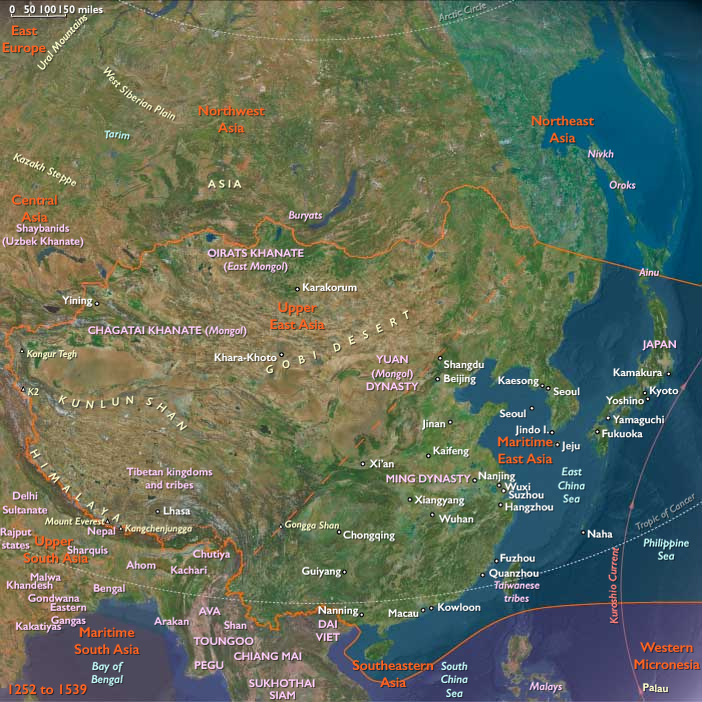
The Mongol rulers have established peace in Asia by the early 1300s Access to China becomes relatively easy, and China enters another age of cosmopolitanism and broad foreign contact, particularly with the West.
The Mongol Yuan dynasty supports foreign mercantile ventures in China, welcome foreign faiths like Nestorian Christianity and Islam, and patronize Tibetan Buddhism, or Tantrism.
The Mongol rulers also employ numerous foreigners in the state bureaucracy, but systematically discriminate against the native Chinese for government service, saddling them with numerous legal disabilities.
Despite the oppressive nature of Yuan rule, China experiences a flowering of native arts, especially calligraphy and painting produced by the scholar-gentry class, and two literary forms—drama and the novel.
A census in Imperial China finds that it has roughly sixty million inhabitants (having lost twenty million after nearly a century of Mongolian conquests).
The Temple of Confucius at Beijing, the second largest Confucian Temple in China after the one in Confucius' hometown of Qufu, is built in 1302, and imperial officials will use it to pay their respects to Confucius until 1911.
Locations
Groups
- Confucianists
- Buddhism, Tibetan
- Chinese (Han) people
- Christians, Eastern (Diophysite, or “Nestorian”) (Church of the East)
- Islam
- Mongols
- Mongol Empire
- Chinese Empire, Yüan, or Mongol, Dynasty
Subjects
Regions
Subregions

Years: 1302 - 1302
Locations
Groups
- Confucianists
- Buddhism, Tibetan
- Chinese (Han) people
- Christians, Eastern (Diophysite, or “Nestorian”) (Church of the East)
- Islam
- Mongols
- Mongol Empire
- Chinese Empire, Yüan, or Mongol, Dynasty
Subjects
Regions
Subregions