
The monastery of Monte Cassino had been …
Years: 584 - 584
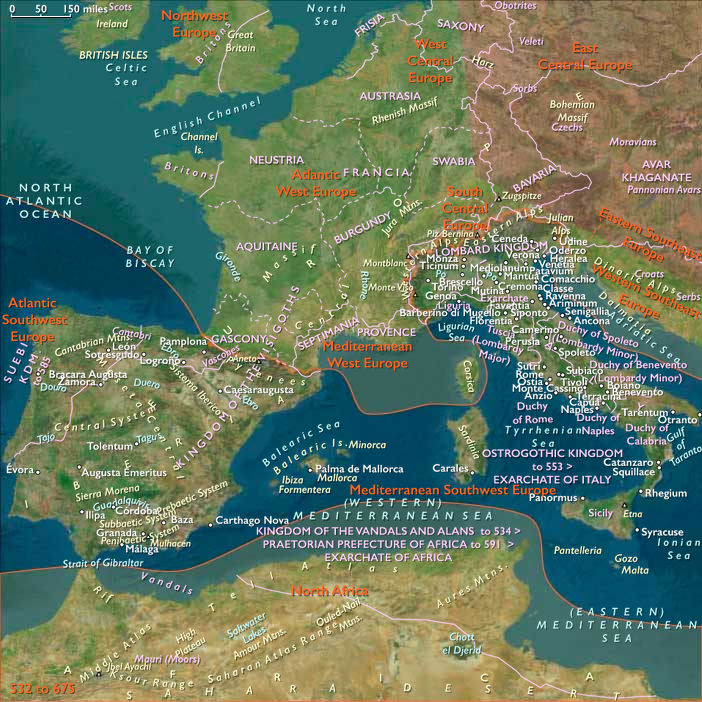
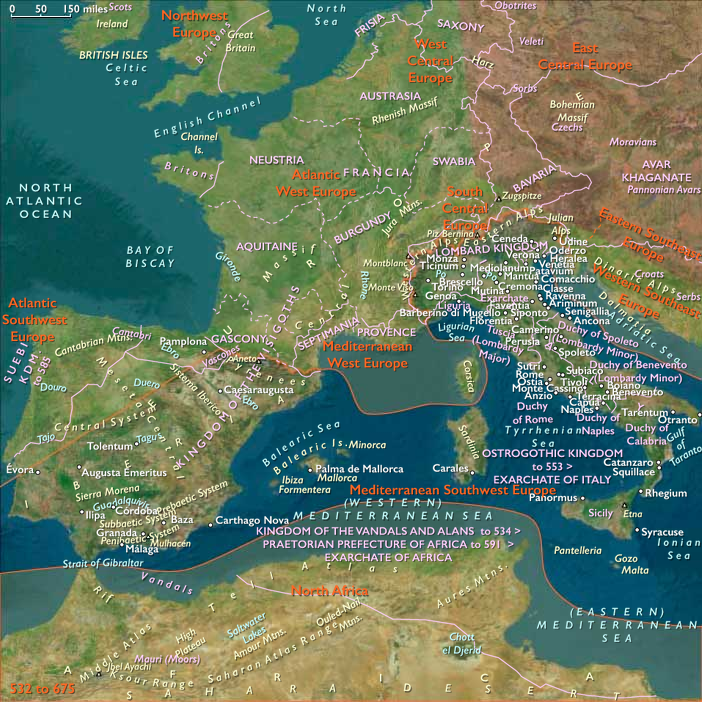
The monastery of Monte Cassino had been constructed on an older pagan site, a temple of Apollo that crowned the hill, according to Gregory the Great's biography of Benedict, Life of Saint Benedict of Nursia.
The biography records that the area was still largely pagan at the time and Benedict's first act was to smash the sculpture of Apollo and destroy the altar.
He then reused the temple, dedicating it to Saint Martin, and built another chapel on the site of the altar dedicated to Saint John the Baptist.
Once established at Monte Cassino, Benedict never left.
Here he wrote the Benedictine Rule that had become the founding principle for western monasticism, here he had received a visit from Totila, king of the Ostrogoths, perhaps in 543 (the only remotely secure historical date for Benedict), and here he died.
Monte Cassino had become a model for future developments.
Unfortunately its prominent site has always made it an object of strategic importance, and it will be sacked or destroyed a number of times.
The Lombards sack the abbey in 584, during the abbacy of Bonitus, and the surviving monks flee to Rome, where they will remain or more than a century.
During this time the body of St. Benedict is transferred to Fleury, the modern Saint-Benoit-sur-Loire near Orleans, France.
Locations
People
Groups
- Lombards (West Germanic tribe)
- East, or Oriens, Praetorian prefecture of
- Christianity, Chalcedonian
- Paris, Frankish Kingdom of
- Orléans (eventually Burgundy), Frankish Kingdom of
- Soissons (eventually Neustria), Frankish Kingdom of
- Roman Empire, Eastern: Justinian dynasty
- Benedictines, or Order of St. Benedict
- Reims and Metz (eventually Austrasia), Frankish Kingdom of
- Ravenna, Exarchate of
Topics
Subjects
Regions
Subregions
Years: 584 - 584
Locations
People
Groups
- Lombards (West Germanic tribe)
- East, or Oriens, Praetorian prefecture of
- Christianity, Chalcedonian
- Paris, Frankish Kingdom of
- Orléans (eventually Burgundy), Frankish Kingdom of
- Soissons (eventually Neustria), Frankish Kingdom of
- Roman Empire, Eastern: Justinian dynasty
- Benedictines, or Order of St. Benedict
- Reims and Metz (eventually Austrasia), Frankish Kingdom of
- Ravenna, Exarchate of
Topics
Subjects
Regions
Subregions