The monarch of Ayutthaya, King Borommarachathirat, constructs …
Years: 1369 - 1369
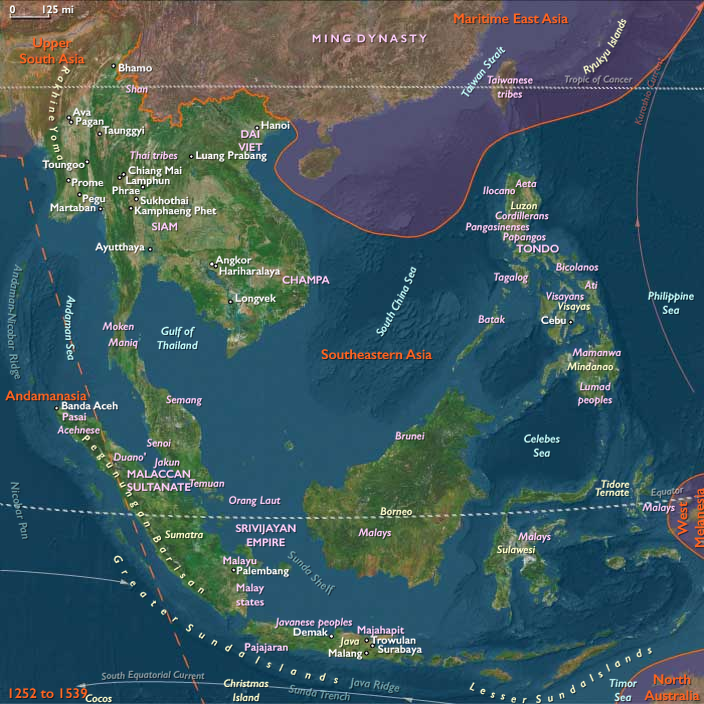
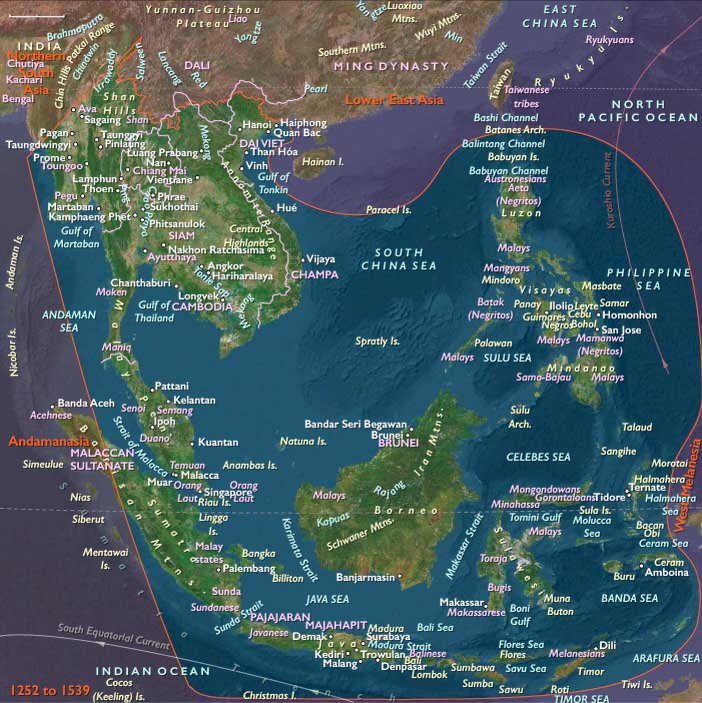
The monarch of Ayutthaya, King Borommarachathirat, constructs a major Buddhist temple, the Wat Phra Ram, in 1369.
Locations
People
Groups
Subjects
Regions
Subregions
Related Events
Filter results
Showing 10 events out of 43887 total
The town of Pegu, which had declined when the Burmese conquered the area in the eleventh century, becomes the capital of the revived Mon kingdom in 1369.
Ayutthayan invaders occupy the Khmer capital of Angkor Wat in 1369.
The Mongols, vainly holding themselves to be the legitimate rulers of a China now utterly lost to them after the collapse of the Yüan dynasty and the attendant Mongol withdrawal from China, continue to control portions of Tibet and the area northward along the borders of Turkistan.
Peter returns to Cyprus, but is rapidly plunged into domestic troubles.
Queen Eleanor had been unfaithful during his long absences in Europe, and he retaliates by tyrannizing her favorite nobles, alienating even his brothers.
Three of his own knights assassinate him on January 17, 1369, in his own bed at the Palace of La Cava, Nicosia.
His son succeeds him as king, and a treaty of peace is signed with Egypt.
Amadeus has persuaded his cousin the Emperor to go to Rome and make his personal submission to the Holy See, where in October 1369, John confesses the Roman faith and offers to submit the Greek Church to Roman supremacy.
Wars with the Serbs and Turks have drained Constantinople's treasury, and the impoverished Emperor is arrested as an insolvent debtor when he visits Venice in late 1369.
The Republic of Lucca, which had been occupied by the troops of Louis of Bavaria, had been sold to a rich Genoese, Gherardino Spinola, then seized by John, King of Bohemia, then pawned to the Rossi of Parma, by whom it had been ceded to Martino della Scala of Verona.
It was eventually sold to the Florentines, then surrendered to the Pisans (1342–1368), and in 1369 is nominally liberated by the emperor Charles IV (son of John, King of Bohemia) and governed by his vicar.
Henry de Trastámara, with the Black Prince gone from Castile, leads a second invasion with French help.
Bertrand du Guesclin had won renown in May, 1364, for winning the battle of Cocherel in Normandy against the opponents of Charles V. Except for this victory, he is unsuccessful in pitched battles, having lost at Auray in 1364 and Nájera in 1367; although eventually celebrated as a symbol of chivalry, he is most successful at such unchivalrous pursuits as brigandage and guerrilla warfare Respected by—and thus able to control—the fierce warriors who are the scourge of the countryside when undisciplined, du Guesclin leads such troops in successfully installing the pro-French Trastamara on the throne of Castile (and León) as Henry II after he defeats his half-brother Peter of Castile and León at Montiel, and murders him on March 23, 1369.
The new Castilian regime will provide naval support to French campaigns against Aquitaine and England.

The Fernandine Wars: Ferdinand I’s Failed Castilian Ambitions (1369–1371)
Upon ascending the Portuguese throne in 1367, Ferdinand I of Portugal sought to expand his influence in Castile, taking advantage of the ongoing civil war between Henry II of Trastámara and the murdered Peter I of Castile.
Ferdinand’s Claim to the Castilian Throne (1369)
- In 1369, Peter I of Castile was assassinated by his half-brother, Henry of Trastámara, after a long civil war.
- As Peter’s closest legitimate male relative, Ferdinand claimed the Castilian throne, receiving support from several Castilian towns that remained loyal to Peter’s lineage.
- Henry II, now King of Castile, viewed Ferdinand’s claim as a direct threat and invaded Portugal in late 1369.
The First Fernandine War (1369–1371): A Humiliating Defeat
- The war quickly turned against Ferdinand, as Henry II’s forces—bolstered by French support—proved superior in strategy and manpower.
- Ferdinand failed to rally enough Castilian nobles to his cause and suffered several military defeats.
- The war ended in 1371 with the Treaty of Alcoutim, in which:
- Ferdinand abandoned his claim to the Castilian throne.
- Portugal was forced to pay Castile reparations.
- Ferdinand agreed to marry Henry’s daughter, Leonor of Castile, to cement peace.
Political Fallout
- The treaty infuriated the Portuguese nobility, particularly when Ferdinand reneged on the arranged marriage and instead married Leonor Teles, a controversial and ambitious noblewoman.
- The failure of the war weakened Ferdinand’s credibility, yet he would continue to pursue Castilian ambitions, leading to two more Fernandine Wars (1372–1373, 1381–1382), further destabilizing Portugal.
This first disastrous war exposed Ferdinand’s military shortcomings and set Portugal on a path of continuous conflict with Castile, weakening the kingdom’s stability and paving the way for the crisis of 1383–1385, which would ultimately determine Portugal’s independence.
Amsterdam’s Growth and Entry into the Hanseatic League (1369)
Amsterdam, situated where the IJ River flows into the Zuiderzee (now the IJsselmeer), derives its name from a dam built on the Amstel River, which flows into the IJ at this point. By the 14th century, the city had expanded significantly under the Counts of Holland, transforming into an important regional trade hub.
Expansion Under the Counts of Holland
- During the 14th century, Amsterdam grew rapidly, benefiting from its strategic location at the intersection of river and sea trade routes.
- The Counts of Holland encouraged its development, investing in infrastructure and trade connections to strengthen their influence in the region.
Amsterdam Joins the Hanseatic League (1369)
- In 1369, Amsterdam formally joined the Hanseatic League, an influential commercial alliance of northern European cities.
- As a result, Amsterdam’s merchants gained access to the lucrative Baltic trade, dealing in:
- Grain from Poland and Prussia
- Timber and tar from Scandinavia
- Salted fish from the North Sea
- Furs and textiles from northern Germany
- The city’s Hanseatic membership increased its wealth and economic connections, setting the stage for its future dominance as a commercial power.
Impact and Legacy
- Amsterdam’s entry into the Hanseatic League marked a turning point, integrating the city into the major trade networks of medieval Europe.
- This boosted its economy, accelerating its rise as a key port city in the Low Countries.
- The city’s foundation as a trading hub in the 14th century laid the groundwork for its golden age in the 17th century, when it became the center of global commerce.
By 1369, Amsterdam had firmly established itself as a major trading city, benefiting from Hanseatic connections that would drive its future growth and economic dominance in the centuries to come.