
The Monacan towns of Mowhemencho and Mahock …
Years: 1671 - 1671
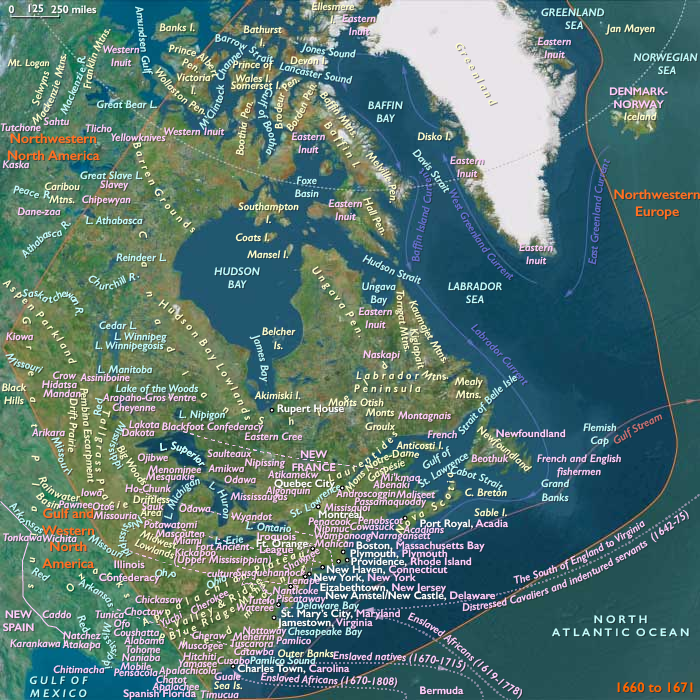
The Monacan towns of Mowhemencho and Mahock were still in the area in 1670, when they were visited by John Lederer and Major Harris, who found that the men possessed muskets.
Lederer recorded their tradition that they had settled in the area on account of an oracle four hundred years earlier, having been driven from the northwest by an enemy nation.
They told him they had found it occupied by the Doegs, whom they eventually displaced, in the meantime teaching them the art of growing corn.
Another Monacan tradition he records as follows: "From four women, viz. Pash, Sepoy, Askarin, and Maraskarin, they derive the race of mankinde; which they therefore divide into four tribes, distinguished under those several names."
At the time of Lederer's visit, the tribe had about thirty bowmen, out of a total population of perhaps one hundred.
Lederer also noted the towns of Sapon and Pintahae on the Staunton River; Swanton considers this last to be a Nahyssan village, which Batts and Fallam record as Hanahaskie in 1671.
Locations
Groups
- Iroquois (Haudenosaunee, also known as the League of Peace and Power, Five Nations, or Six Nations)
- Susquehannock (Amerind tribe)
- Lenape or Lenni-Lenape (later named Delaware Indians by Europeans)
- New France (French Colony)
- Netherlands, United Provinces of the (Dutch Republic)
- France, (Bourbon) Kingdom of
- England, (Stewart, Restored) Kingdom of
- Maryland, Province of (English Colony)
Topics
- Colonization of the Americas, French
- Colonization of the Americas, English
- Beaver Wars, or French and Iroquois Wars
- Colonization of the Americas, Dutch
- Dutch-Indian Wars of 1655-64 (Esopus War)
Commodoties
Subjects
Regions
Subregions
Years: 1671 - 1671
Locations
Groups
- Iroquois (Haudenosaunee, also known as the League of Peace and Power, Five Nations, or Six Nations)
- Susquehannock (Amerind tribe)
- Lenape or Lenni-Lenape (later named Delaware Indians by Europeans)
- New France (French Colony)
- Netherlands, United Provinces of the (Dutch Republic)
- France, (Bourbon) Kingdom of
- England, (Stewart, Restored) Kingdom of
- Maryland, Province of (English Colony)
Topics
- Colonization of the Americas, French
- Colonization of the Americas, English
- Beaver Wars, or French and Iroquois Wars
- Colonization of the Americas, Dutch
- Dutch-Indian Wars of 1655-64 (Esopus War)
Commodoties
Subjects
Regions
Subregions