Long wars with the Mongols, incursions by …
Years: 1636 - 1647
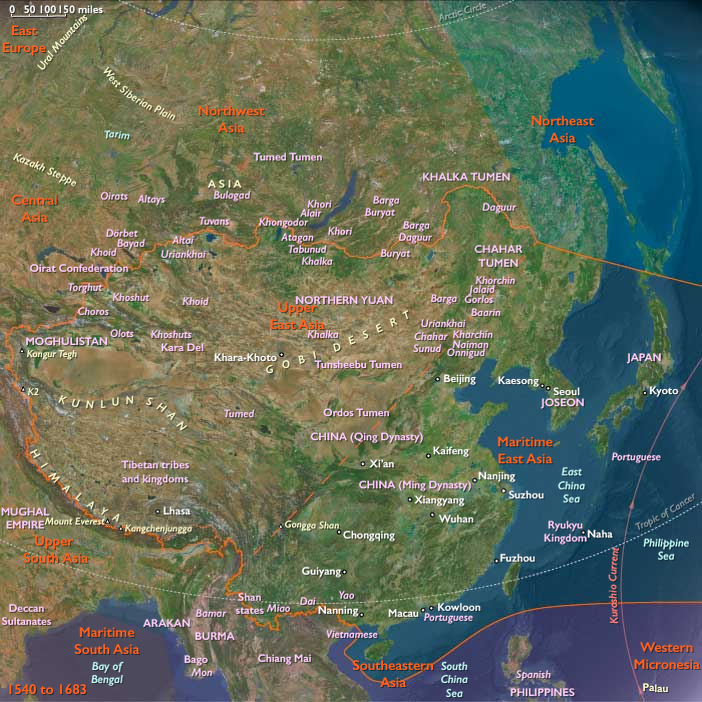
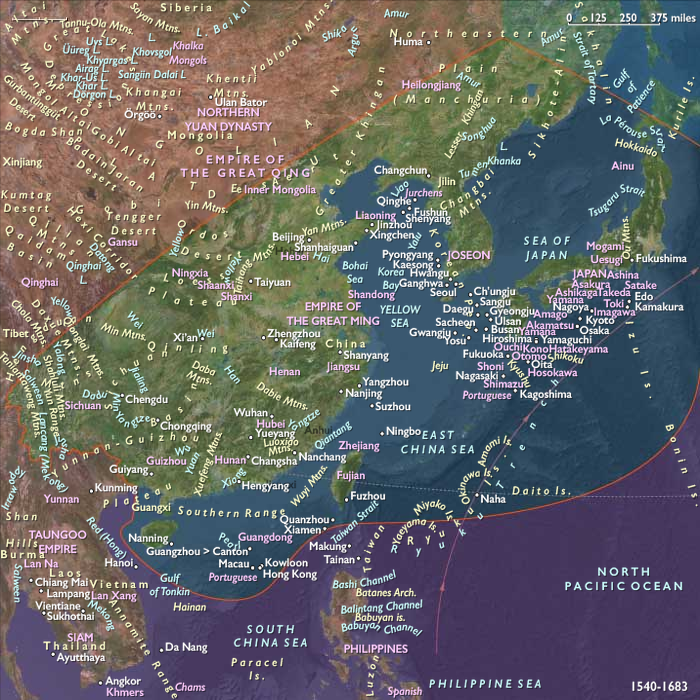
Long wars with the Mongols, incursions by the Japanese into Korea, and harassment of Chinese coastal cities by the Japanese in the sixteenth century weaken Ming rule, which becomes, as earlier Chinese dynasties had, ripe for an alien takeover
In 1644 the Manchus take Beijing from the north and become masters of north China, establishing the last imperial dynasty, the Qing (1644-1911).
Locations
Groups
- Chinese (Han) people
- Neo-Confucianism
- Mongols
- Chinese Empire, Ming Dynasty
- Chinese Empire, Qing (Manchu) Dynasty
Topics
Subjects
Regions
Subregions
Related Events
Filter results
Showing 10 events out of 32410 total
The Dutch, who had arrived in Asia a century after the Portuguese, had soon become active in the region's opium commerce.
Instead of trading directly with China like the Portuguese, the Dutch had established a permanent port at Batavia (modern Jakarta) in 1619.
They begin purchasing opium from Bengal in 1640 to supply Java's limited demand.
Japanese society of the Tokugawa period is influenced by Confucian principles of social order.
At the top of the hierarchy, but removed from political power, are the imperial court families at Kyoto.
The real political power holders are the samurai followed by the rest of society, in descending hierarchical order: farmers, who are organized into villages, artisans, and merchants.
Urban dwellers, often well-to-do merchants, are known as chonin (townspeople) and confined to special districts.
The individual has no legal rights in Tokugawa Japan.
The family is the smallest legal entity, and the maintenance of family status and privileges is of great importance at all levels of society.
The major intellectual development of the Tokugawa period is the flourishing of neo-Confucianism.
Confucian studies have long been kept active in Japan by Buddhist clerics, but during the Tokugawa period, Confucianism emerges from Buddhist religious control.
This system of thought increases attention to a secular view of man and society.
The ethical humanism, rationalism, and historical perspective of neo-Confucian doctrine appeals to the official class, and by the mid-seventeenth century, it is Japan's dominant legal philosophy and contributes directly to the development of the kokugaku (national learning) school of thought.
The Shimabara Rebellion of 1637-38, in which discontented Christian samurai and peasants rebel against the bakufu—and Edo calls in Dutch ships to bombard the rebel stronghold—marks the end of the Christian movement.
Soon thereafter the Portuguese are permanently expelled, members of the Portuguese diplomatic mission are executed, all subjects are ordered to register at a Buddhist or Shinto temple, and the Dutch and Chinese are restricted respectively to Deshima and a special quarter in Nagasaki.
Besides small trade of some outer daimyo with Korea and the Ryukyu Islands, to the southwest of Japan's main islands, by 1641 foreign contacts are limited to Nagasaki.
Economic development during the Tokugawa period includes urbanization, more shipping of commodities, a significant expansion of domestic and, initially, foreign commerce, and a diffusion of trade and handicraft industries.
Edo has a population of more than one million and Osaka and Kyoto each have more than four hundred thousand inhabitants by the mid-eighteenth century.
Many other castle towns grow as well.
Osaka and Kyoto become busy trading and handicraft production centers while Edo is the center for the supply of food and essential urban consumer goods.
The construction trades flourish along with banking facilities and merchant associations.
Increasingly, han authorities oversee the rising agricultural production and the spread of rural handicrafts.
Japan’s Edo Shogunate, in the interest of regulating and weakening the daimyo, has decreed that each daimyo must spend alternate years in the capital and in their country mansions.
Because of this rule, Japan’s transportation and lodging systems evolved enormously; further, the decree promoted cultural exchange between Edo and the provinces.
The shogunate, staffed by the Bushi, or Samurai, class of warriors turned bureaucrats, promulgated a rigid class system, Shi-no-ko-sho.
The merchant class, Sho, though socially inferior to the warrior (Shi), farmer (No) and artisan (Ko) classes, became wealthy and enjoyed the richest life of the four upper classes.
The shogunate also established two lower classes: the Eta, assigned such “unclean” occupations as butcher or tanner; and the Hinin, “inhuman” or criminal class, from which one could potentially re-ascend to one’s original class.
Thousands of heavily taxed farmers in Japan’s Amakasu province on Japan’s western shore rebel against their daimyo in 1637 and capture the castle of Shimabara.
The daimyo turn for help to the shogunate, whose army arrives to slaughter the rebellious, and mostly Christian, peasant families to the last child.
The Japanese government under Tokugawa Iemetsu, the third shogun, prohibits Christianity and erects an isolation policy called sakoku, expels from Japan all foreign traders—except the Chinese and the Dutch, who may only call in Nagasaki’s Dejima port.
Japan, now effectively closed to outside influences; will remain so for more than two centuries.
Massive epidemics had broken out in northern and central China in 1640 and raced south down along the Grand Canal of China and the densely populated settlements there, from the northern terminus at Beijing, to the fertile Jiangnan region.
The epidemic wipes out ninety percent of the local populace in some areas and towns.
East Europe (1636–1647 CE): Romanov Stability and Emerging Challenges
Political and Military Developments
Continued Centralization under the Romanovs
Between 1636 and 1647 CE, Muscovy continued to solidify political centralization under the Romanov dynasty. Administrative reforms further streamlined governance, reinforcing Tsar Michael Romanov’s control and fostering political stability.
Diplomatic Maneuvering and Foreign Policy
Muscovy's diplomatic relations remained carefully balanced, especially with neighbors such as Poland-Lithuania and Sweden. Diplomatic skill and strategic alliances kept regional tensions manageable, though challenges persisted.
Strengthening Military Capabilities
Efforts persisted to enhance military capabilities and fortifications, crucial for maintaining territorial integrity and regional security. Advances in military technology and tactics improved Muscovy's defensive preparedness.
Economic and Technological Developments
Economic Expansion and Stability
Economic growth continued steadily, with prosperous trade and expanding urban markets. Increased trade activity, particularly along major routes, supported economic resilience and urban prosperity.
Technological Progress and Infrastructure
Technological advancements persisted, notably in urban infrastructure and military fortifications. Improved transportation networks and fortified cities strengthened trade security and regional stability.
Cultural and Artistic Developments
Flourishing Cultural Expressions
Cultural patronage by the Romanovs remained robust, promoting significant developments in architecture, religious art, and secular culture. This period further enhanced Muscovy’s distinct cultural heritage.
Intellectual and Literary Activity
Scholarly and literary endeavors continued vigorously, with chroniclers and intellectuals actively recording political events, social changes, and cultural achievements, enriching Muscovy's historical legacy.
Settlement Patterns and Urban Development
Sustained Urban Growth
Cities experienced ongoing expansion, driven by strategic urban planning and infrastructural improvements. Moscow and other key urban centers benefited significantly from demographic growth and economic activity.
Reinforcement of Urban Defenses
Fortification improvements continued, ensuring robust urban defenses and regional security. Strategic fortifications played a critical role in protecting urban centers from potential external and internal threats.
Social and Religious Developments
Social Cohesion and Stability
Social cohesion strengthened further, facilitated by administrative reforms and inclusive policies aimed at integrating diverse ethnic communities into broader Muscovite society.
Continued Influence of the Orthodox Church
The Orthodox Church maintained its influential role, significantly shaping educational standards, community cohesion, and moral values, thereby contributing to overall societal stability and cultural continuity.
Long-Term Consequences and Historical Significance
The era from 1636 to 1647 CE marked sustained political centralization, economic prosperity, and cultural achievements under the Romanovs. These developments set the stage for future challenges and opportunities, reinforcing the foundations of the evolving Russian state.

Many of the Torghut, the westernmost of the Oirat Mongols, have meanwhile begin to migrate westward in approximately 1620.
Possibly the movement is a reaction to the growing dominance of the Dzungar Mongols, an Oirat subclan and neighbors of the Torgut to the south.
In any event, the Torghut fight their way through Kyrgyz and Kazakh territory, to cross the Embe River.
Becoming better known as the Kalmyk tribe, they subsequently settle in the Trans-Volga steppe and raid Russian settlements on both sides of the river.
Finally submitting to Russia in 1646, they maintain autonomy under their own khan.
They become an excellent source of light cavalry for the Russians, who will later use them in campaigns against the Crimean Tatars and in Inner Asia.
Years: 1636 - 1647
Locations
Groups
- Chinese (Han) people
- Neo-Confucianism
- Mongols
- Chinese Empire, Ming Dynasty
- Chinese Empire, Qing (Manchu) Dynasty