
The military might of China had been …
Years: 751 - 751
The military might of China had been projected beyond the harsh continental climate and the dry, desolate, and difficult terrain of the Tarim Basin, much of which consists of the Taklamakan Desert, as early as the Han Dynasty, when Emperor Wu of Han sent military expeditions to seize horses, which got as far as the Ferghana Valley.
Then, in 715, Alutar, the new king of Fergana Valley, had been installed with the help of the Arabs of the Umayyad Caliphate.
The deposed king Ikhshid had fled to Kucha (seat of Anxi Protectorate), and sought Chinese intervention.
The Chinese had sent ten thousand troops under Zhang Xiaosong to Ferghana, where he had defeated the Arab puppet-ruler Alutar at Namangan and reinstalled Ikhshid.
The inhabitants of three Sogdian cities had been massacred as a result of the battle.
The second encounter had occurred in 717, when Arabs, guided by the Turgesh, had besieged two cities in the area of Aksu.
The commander of the Chinese Protectorate General to Pacify the West, Tang Jiahui, had responded using two armies, one composed of Karluk mercenaries led by Ashina Xin (client qaghan of Onoq) and another composed of Tang regulars led by Jiahui himself.
After his decisive victory at the Battle of the Zab and eliminating those of the Umayyad family who failed to escape to Al-Andalus, As-Saffah had sent his forces to consolidate his Abbasid caliphate, including Central Asia, where his forces confront many regional powers, including those of China's Tang Dynasty.
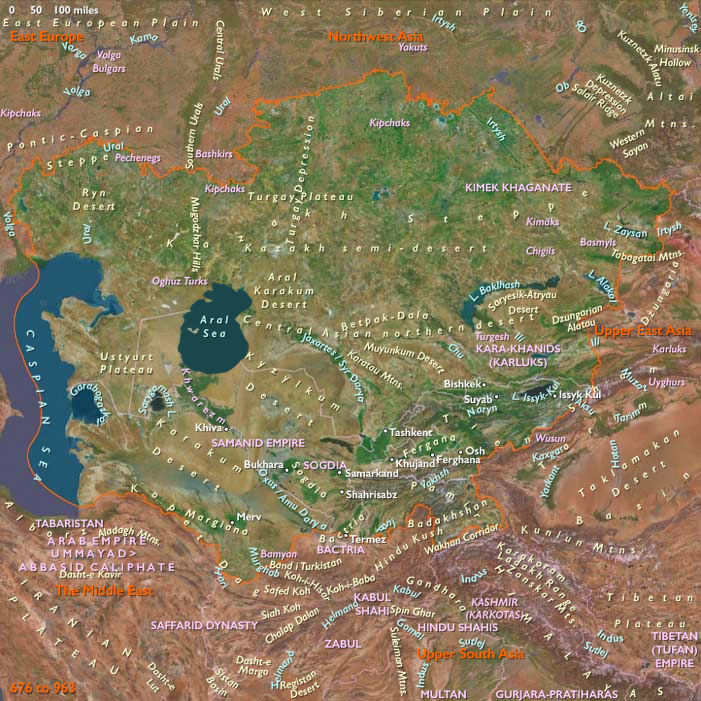
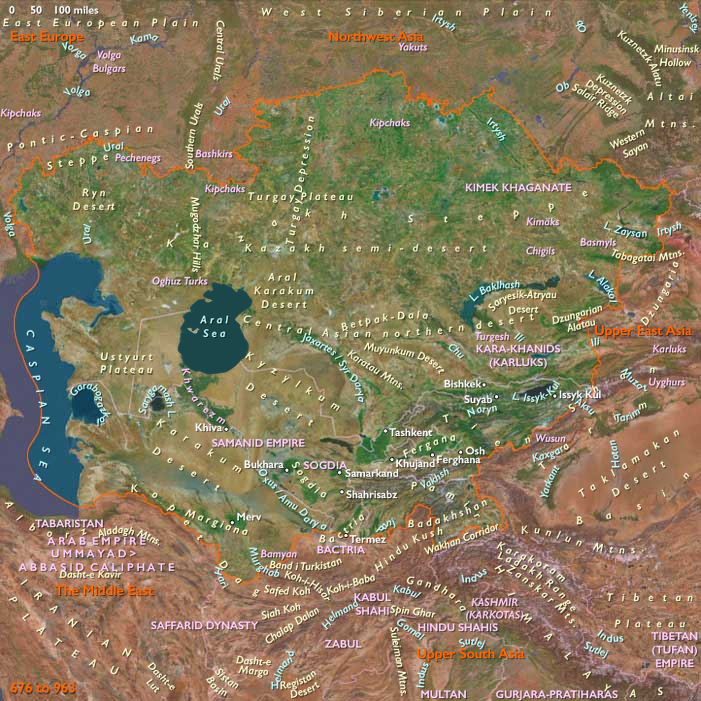
In the month of July 751, the Abbasid forces join in combat with the Tang Chinese force (the combined army of Tang Chinese and Karluk mercenaries) on the banks of the Talas river, which starts in the mountains of Kyrgyzstan and winds down into Kazakhstan.
The Chinese name Daluosi (Talas) is first seen in the account of Xuanzang.
Du Huan locates the city near the western drain of the Chui River.
The exact location of the battle has not been confirmed but is believed to be near Talas in present day Kyrgyzstan.
The Tang dynasty's devastating defeat is due to the defection of Karluk mercenaries and the retreat of Ferghana allies who originally supported the Chinese.
The Karluk forces, which comprise two-thirds of the Tang army, change to the Muslim side while the battle is ongoing so that Karluk troops attack the Tang army from close quarters and the main Abbasid forces attack from the front; the Tang troops are unable to hold their positions.
Ferghana forces inadvertently cut the Chinese troops off from the rest of their army and their route of retreat.
The commander of the Tang forces, Gao Xianzhi, recognizing that defeat is imminent, manages to escape with some of his Tang regulars with the help of Li Siye.
Out of an estimated ten thousand Tang troops, only two thousand manage to return from Talas to their territory in Central Asia.
Despite losing the battle, Li does inflict heavy losses on the pursuing Arab army after being reproached by Duan Xiushi.
Though Gao will be able to rebuild his forces within months, he will never again gain the confidence of the local tribes residing in the area.
Among the Chinese prisoners taken by the Arabs of Samarkand in their successful defense of that city are several skilled in the art of papermaking, or so the story goes.
The city's governor soon forces them to build and operate a paper mill, fueled by Samarkand's abundant supply of water, flax, and hemp.
In a short time, Samarkand will become the papermaking center of the Arab world.
In fact, high quality paper had been known—and made—in Central Asia for centuries; a letter on paper survives from the fourth century to a merchant in Samarkand, but the Islamic conquest of Central Asia in the late seventh and early eighth centuries has opened up this knowledge for the first time to what becomes the Muslim world.
Locations
Groups
- Iranian peoples
- Arab people
- Sogdia
- Transoxiana
- Kucha
- Chinese (Han) people
- Karluks
- Chinese Empire, Tang Dynasty
- Protectorate General to Pacify the East
- Türgesh Kaganate
- Abbasid Caliphate (Kufa)
Topics
Commodoties
Subjects
Regions
Subregions
Years: 751 - 751
Locations
Groups
- Iranian peoples
- Arab people
- Sogdia
- Transoxiana
- Kucha
- Chinese (Han) people
- Karluks
- Chinese Empire, Tang Dynasty
- Protectorate General to Pacify the East
- Türgesh Kaganate
- Abbasid Caliphate (Kufa)
Topics
Commodoties
Subjects
Regions
Subregions