
The military defeat had sealed the fate …
Years: 765 - 765
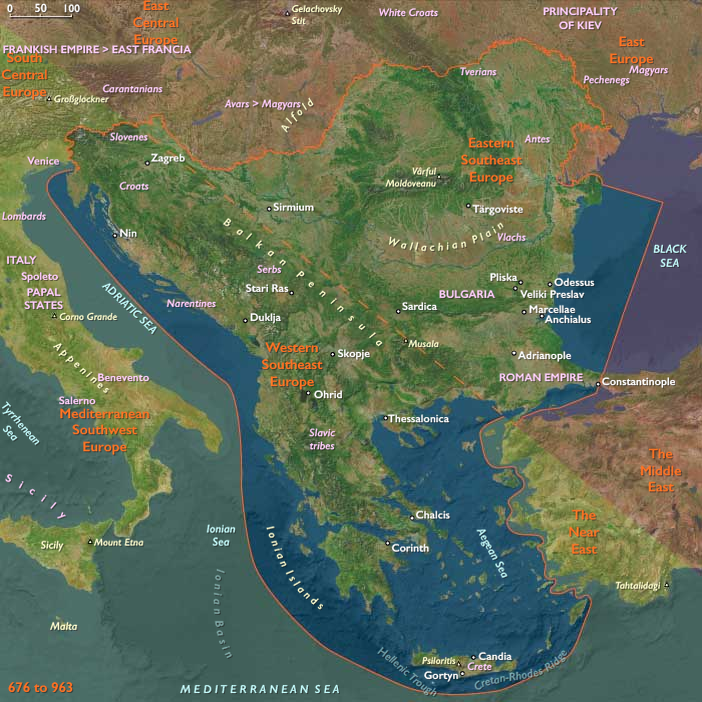
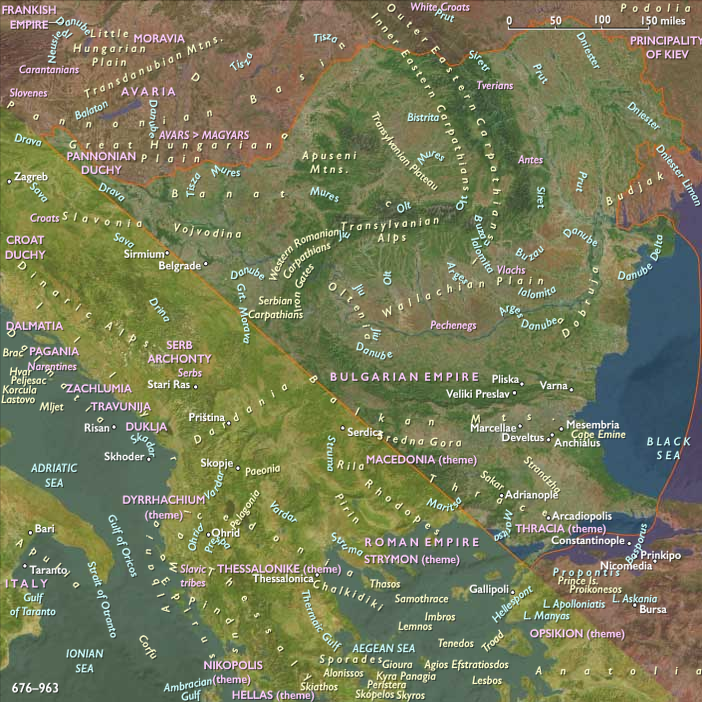
The military defeat had sealed the fate of Telets, who is lynched together with his supporters by his rebellious subjects in 765.
Some scholars think that Sabin, his successor, was omitted from the Namelist of Bulgarian Rulers because he was a Slav, but his name could indicate Latin or even Iranian origins.
He was related by marriage to Kormisosh, who was either a father-in-law or a brother-in-law of Sabin.
Since the relation is by marriage, Sabin would not have actually belonged to the Vokil clan.
Sabin rises to the throne after the murder of Telets in 765 and represents that part of the Bulgarian nobility which is seeking a policy of accommodation with the Empire.
Accordingly, he swiftly dispatches secret emissaries to Emperor Constantine V, seeking to reestablish peace.
When the negotiations are discovered, the Bulgarians rebelled and hold an assembly in which they accuse Sabin of causing Bulgaria's enslavement by the Empire.
Locations
People
Groups
- Greeks, Medieval (Byzantines)
- Bulgarian Empire (First)
- Bulgarians (South Slavs)
- Roman Empire, Eastern: Isaurian dynasty
Topics
Commodoties
Subjects
Regions
Subregions
Related Events
Filter results
Showing 10 events out of 72 total
Northern North America (1684–1827 CE); Empires Contested, Nations Born, Frontiers Pushed
Geography & Environmental Context
Northern North America includes the modern United States and Canada, excluding the West Indies. It is divided into three subregions:
-
Northeastern North America: east of 110°W, from New England and the Maritimes through the Great Lakes and Hudson Bay to Virginia, the Carolinas, most of Georgia, and the Mississippi Valley above Little Egypt.
-
Northwestern North America: west of 110°W, from Alaska and the Yukon to the Pacific Northwest and northern California north of the Gulf line.
-
Gulf and Western North America: the wedge south of the Montana diagonal, encompassing the plantation South, the Mississippi Valley below Illinois’ Little Egypt, the Plains, the Southwest, and California south of the Oregon border.
Together, these lands embraced a mosaic of boreal forest, prairie, Appalachian highlands, arid plains, subtropical deltas, and Pacific fjords. Each subregion developed distinct lifeways, but all were drawn into the same imperial rivalries and revolutionary transformations.
Climate & Environmental Shifts
The Little Ice Age persisted into the 18th century, bringing harsh winters to the northeast, erratic salmon and root harvests in the northwest, and drought cycles to the Southwest. Hurricanes battered the Gulf coast, while floods shaped the Mississippi delta. Resource pressures mounted: beaver populations declined from overtrapping, forests receded around port towns and plantations, and horse herds spread across the Plains.
Subsistence & Settlement
-
Indigenous nations maintained diverse economies: maize horticulture in the northeast and southeast, bison hunting on the Plains, salmon fisheries along Pacific rivers, and seal and whale hunting in the Arctic.
-
Colonial settlements took different forms: French Canada and Louisiana, Spanish missions in the Southwest and California, British seaboard colonies, and Russian posts in Alaska.
-
The United States, born of revolution, expanded westward into Kentucky, Tennessee, and the Ohio Valley, while Loyalists and Acadians reshaped Canada’s demography.
Technology & Material Culture
Indigenous technologies — birchbark canoes, snowshoes, horse gear, cedar plankhouses, irrigation systems — persisted alongside European imports: muskets, iron tools, plows, mills, sailing ships, and missions. Hybrid cultures emerged, such as Métis in the fur trade, African-descended Gullah in the Carolinas, and Spanish-Indian ranching lifeways in the Southwest.
Movement & Interaction Corridors
-
Rivers: the St. Lawrence, Great Lakes, Mississippi, and Columbia were arteries of commerce and war.
-
Maritime networks: Atlantic ports linked to Europe, the Caribbean, and Africa; Gulf and Pacific ports tied into global markets.
-
Overland corridors: mission trails, fur brigades, and horse trade networks tied regions together.
-
Migration: enslaved Africans carried to the South, European immigrants to the seaboard and interior, Loyalist refugees to Canada, and Indigenous nations displaced westward.
Cultural & Symbolic Expressions
Indigenous diplomacy — wampum belts, council fires, potlatch ceremonies, and Green Corn rituals — remained central. European religions spread: Catholicism in French and Spanish zones, Protestantism in the British colonies, syncretic traditions among African and Native peoples. Symbols of sovereignty proliferated: forts, flags, treaties, missions, and plantations marked territorial claims.
Environmental Adaptation & Resilience
Indigenous nations diversified subsistence, shifting to fur trapping, mounted bison hunting, or blending ritual with Catholic observance. Colonists adapted to hurricanes, droughts, and floods with new architecture, irrigation, and crop rotations. Food storage, trade alliances, and hybrid practices allowed resilience in a volatile climate.
Political & Military Shocks
-
Imperial wars: Nine Years’ War, Queen Anne’s War, and the Seven Years’ War reshaped borders and alliances.
-
Revolutions: The American Revolution created the United States; the Haitian Revolution reverberated through the Gulf; Indigenous uprisings, from Tecumseh’s confederacy to Pueblo resistance, challenged colonial regimes.
-
Territorial transfers: Louisiana Purchase (1803), Florida cession (1821), Russian America consolidations in Alaska.
-
War of 1812: Britain and the U.S. contested Great Lakes and Gulf coasts, leaving Native confederacies weakened.
Transition
Between 1684 and 1827, Northern North America was transformed from a patchwork of Indigenous nations and rival empires into a continental stage of settler republics, expanding frontiers, and Indigenous dispossession. The fur trade, cod fisheries, plantations, and salmon runs tied its subregions into global markets, while revolution and war redrew its maps. By 1827, the United States was pushing across Appalachia, Canada remained in Britain’s orbit, Russian America and Spanish missions dotted the Pacific, and Native nations, though battered, continued to anchor economies and cultures from the Arctic to the Gulf.
Fur trading is one of the main economic activities in Northern America from the late sixteenth century to the mid-nineteenth century
At this time, demand for fur is surging in Europe as it is used to make cloth and fancy hats.
Data collected from England in the eighteenth century highlights that the years from 1746 to 1763 see an increase of twelve shillings per pelt.
It has been calculated that over twenty million beaver hats were exported from England alone from 1700 to 1770.
Both trading partners in North America, natives and Europeans, provide the other a comparative advantage in the fur trade industry.
The opportunity cost of hunting beavers in Europe is extremely high: by the seventeenth and eighteenth centuries, the Eurasian beaver is near extinction in England and France.
On the other hand, traders and trappers think the wildlife in the New World is essentially limitless.
Natives make use of the trade goods received, particularly knives, axes, and guns.
The fur trade will provides a stable source of income for many Native Americans until the mid-nineteenth century, when changing fashion trends in Europe and a decline in the beaver population in North America bring about a collapse in demand for fur.
As Native Americans are pressed into alliances by the Europeans for Queen Anne's War, the Seven Years' War, the Nine Years' War, and other standing competitions among the European powers: France, Great Britain and Spain, with whom they are dealing in North America, they feel drawn into the Europeans' endemic warfare.
The Pacific Northwest is one of the last significant non-polar regions in the world to be explored by Europeans.
Centuries of reconnaissance and conquest have brought the rest of North America within the claims of imperial powers.
A number of empires and commercial systems during the late eighteenth and early nineteenth centuries converge upon the Northwest Coast, by sea as well as by land across the continent.
The Russian and Spanish empires are extended into the region simultaneously, from opposite directions.
British interest in the maritime fur trade peaks between 1785 and 1794, then declines as the French Revolutionary Wars diminish Britain's available manpower and investment capital.
The country also concentrates its foreign trade activities in India.
Port Louis, open to free trade after the demise of the French East India Company, sees a major increase in shipping, especially from Europe and North America.
For example, from 1786 to 1810 almost six hundred ships from the United States call on Mauritius, and the United States establishes a consulate in Port Louis in 1794.
Privateering is an even greater boon to the economy.
News of the French Revolution reaches Mauritius in 1790, prompting settlers unhappy with royal administration to establish more representative forms of government: a colonial assembly and municipal councils.
When a squadron arrives three years later, however, to enforce the new French government's abolition of slavery, the settlers turn the squadron back.
Napoleon sends a new governor to the island in 1803, resulting in the dissolution of the assembly and councils.
The waning of French hegemony in the region permits a British force of ten thousand, carried from the Indian subcontinent by a fleet of seventy ships, to land on Mauritius in 1810.
The French capitulate to the British, but the British agree to leave in place existing legal and administrative structures.
The 1814 Treaty of Paris awards the island, together with the Seychelles and Rodrigues islands, to Britain.
English becomes the official language, but French and Creole dominate.
Few British immigrants come to the colony.
Northeastern North America (1684–1827 CE): Empires, Nations, and Atlantic Gateways
Geography & Environmental Context
Northeastern North America includes all territory east of 110°W, except the lands belonging to Gulf and Western North America. This encompasses the Great Lakes basin, the St. Lawrence River corridor, Hudson Bay and Labrador, Newfoundland, Greenland, the Arctic, the Maritime provinces, and the Atlantic seaboard from New England through Virginia, the Carolinas, and most of Georgia. It also contains the Mississippi Valley north of Illinois’ Little Egypt and the Upper Missouri above the Iowa–Nebraska crossing, as well as northeast Alabama, central and eastern Tennessee, and nearly all of Kentucky.
Anchors included the Great Lakes–St. Lawrence system, Hudson Bay, the Mississippi headwaters, the Appalachian piedmont and coastal plain, and the Greenland ice sheet. This was a land of forests and prairies, river valleys and tundra, increasingly tied to transatlantic markets.
Climate & Environmental Shifts
This age unfolded under the continuing Little Ice Age. Winters were harsh: ice closed the St. Lawrence, snow lingered across New England and the Maritimes, and Greenland’s fjords froze for longer periods, forcing Inuit hunters to adapt routes and tools. In the Great Lakes and Midwest, shorter growing seasons sometimes strained maize harvests. Atlantic storms battered coastlines, while the cod-rich Grand Banks remained among the world’s most productive fisheries.
Subsistence & Settlement
-
Indigenous nations:
-
Iroquois (Haudenosaunee), Huron-Wendat, and Algonquian peoples relied on maize horticulture, deer, moose, caribou, and fisheries.
-
Inuit in Greenland and Labrador centered subsistence on seals, whales, and caribou, adapting to changing sea ice.
-
Southeastern groups (Cherokee, Creek) combined horticulture with hunting.
-
-
Colonial settlements:
-
New France spread from Quebec to the Great Lakes and Mississippi through forts and missions.
-
New England, New York, and the Chesapeake grew rapidly, displacing Native peoples.
-
Hudson’s Bay Company (chartered 1670) expanded posts like York Factory and Fort Albany, anchoring the fur trade.
-
Spanish Florida persisted tenuously until ceded to Britain (1763), then to the U.S. (1821).
-
Greenland saw Inuit continuity until Danish missions after 1721.
-
-
Economic systems: Fur and cod in the north, wheat and mixed farms in the interior, tobacco, rice, and indigo in the southern reaches.
Technology & Material Culture
-
Indigenous technologies: canoes, snowshoes, fishing gear, longhouses, wampum belts, dog sleds, umiaks, and harpoons.
-
European imports: firearms, iron tools, textiles, plows, ships, and mills.
-
Trade goods: kettles, knives, and muskets became embedded in Native economies.
-
Colonial towns: churches, courthouses, colleges, and printing presses reflected European traditions, while frontier cabins and missions reflected adaptation.
Movement & Interaction Corridors
-
Fur trade networks: Carried beaver pelts from the Great Lakes and Hudson Bay into Europe, exchanged for manufactured goods.
-
Maritime corridors: The Grand Banks drew fleets from England, France, Spain, and Portugal; New England merchants trafficked with the Caribbean and Africa.
-
Indigenous corridors: Canoe routes and portages linked Hudson Bay, the Great Lakes, and the Mississippi basin.
-
Greenland: Inuit maintained ice routes across Baffin Bay; Danish missions established lasting presence after 1721.
Cultural & Symbolic Expressions
-
Indigenous nations:
-
The Haudenosaunee Confederacy remained a powerful political and diplomatic bloc.
-
Oral traditions, seasonal rituals, and clan governance reinforced autonomy.
-
-
Colonial cultures:
-
Catholic missions dominated New France; Protestant congregations spread in New England and the South.
-
Anglicanism tied seaboard elites to Britain.
-
Jewish communities established early synagogues in port cities like Newport.
-
-
Greenland Inuit: Rituals around whale and seal hunting persisted; Christian teaching blended with older cosmologies after Danish missions.
-
Symbols of territory: forts, flags, treaties, and wampum belts embodied contested claims of sovereignty.
Environmental Adaptation & Resilience
Indigenous farmers rotated crops, built surpluses, and shifted villages as conditions required. Hunters diversified prey; Inuit adjusted hunting gear and routes to ice changes. Colonists overexploited cod, timber, and beaver but also relied on Native knowledge for survival in harsh climates. Beaver depletion shifted fur trade routes deeper into the interior, while forest clearing transformed seaboard ecosystems.
Political & Military Shocks
-
Imperial wars: The Nine Years’ War, Queen Anne’s War, and the Seven Years’ War drew Indigenous peoples into shifting alliances.
-
Seven Years’ War (1756–63): Britain seized New France, transforming the balance of power.
-
American Revolution (1775–83): Created the United States from New England to Georgia; Loyalists resettled in Canada, reshaping its demographics.
-
War of 1812: Britain and the U.S. clashed over the Great Lakes and Chesapeake; Native confederacies (notably Tecumseh’s) collapsed in defeat.
-
Greenland: Danish rule consolidated after missions, linking Inuit more firmly into European frameworks.
Transition
By 1827 CE, Northeastern North America had become a patchwork of Indigenous nations, colonial legacies, and new settler republics. The fur trade and cod fisheries tied forests and coasts to Atlantic markets; French Canada endured under British rule; the United States secured independence and expanded inland. Greenland was drawn into Danish orbit. Indigenous nations remained vital, but faced epidemic disease, land dispossession, and broken alliances. What had begun as an imperial frontier was by the early 19th century a continental zone of nations, settler societies, and Native resilience under unprecedented pressure.
In the peace treaty of 1783, American sovereignty is recognized from the Atlantic coast west to the Mississippi River.
Nationalists lead the Philadelphia Convention of 1787 in writing the United States Constitution, ratified in state conventions in 1788.
The federal government is reorganized into three branches, on the principle of creating salutary checks and balances, in 1789.
George Washington, who had led the revolutionary army to victory, is the first president elected under the new constitution.
The Bill of Rights, forbidding federal restriction of personal freedoms and guaranteeing a range of legal protections, is adopted in 1791.
Northeastern North America
(1780 to 1791 CE): Decisive Struggles, Frontier Expansion, and Indigenous Repercussions
The era 1780 to 1791 in Northeastern North America witnessed the decisive conclusion of the American Revolutionary War, the formation of the United States under a new Constitution, critical territorial reorganization in British Canada, and profound impacts on indigenous nations throughout the region. This period was marked by shifting frontiers, postwar migrations, severe epidemic outbreaks, and significant social, economic, and political restructuring.
Final Years of the Revolutionary War
Southern Campaigns and British Defeat
From 1780, the conflict in the southern colonies intensified, especially in South Carolina, where warfare devastated the region. British forces captured Charleston (May 1780), securing their largest victory of the war. However, guerrilla leaders like Francis Marion ("Swamp Fox"), Thomas Sumter, and Andrew Pickens conducted relentless raids against British and Loyalist forces. The decisive American victories at Kings Mountain (1780) and Cowpens (1781) turned the tide, culminating in British General Cornwallis’s surrender at Yorktown (October 1781).
Treaty of Paris (1783) and Territorial Reconfigurations
Recognition of American Independence
The Treaty of Paris (1783) formally recognized the independence of the United States, ceding all British claims east of the Mississippi River (except Florida, returned to Spain). This significantly reshaped the geopolitical landscape.
Indigenous Exclusion and Continuing Tensions
Indigenous nations were excluded from the treaty, leaving territorial claims unresolved. Tribes allied with Britain—such as parts of the Iroquois Confederacy and the Cherokee—suffered severe repercussions, including major land losses.
Westward Expansion and Frontier Hardships
Movement West of the Appalachians
As soon as the war ended in 1781, a significant westward migration originated in Pennsylvania, Virginia, and North Carolina, rapidly extending beyond the Appalachian Mountains. Early settlers initially relied on hunting abundant deer, turkeys, and other game for survival. Gradually, livestock—hogs, sheep, cattle, and horses—became commonplace. Primitive lean-to shelters gave way to one-room log cabins, animal-skin clothing was replaced by homespun garments, and rudimentary farming communities took shape.
The restless pioneer ethos prompted continual westward movement, as settlers periodically uprooted themselves to establish new settlements fifty or a hundred miles further into the wilderness.
The Wilderness Road and Kentucky Settlements
The Wilderness Road, pioneered by Daniel Boone, became a primary corridor for settlers moving into Kentucky. Despite its steepness and rough conditions, traversable only by foot or horseback, thousands poured into Kentucky after 1783. Violent indigenous resistance was frequent; in 1784 alone, Native American warriors killed over one hundred travelers along the route. Among them was the grandfather of future president Abraham Lincoln, who was killed and scalped near Louisville in 1784.
In 1788, settlers founded Marietta, Ohio, the first permanent American settlement in the Northwest Territory, heralding further settlement west of the Appalachians.
Devastating Epidemics Among Plains Tribes
The Smallpox Epidemic of 1781
A devastating smallpox epidemic, originating in Mexico City (1779–1780), slowly traveled northward along indigenous trade routes, reaching the Northern Plains in 1781. Nations such as the Comanche, Shoshone, Mandan, and Hidatsa were severely affected.
The Mandan suffered catastrophic losses; their thirteen clans were reduced to only seven, losing three clan lineages altogether. Subsequently, survivors moved north approximately twenty-five miles and consolidated into two villages on opposite banks of the Missouri River, where remnants of the similarly devastated Hidatsa joined them for mutual defense. Raids by the Lakota Sioux and Crow warriors during and after the epidemic exacerbated their vulnerability.
Indigenous Resistance in the Northwest Territory
Following American independence, increased settlement in the Ohio Country (the newly designated Northwest Territory) triggered violent resistance by indigenous coalitions, including the Miami Confederacy and Shawnee, under leaders such as Little Turtle and Blue Jacket. They inflicted severe defeats upon American forces, culminating in St. Clair’s Defeat (1791), highlighting ongoing indigenous opposition to American expansion.
Shays' Rebellion and Constitutional Reform
Economic Instability and Shays' Rebellion (1786–1787)
Post-revolutionary economic prosperity quickly devolved into severe depression, characterized by widespread debt, delinquent taxes, and foreclosures. In Massachusetts, economic desperation erupted into violent protests known as Shays’ Rebellion, led by farmers against oppressive courts and debt imprisonment. The rebellion exposed critical weaknesses in the Articles of Confederation, notably the federal government's inability to regulate commerce or enforce taxation, galvanizing calls for governmental reform.
U.S. Constitution (1787–1791)
The Philadelphia Convention (1787) drafted the U.S. Constitution to address these governance issues, establishing a robust federal government divided into three branches. Ratified in 1788, the new government took effect with George Washington’s inauguration in 1789, followed by the adoption of the Bill of Rights (1791).
British Canada and Loyalist Migrations
Tens of thousands of Loyalists fleeing revolutionary persecution reshaped British-controlled Canada, prompting Britain to create New Brunswick from Nova Scotia (1784) and split Quebec into English-speaking Upper Canada and French-speaking Lower Canada in 1791, granting each an elected legislative assembly.
Northern Indigenous Societies and Economic Networks
Mandan and Plains Economies
The Mandan continued to prosper economically despite severe population losses. As key intermediaries in the fur and horse trade along the Upper Missouri River, they skillfully navigated commerce with competing European and American traders, solidifying their central role in regional trade networks despite ongoing threats from more militarized Plains nations.
Greenland Settlements and Epidemics
In Greenland’s Egedesminde Colony (Aasiaat), founded by missionary Niels Egede, European whalers inadvertently introduced smallpox epidemics during the 1770s and 1780s, significantly reducing indigenous populations and dramatically reshaping local demographics.
Cultural and Ideological Shifts
The Great Awakening’s Legacy
The evangelical fervor of the Great Awakening continued influencing cultural and political ideologies, fueling revolutionary notions of liberty, religious freedom, and individual rights, laying ideological foundations for American republicanism.
Education and Intellectual Expansion
The immediate postwar period saw increased emphasis on education, with institutions such as Transylvania University (established in 1780 in Kentucky), becoming centers of intellectual discourse in the expanding frontier society.
Legacy of the Era (1780–1791 CE)
Between 1780 and 1791, Northeastern North America experienced transformative shifts. The conclusion of the Revolutionary War and subsequent territorial expansion significantly altered regional geopolitics. Westward migrations profoundly reshaped the frontier, encountering violent resistance from indigenous nations and severe hardships, including devastating epidemics like the smallpox outbreak of 1781.
Internal tensions like Shays’ Rebellion exposed critical weaknesses in national governance, prompting constitutional reform. Simultaneously, Loyalist migrations restructured British Canadian territories. These complex interactions among settlers, indigenous nations, and emergent national governments created foundational dynamics influencing the region’s future trajectory.
The United States, having won its independence from Great Britain through revolution from 1775, remains threatened internally by destabilizing sectional conflicts over slavery, taxation, and the distribution of wealth.
After the signing of the Paris Peace Treaty ending the American Revolution in 1783, the United States has yet to form formal government organizations and the constitutional convention has yet to convene.
The prosperity that reigned at war's end soon devolves into a severe economic depression.
Property holders begin losing their possessions through seizures for overdue debts and delinquent taxes and become subject to debtor's imprisonment.
Demonstrations ensue, with threats of violence against the courts handling the enforcement and indictments.
In what comes to be known as Shays' Rebellion, farmers and working people in Massachusetts begin organizing in protest against dictatorial and oppressive governmental and court systems and against excessive salaries for government and court officials.
The authors of the Constitution are heavily influenced by the country's experience under the Articles of Confederation (1781-89), which had attempted to retain as much independence and sovereignty for the states as possible and to assign to the central government only those nationally important functions that the states could not handle individually.
The events of the years 1781 to 1787, including the national government's inability to act during Shays' Rebellion, show that the Articles are unworkable because they deprive the national government of many essential powers, including direct taxation and the ability to regulate interstate commerce.
Its framers hope that the new Constitution will remedy this problem.
He sold Boone's Barony to pay bills for the rations of his Southern army.
After twice refusing the post of Secretary of War, Greene settles in 1785 on his Georgia estate at Mulberry Grove.
He dies here at age forty-three, on June 19, 1786.
Greene was an original member of the Rhode Island Society of the Cincinnati and serves as the Society's president from its founding in 1783 until his death in 1786.
He is succeeded by his son George Washington Greene, his grandson Dr. Nathanael Greene (who will serve as president of the Rhode Island Society), then by his great great grandson George Washington Greene Carpenter.
Years: 765 - 765
Locations
People
Groups
- Greeks, Medieval (Byzantines)
- Bulgarian Empire (First)
- Bulgarians (South Slavs)
- Roman Empire, Eastern: Isaurian dynasty
Topics
Commodoties
Subjects
Regions
Subregions