The militantly Protestant Swiss canton of Zürich, …
Years: 1529 - 1529
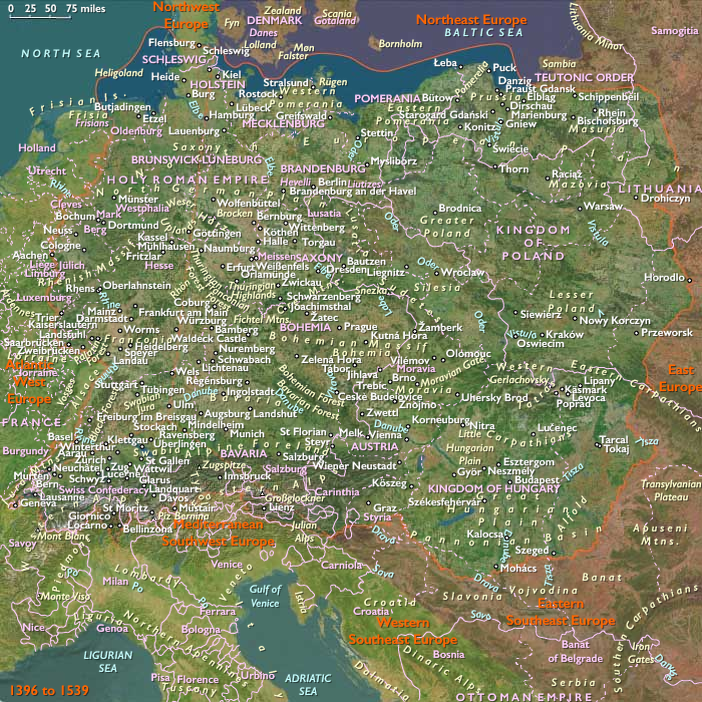
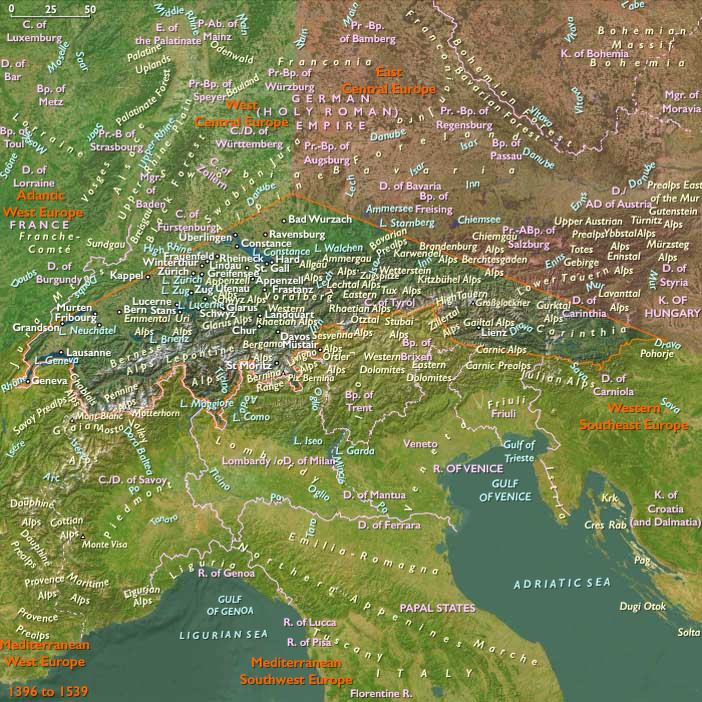
The militantly Protestant Swiss canton of Zürich, under the terms of an armistice signed in 1529 at Kappel on the border between Zürich and Zug, forces the five Catholic Swiss cantons of the Christian Union to break their alliance with Austria.
Uri, Zug, Luzern, Schwyz, and Unterwalden agree to allow religious freedom within their cantons.
Locations
Groups
- Christians, Roman Catholic
- Austria, Archduchy of
- Uri, Swiss Canton of
- Schwyz, Swiss Canton of
- Unterwalden, Swiss Canton of
- Lucerne, Swiss Canton of
- Zürich, Swiss Canton of
- Zug, Swiss Canton of
- Protestantism
Topics
Subjects
Regions
Subregions
Related Events
Filter results
Showing 10 events out of 38077 total
Martin Luther's Small Catechism (Der Kleine Katechismus) is written and published in 1529 for the training of children.
Luther's Small Catechism reviews the Ten Commandments, the Apostles' Creed, the Lord's Prayer, the Sacrament of Holy Baptism, the Office of the Keys and Confession and the Sacrament of the Eucharist.
It is included in the Book of Concord as an authoritative statement of what Lutherans believe.
It is widely used today in Lutheran churches as part of youth education and Confirmation.
Mazovia had become Poland's fief in 1351 after the reunification of the Polish state by Władysław I in the early fourteenth century.
The eastern part of the Mazovia region (Łomża) had been settled in the fifteenth century, mainly by the yeomanry (drobna szlachta).
Western Mazovia had in the second half of the fifteenth century been incorporated into the Polish state, as, in 1526/1529, is the main part, with its capital in Warsaw.
In comparison with Greater Poland and Lesser Poland, Mazovia, with the lowest urban population, is considered underdeveloped.
Georg Bauer, the German physician and mineralogist better known as Agricola, describes the fluorine-containing mineral fluorspar (fluorite) in 1529, noting its use as flux in metallurgy.
Agricola also latinizes wismut to bisemutum, identifying the distinctive qualities of bismuth and describing how to obtain the element from its ores.
Albrect Altdorfer’s atypical Battle of Issus (or of Alexander) of 1529 is commissioned by William IV, Duke of Bavaria as part of a series of eight historical battle scenes destined to hang in the Residenz in Munich.
A masterpiece of large spatial organization, the panoramic painting exemplifies the forty-eight-year-old artist’s interest in magic, ruins, fantastic landscape, and mysterious light.
Altdorfer’s use of sophisticated atmospheric and aerial perspective as well as naturalistic detail produces an image that ultimately evokes a sense of the primordial powers that rule the universe.
His depiction of the moment in 333 BCE when Alexander the Great routed Darius III for supremacy in Asia Minor is vast in ambition, sweeping in scope, vivid in imagery, rich in symbols, and obviously heroic.
In the painting, a swarming cast of thousands of soldiers surround the central action: Alexander on his white steed, leading two rows of charging cavalrymen, dashes after a fleeing Darius, who looks anxiously over his shoulder from a chariot.
The opposing armies are distinguished by the colors of their uniforms: Darius' army in red and Alexander's in blue.
The upper half of The Battle of Alexander expands with unreal rapidity into an arcing panorama comprehending vast coiling tracts of globe and sky.
The victory also lies on the planar surface; The sun outshone the moon just as the Imperial and allied army successfully repel the Turks.
By making the mass number of soldiers blend within the landscape/painting, it shows that he believes that the usage and depiction of landscape is just as significant as a historical event, such as a war.
He had renounced the office of Mayor of Regensburg to accept the commission.
Few of his other paintings resemble this apocalyptic scene of two huge armies dominated by an extravagant landscape seen from a very high viewpoint, which looks south over the whole Mediterranean from modern Turkey to include the island of Cyprus and the mouths of the Nile and the Red Sea (behind the isthmus to the left) on the other side.
However his style here is a development of that of a number of miniatures of battle-scenes he had done much earlier for Maximilian I in his illuminated manuscript Triumphal Procession in 1512-14.
It is thought to be the earliest painting to show the curvature of the Earth from a great height.
Stephen Báthory, a son of Nicholas Báthory (1462–1500) of the Somlyó branch of the Báthory family, had in 1522 been appointed adjutant of the Voivode of Transylvania, serving under the Voivode John Zápolya.
After the Battle of Mohács in 1526, Stephen had supported Zápolya's claim to the Kingship of Hungary and in 1529 is made Voivode of Transylvania.
The Hindu Vijayanagara kingdom under Krishnadevaraya, who dies in 1529, has developed into one of the world’s great trading centers, despite internal opposition and invasions from northeastern Hindu kingdoms.
Krishnadevaraya has worked with Portuguese allies to take control of the Bahmani successor state of Bijapur.
Achyutadevaraya succeeds him.
Troops of the Somali military leader Imam Ahmad ibn Ibrahim al-Ghazi Imam Ahmad defeat a larger Ethiopian contingent in 1529 at the Battle of Shimbra Kure, one hundred and thirty kilometers (eighty miles) southeast of Addis Ababa.
The victory comes at a heavy cost but it solidifies the Somali forces' morale, providing proof that they can stand up to the sizable Ethiopian army.
Five Catholic cantons of the Swiss Confederacy—Uri, Zug, Luzern, Schwyz, and Unterwalden—form the Christian Union to restrict the influence of Protestant Zürich, whose citizens have begun proselytizing and embargoing those cantons still loyal to Rome.
Forces from Zürich skirmish with those of the Union in 1529.
The death of Hernán Cortés’s wife Catalina Suárez had produced a scandal and a major investigation, but weathering that, Cortés is now free to marry someone of high status more appropriate to his wealth and power.
In 1529 he is accorded the noble designation of don, but more importantly is given the noble title of Marquis of the Valley of Oaxaca and marries the Spanish noblewoman Doña Juana de Zúñiga.
The marriage will produce three children, including another son, who is also named Martín.
As the first-born legitimate son, Don Martín Cortés y Zúñiga will become Cortés's heir and succeed his father as holder of the title and estate of the Marquisate of the Valley of Oaxaca.
Cortés's legitimate daughters will be known as Doña Maria, Doña Catalina, and Doña Juana.
Baldassare Castiglione was back in Mantua in 1516, where he married a very young Ippolita Torelli, descendant of another noble Mantuan family.
That Castiglione's love for Ippolita was of a very different nature from his former platonic attachment to Elisabetta Gonzaga is evidenced by the two deeply passionate letters he wrote to her that have survived.
Sadly, Ippolita died a mere four years after their marriage, while Castiglione was away in Rome as ambassador for the Duke of Mantua.
Pope Leo X had conceded to him the tonsura (first sacerdotal ceremony) in 1521 and thereupon began Castiglione's second, ecclesiastical career.
He maintains copious correspondence with personalities of his time.
Castiglione's principal work, The Book of the Courtier, published by Aldine Press is an ideal (and in certain respects also a factual) picture of the life of Renaissance court society, in which famous contemporaries such as Pietro Bembo, Bernardo Bibiena, and Giuliano de'Medici discuss the manners and virtues of the perfect courtier.
Considered the definitive account of Renaissance court life, it is cited frequently along with Stefano Guazzo's The civil conversation (1574) and Giovanni Della Casa's Galateo (1558) as among the most important Renaissance works of the Italian Renaissance.
Pope Clement VII had sent the forty-seven-year-old Castiglione as apostolic nuncio to the court of Charles V in Spain in 1524, and in this role he followed court of Emperor Charles V to Toledo, Seville and Granada.
At the time of the Sack of Rome (1527) Pope Clement VII suspected Castiglione of having harbored a "special friendship" for the Spanish emperor: Castiglione, the Pope believed, should have informed the Holy See of Charles V's intentions, for it was his duty to investigate what Spain was planning against the Eternal City.
On the other hand, Alonso de Valdés, twin brother of the humanist Juan de Valdés and secretary of the emperor, publicly declared the sack to have been a divine punishment for the sinfulness of the clergy.
Castiglione answered both the Pope and Valdés in two famous letters from Burgos.
He took Valdés to task, severely and at length, in his response to the latter's comments about the Sack of Rome.
While in his letter to the Pope (dated December 10, 1527), he had the audacity to criticize Vatican policies, asserting that its own inconsistencies and vacillations had undermined its stated aim of pursuing a fair agreement with the emperor and had provoked Charles V to attack.
Against all expectations, Castiglione received the Pope's apologies and the emperor honored him with the offer of the position of Bishop of Avila.
Historians today believe that Castiglione had carried out his ambassadorial duties to Spain in an honorable manner and bore no responsibility for the sack of Rome.
He dies of the plague in Toledo in 1529.

Years: 1529 - 1529
Locations
Groups
- Christians, Roman Catholic
- Austria, Archduchy of
- Uri, Swiss Canton of
- Schwyz, Swiss Canton of
- Unterwalden, Swiss Canton of
- Lucerne, Swiss Canton of
- Zürich, Swiss Canton of
- Zug, Swiss Canton of
- Protestantism