
The Middle East: 904–915 CE Fragmentation …
Years: 904 - 915
The Middle East: 904–915 CE
Fragmentation of Abbasid Authority and the Rise of Regional Powers
From 904 to 915 CE, the Abbasid Caliphate faces an accelerating decline of central authority, evident through the growing autonomy and influence of ambitious provincial governors and military commanders. The Abbasid caliphs, increasingly confined to ceremonial roles in Baghdad, see their practical power diminish significantly.
Emergence of Local Dynasties
Local and regional dynasties solidify their control throughout the empire. The Saffarids, having displaced the Tahirids in eastern Iran, consolidate their power by 873 and assert continued dominance during this period. Additionally, Mesopotamia sees the rise of various regional rulers, further fragmenting the caliphate’s once-unified territories.
Revolt and Rebellion
In Bahrain, which encompasses significant portions of eastern Arabia, the Qarmatians under Abu Sa'id al-Hasan al-Jannabi fortify their hold following their earlier capture of the capital Hajr and al-Hasa in 899 CE. Al-Jannabi continues to establish his revolutionary republic based on utopian ideals, significantly disrupting Abbasid control in the region.
Intellectual and Cultural Flourishing
Despite political fragmentation, intellectual and cultural advancements persist. The Persian geographer Ahmad ibn Rustah compiles his detailed geographic compendium, the Book of Precious Records, providing valuable first-hand descriptions of his native Isfahan and insights into regions as distant as Europe and Inner Asia.
The esteemed Persian physician Agha Bakr Muhammad ibn Zakariya al-Razi (al-Razi) continues to advance medical knowledge from his school in Baghdad, advocating opium use in anesthesia and melancholy treatment, reflecting continued innovation within Islamic medical traditions.
Religious and Linguistic Transformations
The Jewish philosopher and theologian Saadia Gaon remains active as head of the Talmudic academy of Sura, vigorously debating religious interpretations and authoring significant commentaries, notably on mystical texts such as the Sefer Yetzira. These writings greatly influence Jewish mystical thought, especially regarding the concept of the sefirot.
Linguistically, the transition from Middle Iranian languages to Modern Iranian continues, marked by a shift toward more rigid grammatical structures and syntax.
Kurdish Identity and Cultural Shifts
The identity of the "Kurds" becomes clearer in early Islamic sources, though still primarily described by their nomadic and pastoral lifestyle rather than as a distinct linguistic group. They emerge as a significant presence in the social and political dynamics of the region.
Thus, this era encapsulates both the fragmentation of Abbasid political authority and ongoing cultural and intellectual vitality across the Middle East.
People
- Abu-Sa'id Jannabi
- Ahmad ibn Rustah
- Khumarawayh ibn Ahmad ibn Tulun
- Muhammad ibn Zakariya al-Razi
- Saadia Gaon
Groups
- Jews
- Kurdish people
- Bahrain, Province of
- Muslims, Kharijite
- Abbasid Caliphate (Samarra)
- Saffarid dynasty
- Qarmatians
Topics
Subjects
Regions
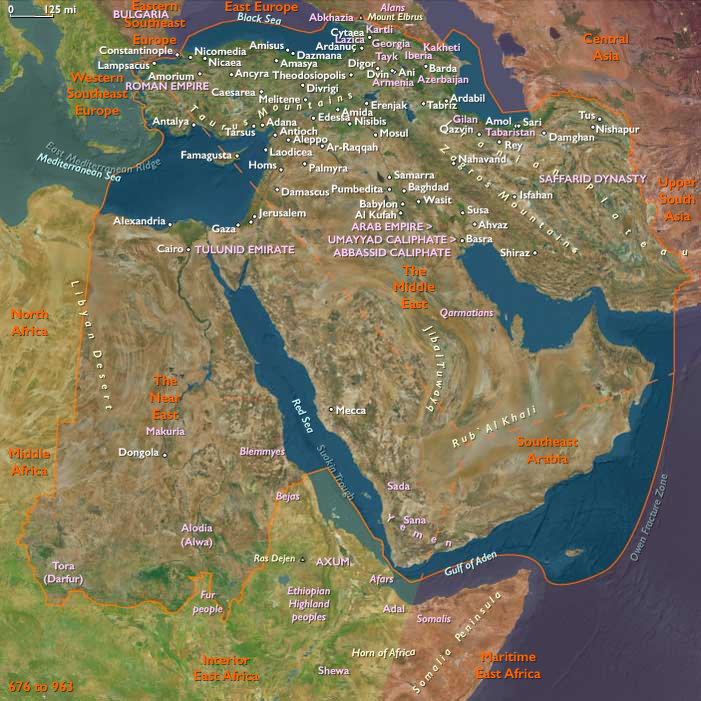
Subregions
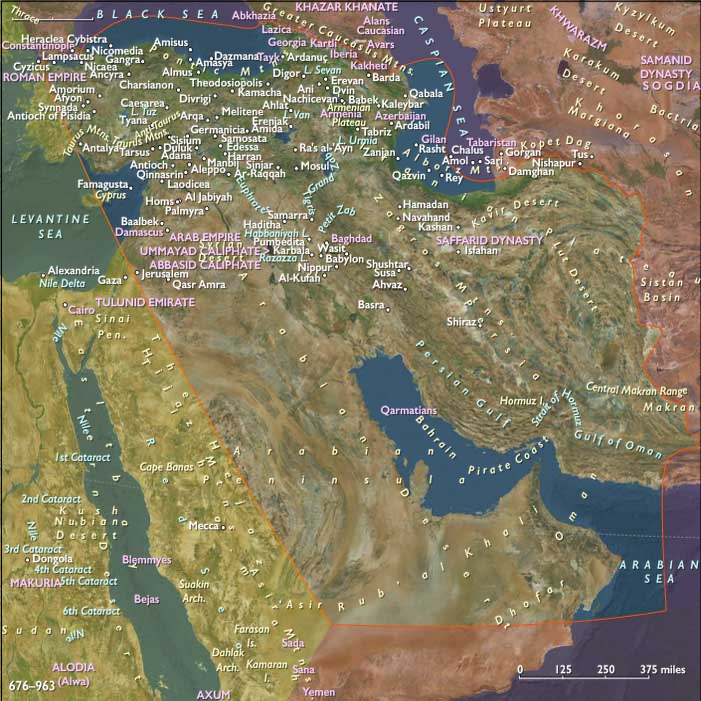
Related Events
Showing 10 events out of 53510 total
Years: 904 - 915
People
- Abu-Sa'id Jannabi
- Ahmad ibn Rustah
- Khumarawayh ibn Ahmad ibn Tulun
- Muhammad ibn Zakariya al-Razi
- Saadia Gaon
Groups
- Jews
- Kurdish people
- Bahrain, Province of
- Muslims, Kharijite
- Abbasid Caliphate (Samarra)
- Saffarid dynasty
- Qarmatians
Topics
Subjects
Regions
Subregions