
The Middle East: 892–903 CE Abbasid …
Years: 892 - 903
The Middle East: 892–903 CE
Abbasid Consolidation, Regional Revolts, and Cultural Advances
Restoration of Abbasid Authority
In 896 CE, Abbasid Caliph al-Mu'tadid decisively crushes the long-standing Kharijite Rebellion, restoring caliphal authority across the troubled regions. However, despite this victory, the Abbasid Caliphate continues to face significant internal and external challenges.
Rise of the Qarmatians
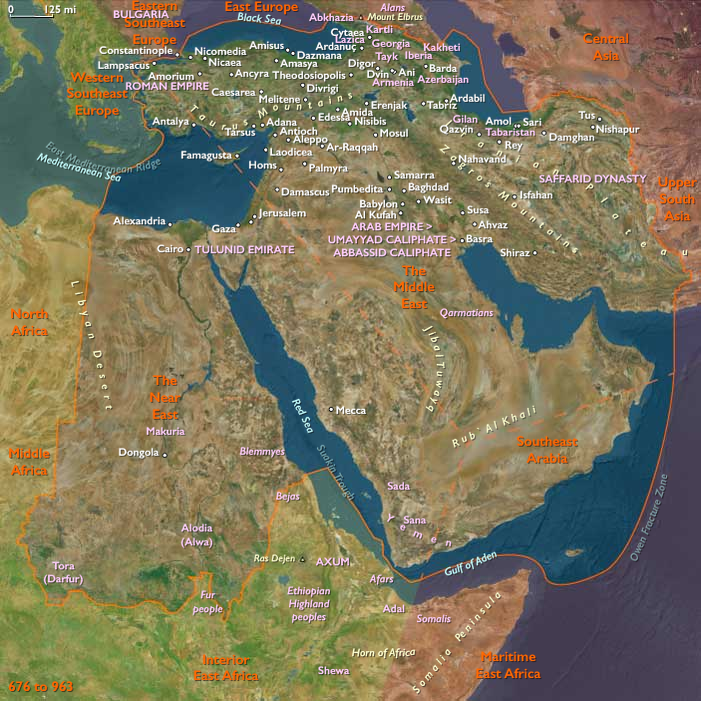
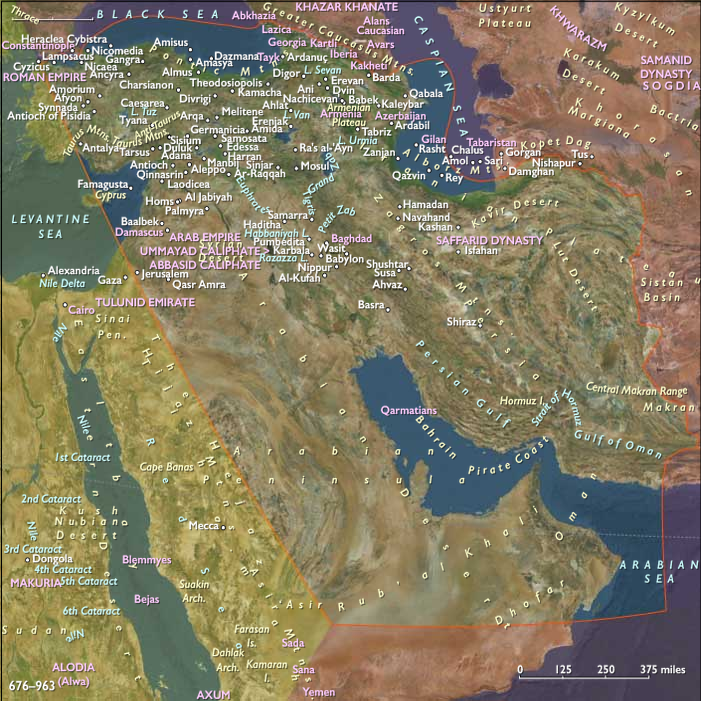
At the close of the ninth century, Bahrain—encompassing much of eastern Arabia and surrounding islands—falls prey to internal strife exacerbated by disturbances in Abbasid Iraq. Seizing upon these disruptions, the Qarmatians, led by Abu Sa'id al-Hasan al-Jannabi, take control of Bahrain’s capital, Hajr, and the region of al-Hasa in 899 CE. Al-Jannabi establishes a utopian society, positioning al-Hasa as the capital of his revolutionary republic. The Qarmatian state thus emerges as a formidable new power in the region.
Geographical Scholarship and Persian Culture
The Persian geographer Ahmad ibn Rustah composes his significant geographical work, the Book of Precious Records, during this era. Ibn Rustah's meticulous account provides valuable firsthand insights, especially about his hometown of Isfahan, detailing its layout, defenses, and administrative divisions. His writings also encompass broader geographic descriptions, including Europe and Inner Asia, making him an indispensable source for otherwise poorly documented regions. Ibn Rustah's notable observation of a Caucasian king who pragmatically worships with Muslims, Jews, and Christians highlights the region's religious diversity and political pragmatism.
Emergence and Identity of the Kurds
The term "Kurd" appears increasingly in early Islamic sources, primarily referencing pastoral nomadic lifestyles rather than defining a distinct linguistic or ethnic group. Early Persian and Arabic texts describe "Kurds" as an amalgamation of various Iranian and Iranicized nomadic tribes, often highlighting their nomadic and pastoral traits rather than linguistic unity.
Medical Advances and Cultural Contributions
The renowned Persian physician Agha Bakr Muhammad ibn Zakariya al-Razi (also known as al-Razi, 845–930 CE), who maintains a laboratory and medical school in Baghdad, significantly advances medical knowledge. In his manual, Man la Yahduruhu Al-Tabib, al-Razi notably advocates the use of opium for anesthesia and the treatment of melancholy, reflecting both practical medical innovations and the continuing legacy of classical medical traditions.
Jewish Mysticism and Philosophical Developments
The prominent Jewish philosopher and scholar Saadia ben Joseph al-Fayyumi, known as Saadia Gaon, heads the Talmudic academy of Sura. Saadia engages in extensive theological and philosophical debates, notably confronting the Karaites over their challenges to Judaic tradition. His significant literary contributions include commentaries on mystical texts like the Sefer Yetzira (Book of Creation), foundational in the development of Jewish cosmology and mysticism. Saadia’s writings profoundly influence Jewish mystical thought, particularly regarding the sefirot, which conceptualize humanity as a microcosm of creation.
Linguistic Shifts in Iranian Languages
This period witnesses significant linguistic transitions, with the flexible word order characteristic of Middle Iranian languages gradually evolving into the more rigid word order structures of Modern Iranian languages. This shift marks an essential phase in the historical development of the Iranian linguistic tradition.
People
- Abu-Sa'id Jannabi
- Ahmad ibn Rustah
- Al-Layth
- Al-Mu'tadid
- Khumarawayh ibn Ahmad ibn Tulun
- Muhammad ibn Zakariya al-Razi
- Saadia Gaon
Groups
- Jews
- Kurdish people
- Bahrain, Province of
- Karaite Judaism
- Muslims, Kharijite
- Abbasid Caliphate (Samarra)
- Qarmatians
Topics
Commodoties
Subjects
- Writing
- Labor and Service
- Conflict
- Mayhem
- Faith
- Government
- Arcanum
- Medicine
- Theology
- Philosophy and logic
- Cosmology
Regions
Subregions
Years: 892 - 903
People
- Abu-Sa'id Jannabi
- Ahmad ibn Rustah
- Al-Layth
- Al-Mu'tadid
- Khumarawayh ibn Ahmad ibn Tulun
- Muhammad ibn Zakariya al-Razi
- Saadia Gaon
Groups
- Jews
- Kurdish people
- Bahrain, Province of
- Karaite Judaism
- Muslims, Kharijite
- Abbasid Caliphate (Samarra)
- Qarmatians
Topics
Commodoties
Subjects
- Writing
- Labor and Service
- Conflict
- Mayhem
- Faith
- Government
- Arcanum
- Medicine
- Theology
- Philosophy and logic
- Cosmology
Regions
Subregions