
The Middle East: 784–795 CE Abbasid …
Years: 784 - 795
The Middle East: 784–795 CE
Abbasid Power and Cultural Flourishing
Golden Age under Harun al-Rashid
The Abbasid Caliphate enters a period of remarkable strength and prosperity during the reign of Harun al-Rashid (786–809), whose early rule spans this era. Baghdad remains a vibrant center of culture, trade, and intellectual life, drawing scholars, poets, and artists from across the known world. Harun’s court becomes legendary for its opulence, scholarship, and patronage, setting the stage for the golden age of Islamic civilization.
Administrative Reforms and Stability
Harun al-Rashid strengthens imperial administration, improving efficiency and fiscal stability. Taxation and land reforms help bolster the empire's economy, supporting extensive infrastructure projects such as roads, bridges, and canals, further enhancing trade and agriculture.
Cultural and Scientific Advancement
Under Harun, the Abbasid court at Baghdad becomes an unparalleled center of learning. Libraries and educational institutions flourish, attracting scholars who translate significant Greek, Persian, and Indian works into Arabic. This wave of intellectual activity forms the basis for subsequent advances in mathematics, medicine, astronomy, and philosophy, profoundly influencing both the Islamic world and later European Renaissance.
Thus, between 784 and 795 CE, the Middle East witnesses an era of exceptional prosperity and intellectual ferment, positioning the Abbasid Caliphate at the pinnacle of its cultural and political influence.
People
Groups
Topics
Commodoties
Subjects
- Commerce
- Faith
- Government
- Scholarship
- Custom and Law
- Medicine
- Mathematics
- Astronomy
- Philosophy and logic
Regions
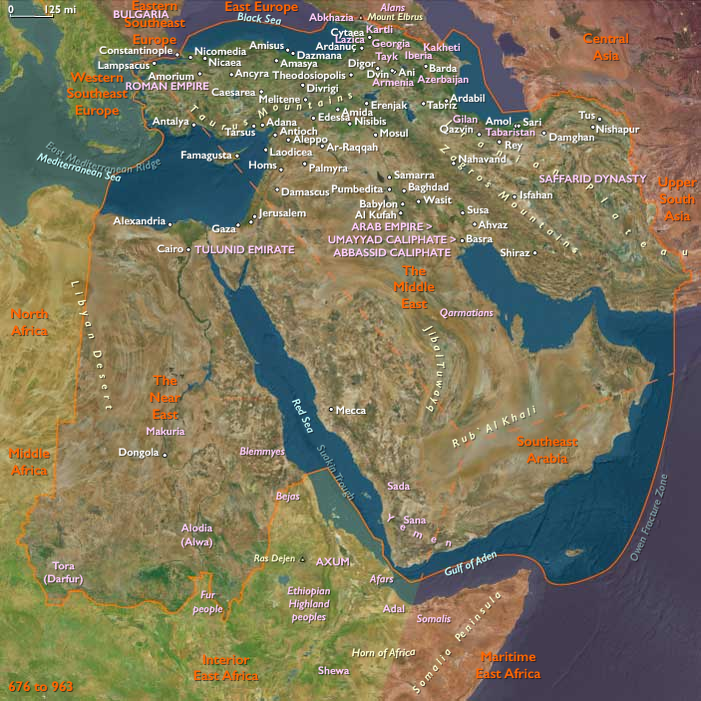
Subregions
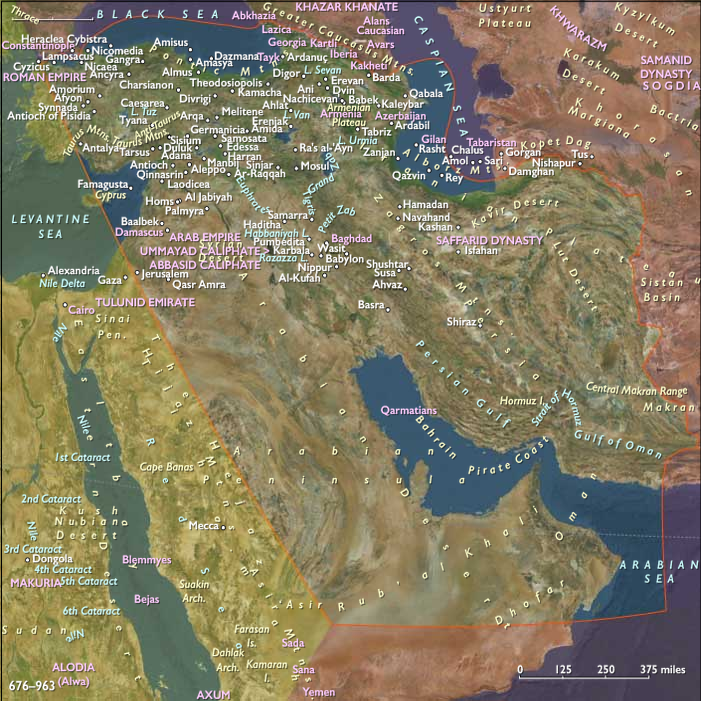
Years: 784 - 795
People
Groups
Topics
Commodoties
Subjects
- Commerce
- Faith
- Government
- Scholarship
- Custom and Law
- Medicine
- Mathematics
- Astronomy
- Philosophy and logic
Regions
Subregions