
The Middle East: 88–99 CE Consolidation …
Years: 88 - 99
The Middle East: 88–99 CE
Consolidation of Parthian Authority and Continued Rivalries
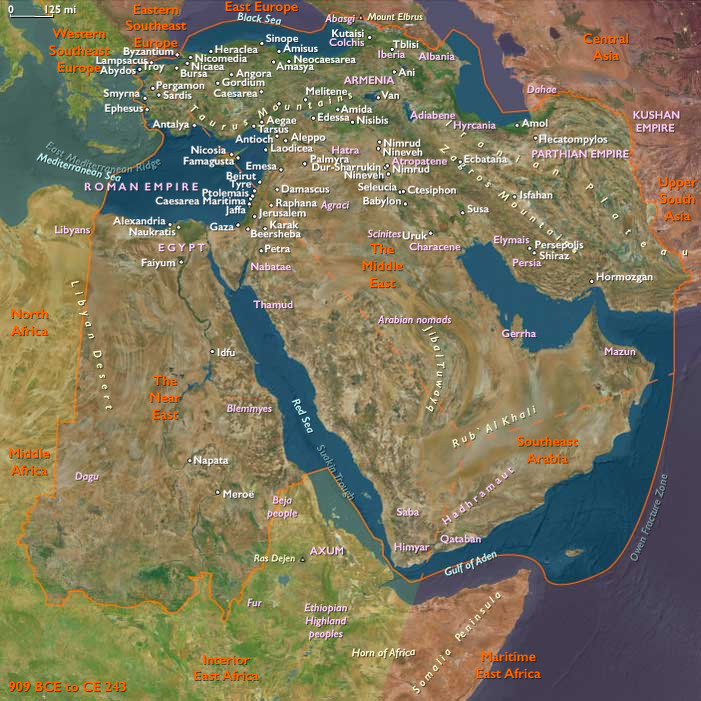
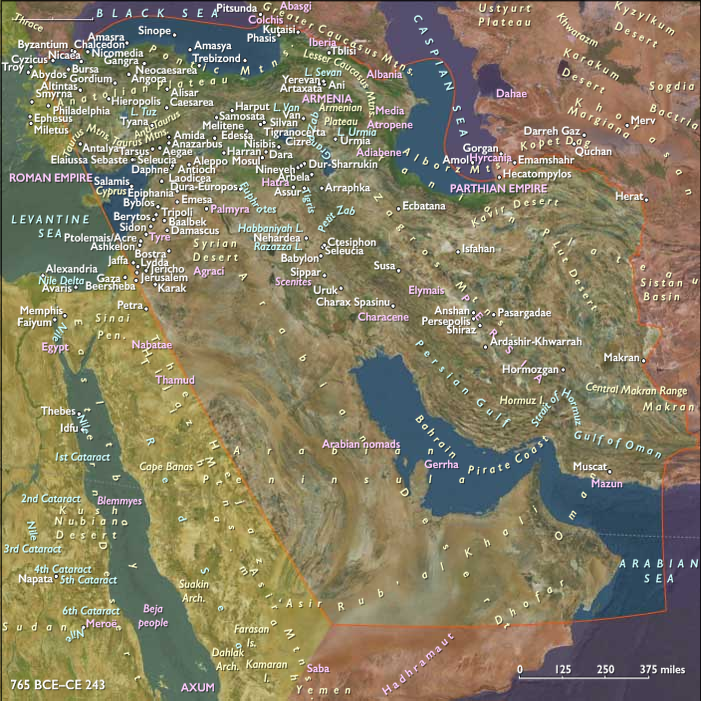
The late first century witnesses continued Parthian political consolidation under Pacorus II, who, after securing power in about 78 CE, rules effectively until 105 CE. His lengthy reign offers a semblance of stability after prior periods of internal strife. Under Pacorus II, Parthian governance remains relatively stable, and he manages to curtail internal rebellions, maintaining Parthian territorial integrity and authority across Mesopotamia and Persia.
Meanwhile, the region continues to be defined by Roman-Parthian rivalry, particularly over Armenia. The Parthian policy of installing and supporting members of the Arsacid dynasty on the Armenian throne remains a constant irritant to Rome, which sees Armenia as a critical buffer state vital for protecting the Roman eastern frontier. Diplomatic exchanges and occasional skirmishes punctuate the relationship, but neither empire escalates tensions into full-scale war during this era.
The Parthian Empire under Pacorus II fosters an environment that sustains economic prosperity, notably benefiting from its strategic control of Silk Road routes linking the Mediterranean with East Asia. Trade flourishes, particularly in luxury goods like silk, spices, precious metals, and textiles, sustaining Mesopotamia as a vibrant economic crossroads.
Culturally, this era marks ongoing exchanges between Greco-Roman and Iranian traditions, although the earlier explicit rejection of Hellenistic customs under Vologases I is gradually softened by pragmatic policies that integrate diverse influences within the empire’s complex cultural tapestry.
Thus, from 88 to 99 CE, the Middle East experiences a period of relative internal stability under Parthian rule, while persistent diplomatic tensions and rivalries between Rome and Parthia continue to shape regional politics, laying the groundwork for continued geopolitical dynamics into the next century.
People
Groups
Topics
Subjects
Regions
Subregions
Years: 88 - 99
People
Groups
Topics
Subjects
Regions
Subregions