
The Middle East: 753–742 BCE Revival …
Years: 753BCE - 742BCE
The Middle East: 753–742 BCE
Revival and Consolidation in Assyria
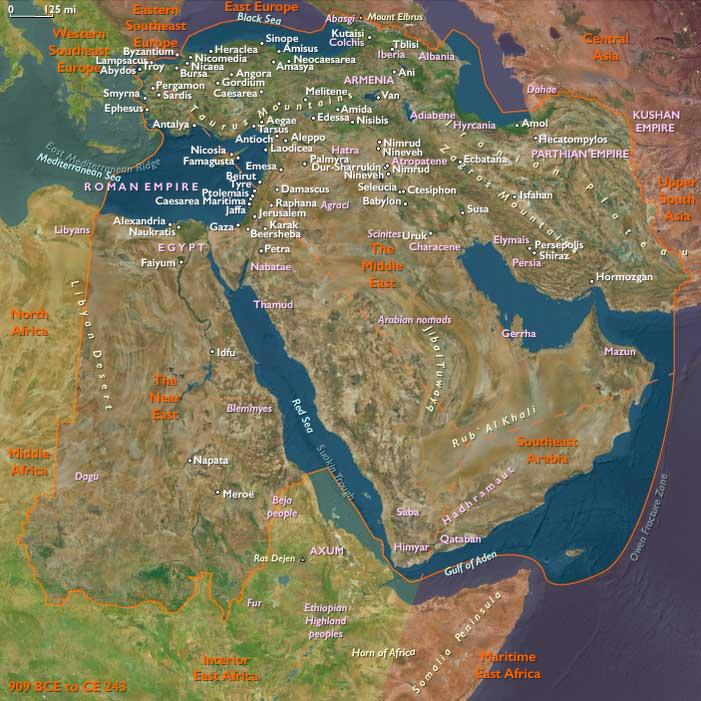
In 745 BCE, following a prolonged period of internal turmoil, a military revolution dramatically transforms Assyria’s fortunes. Ashur-nirari V (755–745 BCE), already weakened by years of ineffective governance and internal strife, is overthrown in a coup led by a dynamic military leader who ascends the throne as Tiglath-Pileser III (745–727 BCE). Immediately upon seizing power, Tiglath-Pileser embarks on an aggressive campaign to restore Assyrian dominance and stability. He swiftly consolidates power domestically and reasserts Assyrian authority over the fragmented territories.
Resurgence and Imperial Ambitions
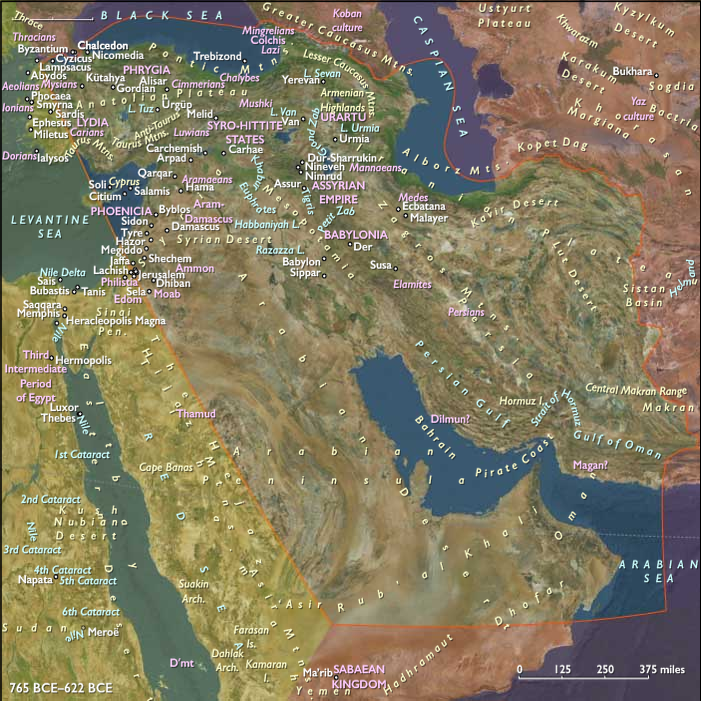
Tiglath-Pileser’s reign signals the rebirth of the Assyrian Empire, marked by decisive military campaigns. In 743 BCE, Assyrian forces deliver significant blows against the powerful kingdom of Urartu, reclaiming lost territories and rolling back Urartian advances that had threatened Assyria's northern frontier. Tiglath-Pileser decisively secures Assyrian interests in Syria and northern Mesopotamia, setting the stage for renewed expansion and control over vassal states.
Meanwhile, in southern Mesopotamia, Nabonassar establishes a new dynasty in Babylon in 747 BCE. Although initially gaining some autonomy during Assyria's internal chaos, Nabonassar’s Babylon soon falls under the renewed power of Assyria. Tiglath-Pileser reasserts Assyrian suzerainty over Babylon, allowing Nabonassar to rule as a vassal king. This arrangement stabilizes relations between Assyria and Babylonia, bringing a semblance of unity back to the broader Mesopotamian region.
Cultural Developments in Iran
During this era, significant cultural developments occur in northwestern Iran, particularly among the emerging Medes. Around 750 BCE, the Medes construct impressive architectural structures at Tappeh Nush-i Jan, near modern Malayer. Notably, a fire temple dating from this period remains partially intact, with walls rising to a height of twenty-six feet (eight meters), reflecting the region’s evolving religious and cultural practices.
Thus, from 753 to 742 BCE, Assyria experiences a remarkable recovery under the vigorous leadership of Tiglath-Pileser III, while regional powers such as Babylon and Media continue to shape the complex geopolitical and cultural landscape of the Middle East.
People
Groups
Topics
Subjects
Regions
Subregions
Years: 753BCE - 742BCE
People
Groups
Topics
Subjects
Regions
Subregions