
The Middle East: 741–730 BCE Assyrian …
Years: 741BCE - 730BCE
The Middle East: 741–730 BCE
Assyrian Dominance and Regional Subjugation
The period from 741 to 730 BCE witnesses Assyria firmly reasserting its imperial strength under the vigorous rule of Tiglath-Pileser III. Following his earlier restoration of internal stability, Tiglath-Pileser embarks on expansive military campaigns aimed at decisively subduing regional opposition and expanding Assyrian territory.
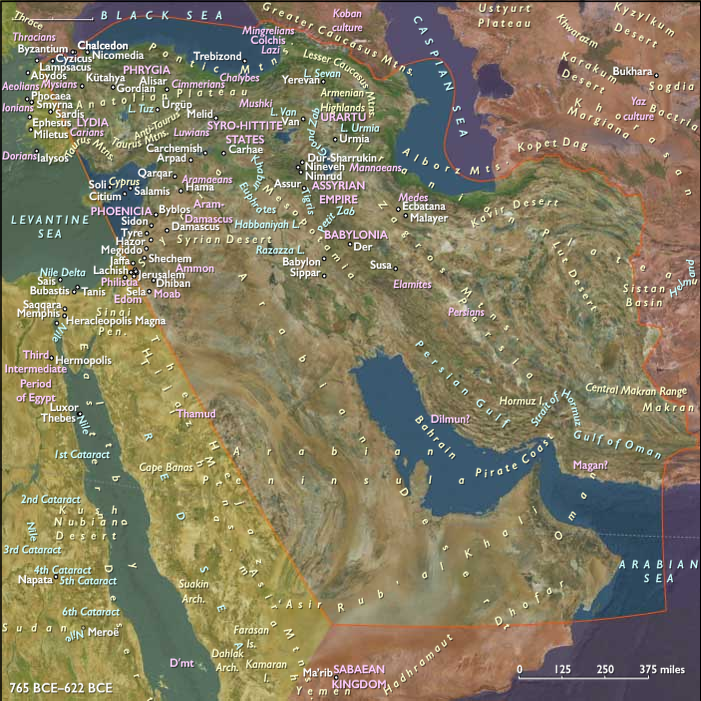
In 740 BCE, Tiglath-Pileser III captures the strategically important city of Arpad in northern Syria. This victory marks a pivotal moment, significantly weakening a northern Syrian coalition that had sought to resist Assyrian dominance. By 738 BCE, the relentless Assyrian king compels various Syrian princes and smaller states scattered throughout eastern Anatolia into submission, extracting heavy tribute and converting many of these vassal states into formal Assyrian provinces. This administrative reorganization reinforces Assyria’s direct control over crucial areas and trade routes, ensuring sustained economic and military dominance.
Meanwhile, Assyrian influence expands further into the southern Levant through alliances and military conquest. Between 735 and 732 BCE, Tiglath-Pileser allies with the kingdom of Judah, conducting extensive warfare across West Asia. These campaigns decisively weaken the kingdom of Israel, resulting in significant territorial losses for the Israelites. The culmination of Tiglath-Pileser’s western campaigns occurs in 732 BCE with the dramatic sack of Damascus, the once-prosperous capital of the Aramaean kingdom. He forcibly deports large populations from both Damascus and northern Israel, systematically breaking local resistance and reshaping the ethnic and political landscape of the region.
Extending Assyrian reach southward, Tiglath-Pileser also successfully forces the Arabian kingdoms into tributary relationships, securing additional wealth and establishing Assyria’s dominance far beyond its traditional Mesopotamian heartland.
Thus, by 730 BCE, Tiglath-Pileser III’s relentless military and administrative reforms have fully revived Assyrian power, firmly establishing it as the dominant force across the Middle East. This period significantly alters the geopolitical dynamics of the region, embedding Assyrian influence deeply into both western Syria and the southern Levant, and solidifying the empire’s legacy of expansion and ruthless governance.
People
Groups
- Babylon, Kingdom of
- Judah, Kingdom of
- Israel (Northern Kingdom of)
- Assyria, (New) Kingdom of (Neo-Assyrian Empire)
Topics
Subjects
Regions
Subregions
Years: 741BCE - 730BCE
People
Groups
- Babylon, Kingdom of
- Judah, Kingdom of
- Israel (Northern Kingdom of)
- Assyria, (New) Kingdom of (Neo-Assyrian Empire)
Topics
Subjects
Regions
Subregions