
The Middle East: 729–718 BCE Tiglath-Pileser …
Years: 729BCE - 718BCE
The Middle East: 729–718 BCE
Tiglath-Pileser III and the Height of Assyrian Expansion
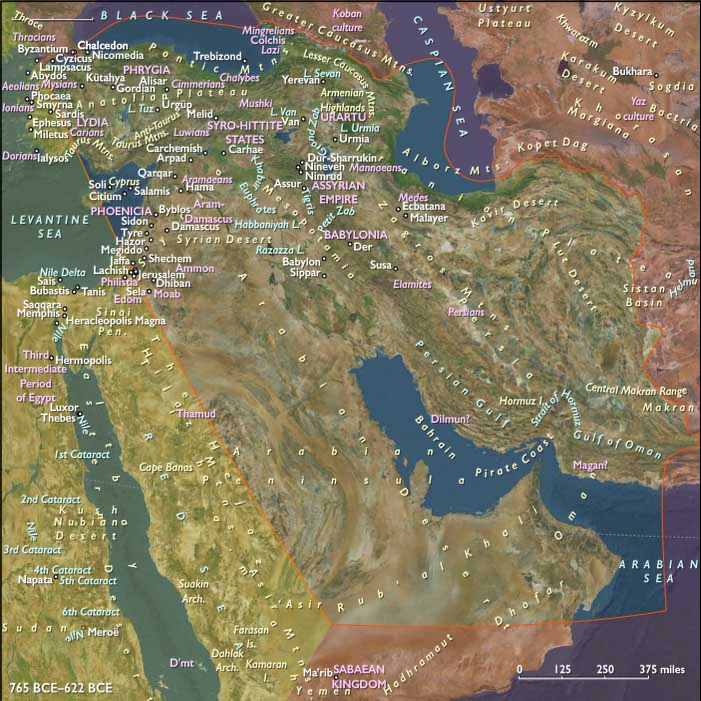
By 729 BCE, Tiglath-Pileser III has successfully ushered Assyria into its final and most expansive phase of imperial conquest, dominating vast regions across Syria, Palestine, and into Arabia. His military campaigns have decisively established Assyrian dominance, effectively laying the foundations of what is often called the Second Assyrian Empire.
To celebrate and immortalize his military triumphs, Tiglath-Pileser commissions elaborate bas-reliefs for his new royal residence at Nimrud (ancient Kalhu). These monumental sculptures vividly depict his victories, each inscribed with detailed annals narrating his campaigns, serving both as royal propaganda and as lasting testament to Assyrian power. (This palace, known as the "Central Palace," will later be dismantled by the Assyrian king Esarhaddon.)
Consolidation of Babylonia and Assyria
Facing increasing unrest from Babylonia, particularly threats from Chaldean tribes intent on rebellion, Tiglath-Pileser acts swiftly in 729 or 728 BCE. To neutralize these threats, he seizes direct control of the Babylonian throne, uniting Assyria and Babylonia into a single imperial domain. In Babylon, Tiglath-Pileser rules under his personal name, Pulu, as recorded in biblical sources (II Kings 15:19; I Chronicles 5:26). This political unification stabilizes the southern frontiers, but it also sets a critical precedent for future Assyrian policy toward Babylonia.
Transition to Shalmaneser V
Tiglath-Pileser III dies soon afterward, in 727 BCE, having irrevocably shaped Assyria's trajectory toward its ultimate zenith. His successor is Ululayu, believed to be his son, previously known as the governor of Zimirra in Phoenicia. Upon his accession, Ululayu assumes the royal name Shalmaneser V (rendered in Akkadian as Shulmanu-asharid, though the name Shalmaneser is familiar through biblical accounts). Shalmaneser V inherits an empire at its greatest extent, yet also faces the immense challenge of preserving the vast territories and complex administrative structure forged by his predecessor.
Thus, the period from 729 to 718 BCE marks a critical era of Assyrian history, defined by Tiglath-Pileser's final achievements and the subsequent challenges faced by Shalmaneser V in managing the sprawling empire.
People
Groups
Topics
Subjects
Regions
Subregions
Years: 729BCE - 718BCE
People
Groups
Topics
Subjects
Regions
Subregions