
The Middle East: 717–706 BCE Sargon …
Years: 717BCE - 706BCE
The Middle East: 717–706 BCE
Sargon II and the Imperial Capital of Dur Sharrukin
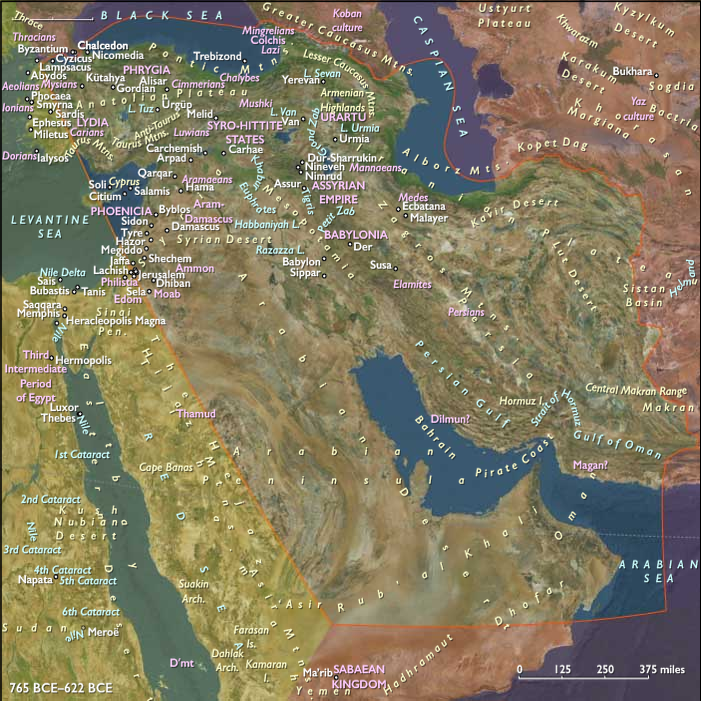
In 717 BCE, the Assyrian king Sargon II embarks upon an expansive series of military and political campaigns that reshape the Near Eastern geopolitical landscape. His conquests begin notably with the capture of the strategically critical Neo-Hittite city-state of Carchemish in the same year. Sargon continues these campaigns vigorously, and in 714 BCE, he launches a decisive expedition against the northern kingdom of Urartu, successfully defeating its forces and incorporating it firmly within the Assyrian imperial system. These victories strengthen Assyrian dominance in the north, securing its frontiers and further consolidating imperial control.
As a symbolic testament to his power and administrative vision, Sargon II constructs a meticulously planned new capital city named Dur Sharrukin ("Fortress of Sargon") in 713 BCE. Situated at the present-day site of Khorsabad, approximately twelve miles (twenty kilometers) northeast of Mosul, Iraq, the city exemplifies Assyrian imperial might and grandeur. Dur Sharrukin is encircled by thick, fortified walls punctuated by guard towers, with colossal human-headed winged bulls (lamassu) of carved stone guarding each of its seven monumental gateways.
At its heart, the upper citadel contains Sargon’s grand palace, adorned with rooms of varying sizes built around courtyards, richly decorated with sculpted bas-reliefs and vividly painted scenes portraying royal hunts, military triumphs, and ceremonial rites. Nearby stands a prominent ziggurat, its stepped structure constructed from vibrant, colored bricks. The lower citadel houses official residences, administrative buildings, and a temple dedicated to the god Nabu. By 710 BCE, Sargon formally relocates the Assyrian capital to this new city, marking a significant administrative and symbolic shift in the empire.
Conflict and Diplomacy with Phrygia under Midas (Mita)
Concurrent with Assyrian ascendancy, the powerful kingdom of Phrygia, centered at Gordium along the upper Sakarya River valley, expands its territorial and cultural influence across central and western Anatolia during the eighth century BCE. Under the reign of King Midas (known as Mita in Assyrian records), Phrygia achieves the height of its power. This historical Midas, who rules approximately from 720 BCE, presides over a prosperous kingdom renowned for its distinct "Polished Ware" pottery and the widespread use of a writing system derived from the Phoenician alphabet.
Phrygia maintains robust trade connections both eastward with Assyria and Urartu, and westward with the Greeks, with whom Midas fosters close diplomatic and cultural relationships—reputedly including marriage to an Aeolian Greek princess. Initially, tensions flare in 716 BCE when Midas foments rebellion against Assyrian rule in Cilicia. Sargon swiftly suppresses the uprising, yet by 709 BCE, Assyrian inscriptions indicate a diplomatic reconciliation, reflecting Phrygia’s pragmatic approach to coexistence with larger powers.
The Fall of Melid and Regional Instability
In the upper Euphrates region, the ancient Luwian Neo-Hittite kingdom of Melid (Kammanu) has thrived independently for several centuries from its capital along the Tohma River. Previously forced into tribute by Assyrian incursions as early as the eleventh century BCE under Tiglath-Pileser I, Melid manages to prosper until its decisive sack by Sargon II in 712 BCE. This destruction coincides with regional turmoil driven by invasions of Anatolia by nomadic groups such as the Cimmerians and Scythians, accelerating Melid’s decline and leading to widespread instability.
Babylonian Affairs and Chaldean Resistance
Further south, in Babylonia, Sargon confronts persistent resistance led by the Chaldean prince Marduk-apla-iddina II, ruler of Babylon. After prolonged conflict involving alliances between Marduk-apla-iddina and powers such as Elam, Aram, and Israel, Sargon finally drives him from power around 710 BCE. Rather than complete destruction, however, Sargon strategically allows the deposed monarch to retain leadership of his tribal base, ensuring some degree of stability and loyalty among the Chaldeans.
This period (717–706 BCE) thus marks a peak in Assyrian imperial strength and consolidation, exemplified by military conquests, administrative innovations, diplomatic maneuvers, and the construction of Dur Sharrukin—reflecting both the strategic brilliance and enduring legacy of Sargon II’s rule.
People
Groups
- Phrygia, Kingdom of
- Syro-Hittite states
- Babylon, Kingdom of
- Elam, (New) Kingdom of
- Cimmerians
- Assyria, (New) Kingdom of (Neo-Assyrian Empire)
- Urartu, Kingdom of
- Scythians, or Sakas
Topics
Subjects
Regions
Subregions
Years: 717BCE - 706BCE
People
Groups
- Phrygia, Kingdom of
- Syro-Hittite states
- Babylon, Kingdom of
- Elam, (New) Kingdom of
- Cimmerians
- Assyria, (New) Kingdom of (Neo-Assyrian Empire)
- Urartu, Kingdom of
- Scythians, or Sakas
Topics
Subjects
Regions
Subregions