
The Middle East: 705–694 BCE Sennacherib’s …
Years: 705BCE - 694BCE
The Middle East: 705–694 BCE
Sennacherib’s Ascension and Consolidation
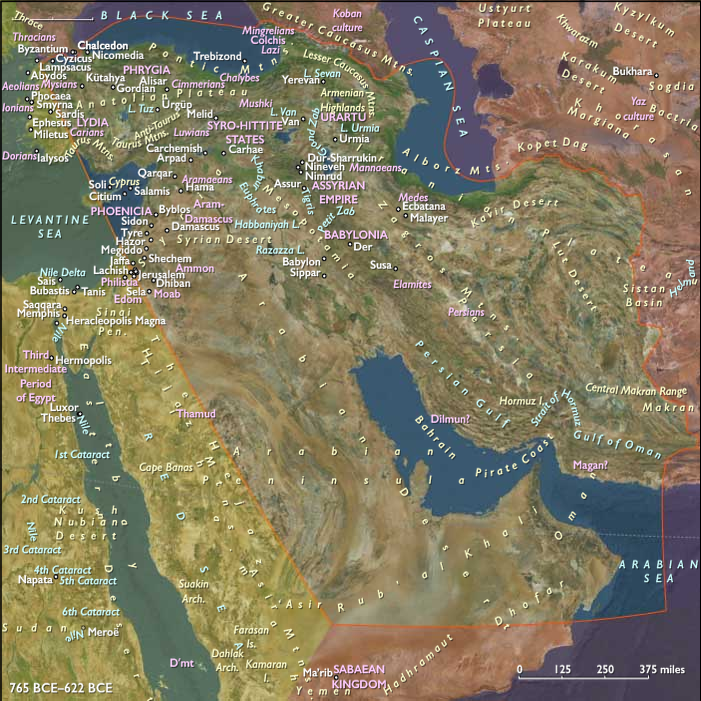
Following the sudden death of Sargon II in battle against the migrating Cimmerians in 705 BCE, his son Sennacherib ascends the Assyrian throne. Bringing extensive military and administrative expertise, Sennacherib inherits an expansive yet turbulent empire. He promptly relocates the imperial capital from Sargon’s unfinished fortress at Dur Sharrukin (Khorsabad) to the historically significant city of Nineveh, initiating a vast urban renewal project. Under his command, Nineveh is magnificently enlarged and reconstructed, becoming the symbolic and political center of Assyrian power.
Cimmerian Incursions and Phrygia’s Collapse
The Cimmerians, a nomadic people originally expelled from the Caucasus by the advancing Scythians, continue their relentless search for new territories in eastern Anatolia. Having been decisively repelled by Sargon II shortly before his death, they turn their attention westward. Between 696 and 695 BCE, they deliver a catastrophic blow to the wealthy and influential Phrygian kingdom, sacking and destroying its capital city, Gordium. According to the historian Herodotus, the Phrygian king Midas commits suicide rather than face capture or humiliation by these fierce invaders. From Phrygia, the Cimmerians carry their destructive raids into Lydia, sowing chaos before ultimately being pushed into Cappadocia by the encroaching Scythians.
Assyrian Military Power and Regional Unrest
Under Sennacherib’s reign, the Assyrian military—particularly its archers, renowned for their disciplined organization, powerful bows, and iron-tipped arrows—asserts dominance throughout the empire’s vast territories. However, shortly after taking power, Sennacherib confronts widespread rebellions. In the west, uprisings erupt throughout Syria and Palestine, demanding swift military response to restore Assyrian authority.
Renewed Babylonian Turmoil
In Babylonia, the Chaldean prince Marduk-apla-iddina II (also known as Merodach-Baladan), who had first seized Babylon’s throne in 721 BCE and was ousted by Sargon II around 710 BCE, returns from exile in Elam upon hearing of Sargon’s death. Successfully rallying support among discontented Babylonians, Marduk-apla-iddina reclaims the throne in 703 BCE, reigniting a persistent rebellion against Assyrian rule. His second reign is brief—lasting only nine months—before Sennacherib decisively defeats him near Kish. Escaping once more into exile in Elam, Marduk-apla-iddina dies shortly thereafter, around 701 BCE.
Nonetheless, Babylon remains restive. A significant rebellion breaks out again in 699 BCE, signaling enduring resistance against Assyrian dominance. Sennacherib is thus forced into continual military vigilance, as the empire simultaneously confronts external invasions and internal revolts.
This era (705–694 BCE) thus marks a period of notable transitions and turbulence in the Middle East, characterized by aggressive migratory pressures, destructive invasions, and the determined reassertion of Assyrian imperial authority under the vigilant leadership of Sennacherib.
People
Groups
- Phrygia, Kingdom of
- Babylon, Kingdom of
- Elam, (New) Kingdom of
- Cimmerians
- Assyria, (New) Kingdom of (Neo-Assyrian Empire)
- Scythians, or Sakas
Topics
Commodoties
Subjects
Regions
Subregions
Years: 705BCE - 694BCE
People
Groups
- Phrygia, Kingdom of
- Babylon, Kingdom of
- Elam, (New) Kingdom of
- Cimmerians
- Assyria, (New) Kingdom of (Neo-Assyrian Empire)
- Scythians, or Sakas
Topics
Commodoties
Subjects
Regions
Subregions