
The Middle East: 609–598 BCE Babylonian …
Years: 609BCE - 598BCE
The Middle East: 609–598 BCE
Babylonian Ascendancy and the Final Defeat of Assyria
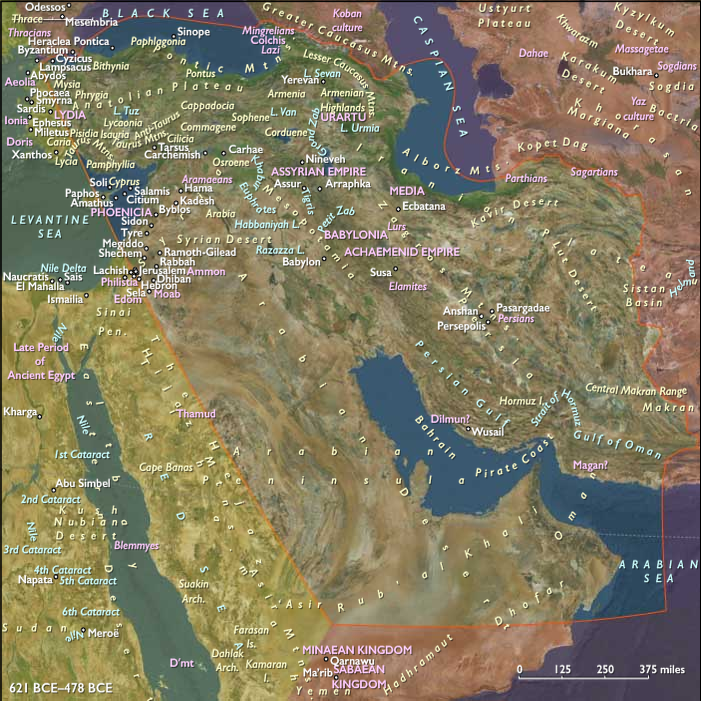
Following the dramatic collapse of Assyria in 610 BCE, the remnants of the Assyrian forces rally under their final ruler, Ashur-uballit II, in the city of Carchemish. In a desperate attempt to preserve Assyrian power, Ashur-uballit allies himself with the Egyptian pharaoh, Necho II, whose forces had previously secured a quick victory over the Kingdom of Judah at Megiddo. After capturing Kadesh on the Orontes, the Egyptians move northward to join their Assyrian allies.
Together, the Egyptian and Assyrian armies cross the Euphrates and besiege Harran, Ashur-uballit’s recently lost stronghold. The siege fails disastrously, forcing Necho’s army to retreat toward northern Syria. With this failure, Ashur-uballit disappears from historical records, marking the definitive end of the Assyrian Empire.
Nebuchadnezzar II and the Neo-Babylonian Empire
With Assyria's downfall imminent, the Babylonian king, Nabopolassar, delegates military command to his capable son, Nebuchadnezzar II (Nabu-kudur-usur). Nebuchadnezzar decisively engages the combined Egyptian-Assyrian forces at the Battle of Carchemish in 605 BCE, decisively defeating them and scattering their remnants. The Babylonians pursue the fleeing Egyptians, inflicting further losses at Hamath and decisively driving them out of Syria. This battle extinguishes the last significant Assyrian resistance, consolidating Babylonia’s dominance over the entire region.
Poised to extend his conquest into Egypt itself, Nebuchadnezzar halts abruptly upon learning of his father’s death, returning swiftly to Babylon to secure the throne. His accession initiates the height of the Neo-Babylonian Empire, characterized by extensive urban renewal, monumental architecture, and significant cultural advancements.
Cultural and Technological Developments
During this era, the Babylonians refine their scientific and mathematical knowledge, as evidenced by sophisticated cuneiform tablets from around 600 BCE. These tablets include complex multiplication, reciprocals, square roots, and algebraic tables, demonstrating advanced mathematical techniques. This expertise notably informs Babylonian astronomy, underscoring the deep integration of mathematics and science in Babylonian culture.
With Assyrian dominance gone, the language of the region also shifts. The Hieroglyphic Luwian script, previously recorded on official seals and monuments, disappears from the historical record, marking a significant linguistic and cultural transition.
Decline of Urartu and Emergence of Armenia
To the north, the powerful kingdom of Urartu, centered around Lake Van and the highlands of what is now eastern Turkey and Armenia, abruptly vanishes around 600 BCE. Historical records suggest that Urartu, significantly weakened by earlier Scythian and Median incursions, is either conquered or peacefully transformed by an emerging local Armenian dynasty, likely the early Orontid Dynasty. Greek and Armenian sources confirm that Armenian prince Paruyr Skayordi, allied with the Medes, plays a critical role in dismantling Assyrian power. These events ultimately give rise to an independent Armenian political identity that fills the vacuum left by Urartu’s disappearance.
Thus, the period from 609 to 598 BCE marks a decisive transition in Middle Eastern history, as the Neo-Babylonian Empire rises to prominence, Egyptian ambitions falter, Assyrian power fades completely, and new cultural identities begin to solidify.
People
Groups
- Medes
- Babylon, Kingdom of
- Judah, Kingdom of
- Assyria, (New) Kingdom of (Neo-Assyrian Empire)
- Persian people
- Urartu, Kingdom of
- Scythians, or Sakas
- Egypt (Ancient), Late Period of
- Neo-Babylonian, or Chaldean, Empire
- Medes, Kingdom of the
- Armenian people
Topics
Subjects
Regions
Subregions
Years: 609BCE - 598BCE
People
Groups
- Medes
- Babylon, Kingdom of
- Judah, Kingdom of
- Assyria, (New) Kingdom of (Neo-Assyrian Empire)
- Persian people
- Urartu, Kingdom of
- Scythians, or Sakas
- Egypt (Ancient), Late Period of
- Neo-Babylonian, or Chaldean, Empire
- Medes, Kingdom of the
- Armenian people
Topics
Subjects
Regions
Subregions