
The Middle East: 597–586 BCE Babylonian …
Years: 597BCE - 586BCE
The Middle East: 597–586 BCE
Babylonian Consolidation under Nebuchadnezzar II
During this critical decade, Nebuchadnezzar II decisively asserts Babylonian dominance throughout the territories once ruled by the Neo-Assyrian Empire, effectively reshaping the political landscape of western Asia. Through relentless military campaigns, he systematically suppresses resistance among smaller kingdoms and vassal states, solidifying Babylonian hegemony.
One of his most notable acts occurs in 587 BCE when he conquers the Hebrew Kingdom of Judah. After a prolonged siege, Jerusalem is captured, the Temple is destroyed, and many of Judah’s leaders, intellectual elite, and skilled artisans are forcibly relocated to Babylon. Despite the harshness of this displacement—known historically as the Babylonian Captivity—the surviving documents indicate that the exiled Judahites are relatively well-treated, permitted to establish communities and practice their religion and traditions within Babylonia.
Median Empire under Cyaxares
In parallel to Babylonian expansion, Cyaxares, ruler of the Median Empire, has solidified his control over significant portions of the fallen Assyrian Empire. His territories now encompass western Iran, northern Mesopotamia, and parts of eastern Anatolia, forming a substantial rival empire to that of Babylonia. From his capital at Ecbatana (modern-day Hamadan), Cyaxares governs a diverse and expansive realm, bringing stability and promoting trade and cultural interactions throughout his domains.
Thus, the period from 597 to 586 BCE sees the consolidation of two dominant powers—Babylonia and Media—who divide and administer the vast territories of the former Assyrian Empire, setting the geopolitical stage for future conflicts and alliances.
People
Groups
Topics
Subjects
Regions
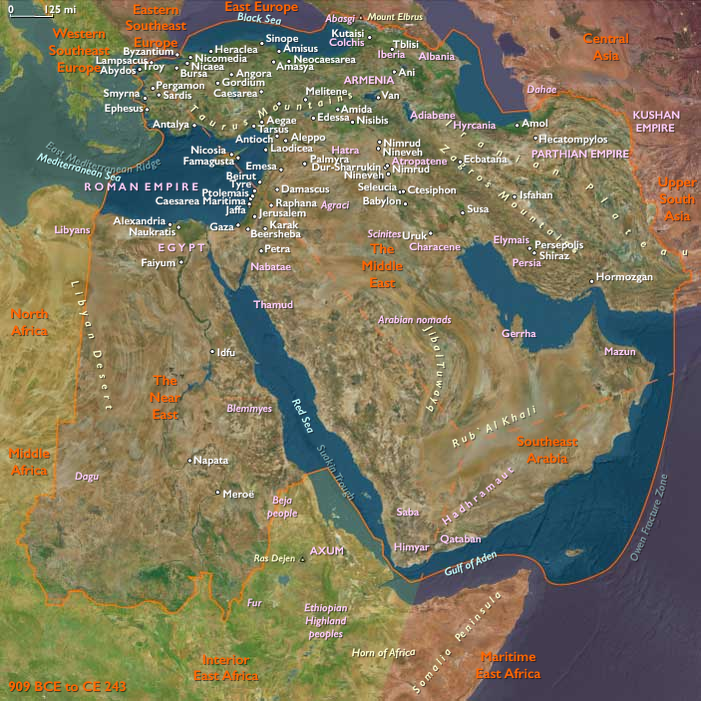
Subregions
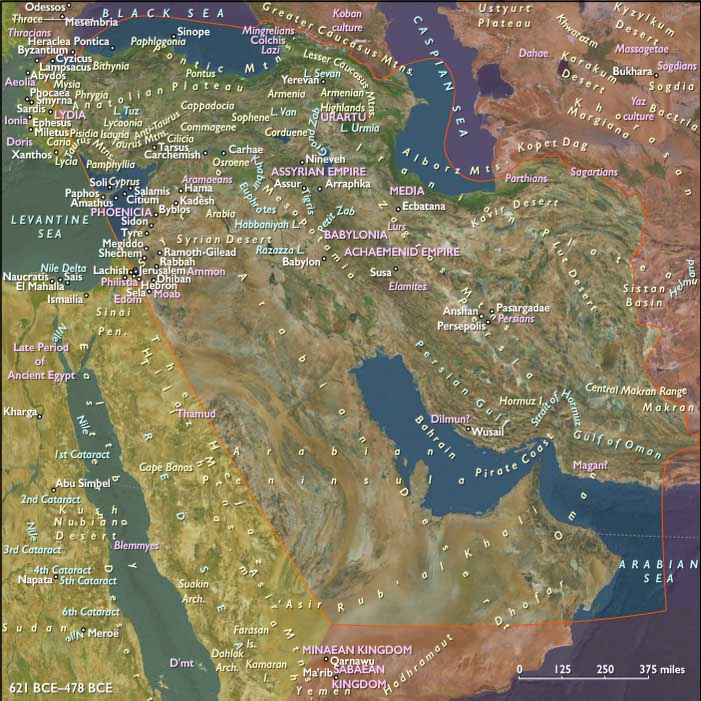
Years: 597BCE - 586BCE
People
Groups
Topics
Subjects
Regions
Subregions