
The Middle East: 573–562 BCE Nebuchadnezzar’s …
Years: 573BCE - 562BCE
The Middle East: 573–562 BCE
Nebuchadnezzar’s Final Campaigns and Legacy
Following the destruction of Jerusalem and the Judahite exile of 586 BCE, the dispersed community begins emphasizing religious rituals and laws to preserve their identity outside their homeland. Practices such as circumcision, Sabbath observance, dietary restrictions, and cleanliness laws become vital for maintaining cohesion among the scattered Judahites.
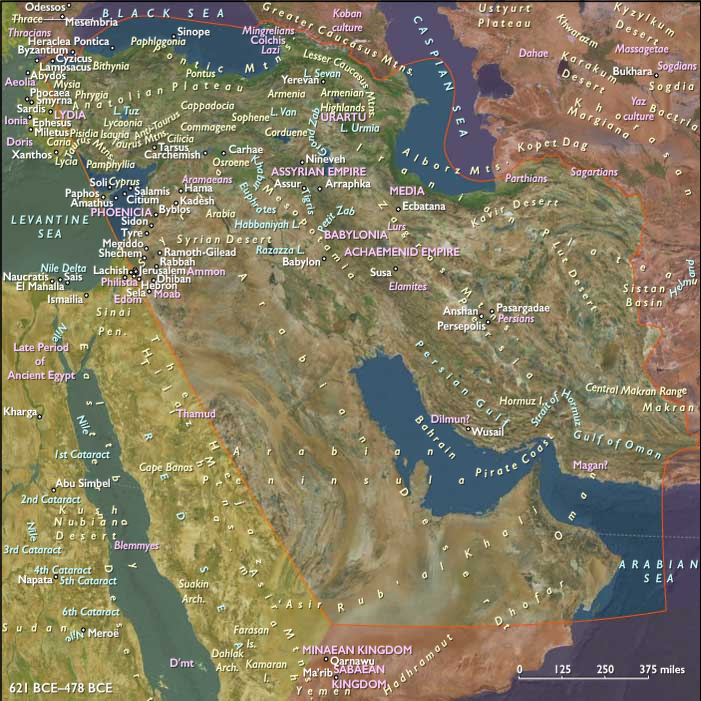
After concluding a prolonged thirteen-year siege of Tyre (585–572 BCE) in a negotiated compromise, Nebuchadnezzar II turns his attention toward Egypt. A cuneiform tablet records Nebuchadnezzar’s campaign against Pharaoh Amasis, although the outcome appears indecisive.
The Architectural Grandeur of Babylon
In the twilight of his reign, Nebuchadnezzar focuses extensively on the architectural revival of Babylon. His construction projects are monumental and lavish, including temples, canals, reservoirs, aqueducts, and a remarkable triple line of defensive walls. He also restores Sippar’s Lake and builds a strategic port on the Persian Gulf, significantly enhancing Babylon’s infrastructure and defenses.
Notable among his grand constructions is the legendary Ishtar Gate, which, along with various trophies of war, adorns Babylon. The famed Hanging Gardens, built for his Median queen Amytis, stand as a testament to the opulence of Nebuchadnezzar's Babylon, designed specifically to evoke the lush landscapes of her Median homeland.
Prophecy and Historical Literature
This period witnesses the flourishing of Hebrew prophetic literature. The prophet Jeremiah, residing near Jerusalem, continues to advocate moral reform, repentance, and a profound renewal of spiritual commitment amid ongoing crises. His introspective and deeply spiritual "confessions" influence significantly the Hebrew scriptures. During these years, a significant portion of the Deuteronomistic History, including the narrative found in the Book of Kings, is likely finalized, embedding Jeremiah’s theological perspectives into the historical narrative of Israel and Judah.
Diplomatic Realignments in Media and Lydia
Following the Battle of Halys and the subsequent peace treaty mediated by Babylon and Cilicia, Astyages ascends the Median throne in 585 BCE. His reign solidifies Median dominance in the Iranian plateau, including Persian territories. To reinforce political stability, Astyages arranges the marriage of his daughter Mandane to Cambyses I, a Persian noble from the kingdom of Anshan. Cambyses, known for his peaceful and diplomatic demeanor, strengthens Median-Persian ties significantly.
Thus, the era from 573 to 562 BCE consolidates significant religious, cultural, and political developments, marking the apex of Nebuchadnezzar’s architectural legacy and signaling pivotal shifts in the geopolitical and religious landscapes of the Middle East.
People
Groups
- Medes
- Judah, Kingdom of
- Persian people
- Anshan, Kingdom of
- Neo-Babylonian, or Chaldean, Empire
- Medes, Kingdom of the
Subjects
Regions
Subregions
Years: 573BCE - 562BCE
People
Groups
- Medes
- Judah, Kingdom of
- Persian people
- Anshan, Kingdom of
- Neo-Babylonian, or Chaldean, Empire
- Medes, Kingdom of the
Subjects
Regions
Subregions