
The Middle East: 580–591 CE The …
Years: 580 - 591
The Middle East: 580–591 CE
The Byzantine–Sassanian War and Cultural Developments
Prolonged Imperial Conflict
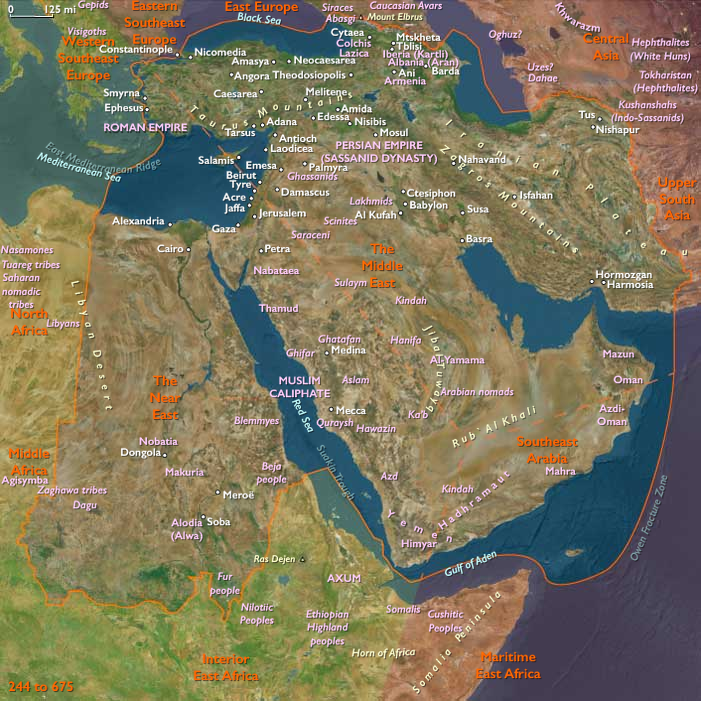
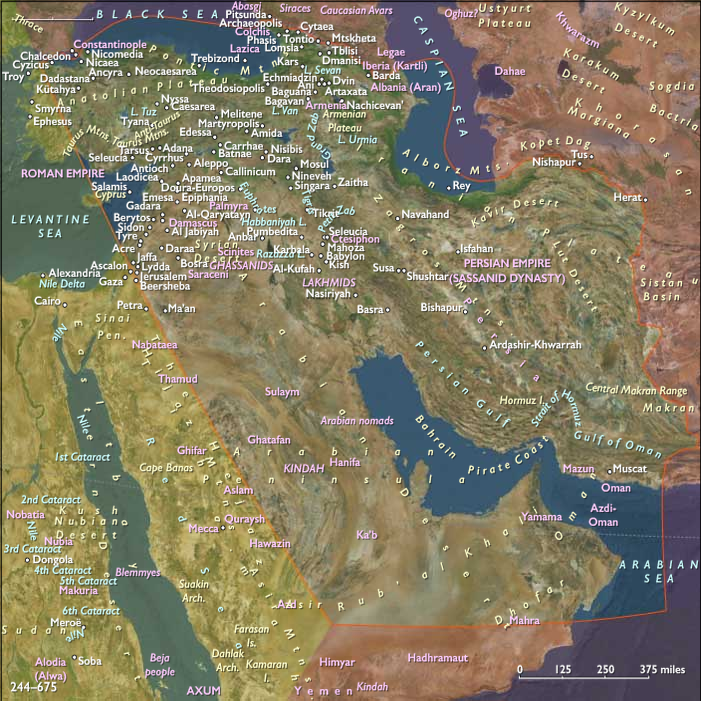
From 580 to 591 CE, the conflict between the Eastern Roman Empire (Byzantine Empire) and the Sassanian Empire of Persia, known as the Byzantine–Sassanian War (572–591), continues with relentless intensity. This war forms part of a broader pattern of hostilities spanning the sixth and early seventh centuries, notable for battles largely confined to frontier regions including Mesopotamia, Greater Armenia, and Syria. Despite continuous military engagements, neither empire manages to sustain a decisive hold over territories deep within enemy lines, marking this era as the final stage of relatively restricted frontier warfare before wider-ranging conflicts emerge in the subsequent decades.
Treaty and Territorial Realignments
The long conflict culminates with the restoration of the Persian king Khosrau II to his throne in 591 CE. In return for the crucial support from Constantinople, Khosrau II cedes most of Persian-controlled Armenia and the western half of Caucasian Iberia to the Byzantines. This significant territorial realignment stabilizes the region temporarily, reestablishing spheres of influence that would profoundly shape subsequent political and military interactions.
Cultural Achievements Amid Turbulence
Remarkably, the period witnesses minimal artistic production due to sustained instability and warfare. Nevertheless, one significant cultural artifact survives: the Rabula Gospels, an illuminated manuscript completed in 586 CE at Zagba in Syria. Distinguished by its elaborate architectural and floral motifs, the manuscript exemplifies a vibrant yet sketchy, informal style characteristic of early Byzantine illuminated manuscripts—rare survivors of this turbulent era.
Ghassanid Influence and Cultural Patronage
Amidst imperial conflicts, the Ghassanids, Arab allies of Constantinople, continue to prosper culturally and economically. They engage in substantial religious and public construction and actively patronize poets such as Nabighah adh-Dhubyani and Hassan ibn Thabit. Nonetheless, their Monophysite beliefs draw suspicion from orthodox Byzantine leaders, resulting in reduced autonomy and direct imperial intervention. This cultural and religious friction underscores the complex interplay of local autonomy and imperial control characteristic of the region during this transformative period.
People
Groups
- Mesopotamia (Roman province)
- Persian Empire, Sassanid, or Sasanid
- Syria Prima (Roman province)
- Syria Secunda (Roman province)
- Armenia, or Persarmenia, (Persian vassal) Marzabanate of
- Christians, Miaphysite (Oriental Orthodox)
- Christianity, Chalcedonian
- Ghassan, Kingdom of
- Roman Empire, Eastern: Justinian dynasty
- Armenia, (Roman vassal) Principality of
Topics
Subjects
Regions
Subregions
Related Events
Showing 10 events out of 57370 total
Years: 580 - 591
People
Groups
- Mesopotamia (Roman province)
- Persian Empire, Sassanid, or Sasanid
- Syria Prima (Roman province)
- Syria Secunda (Roman province)
- Armenia, or Persarmenia, (Persian vassal) Marzabanate of
- Christians, Miaphysite (Oriental Orthodox)
- Christianity, Chalcedonian
- Ghassan, Kingdom of
- Roman Empire, Eastern: Justinian dynasty
- Armenia, (Roman vassal) Principality of
Topics
Subjects
Regions
Subregions