
The Middle East (5517–5374 BCE): Foundations of …
Years: 5517BCE - 5374BCE
The Middle East (5517–5374 BCE): Foundations of Urban Civilization at Eridu
Ecological Confluence and the Origins of Eridu
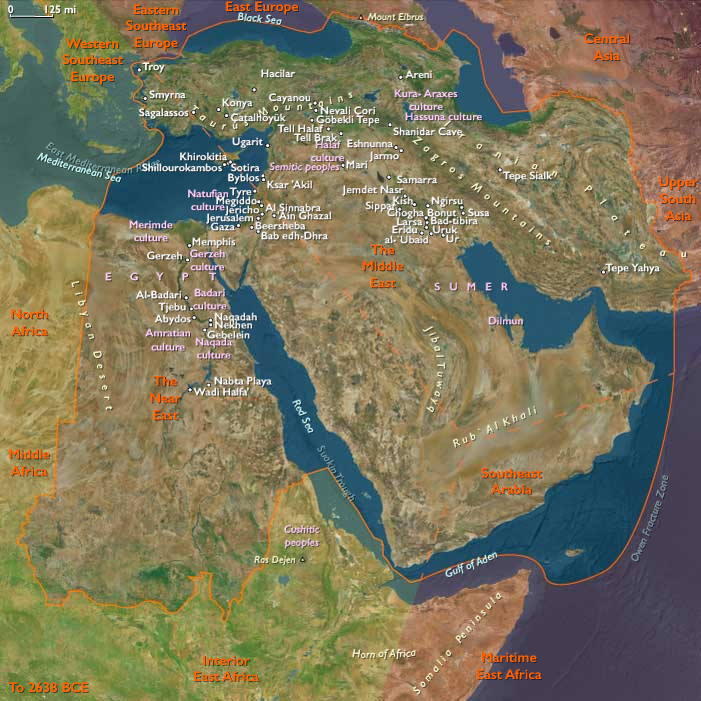
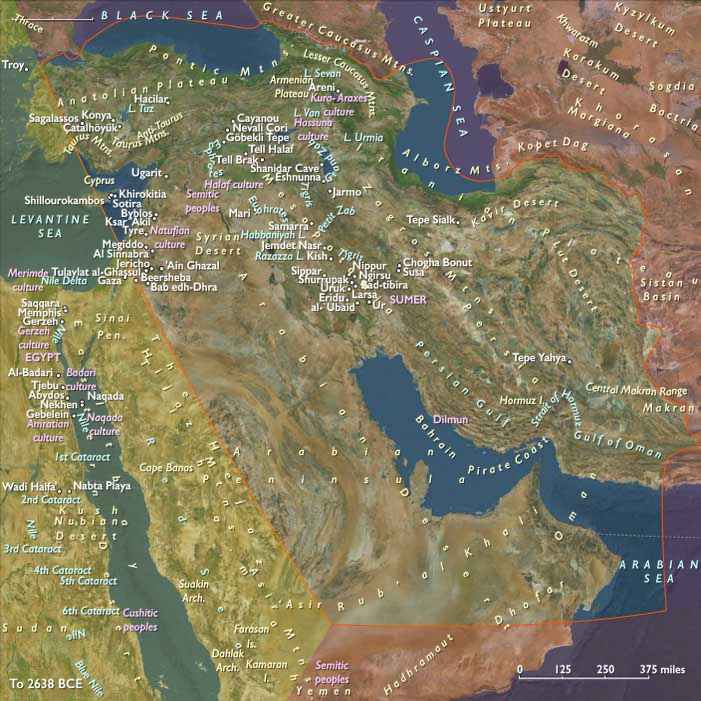
Between 5517 and 5374 BCE, the city of Eridu emerged at the confluence of three distinct ecosystems. According to scholar Gwendolyn Leick, these environments supported varied lifestyles, each agreeing upon mutual access to essential freshwater resources within a desert landscape. Founded approximately in 5400 BCE, Eridu (modern Abu Shahrain, roughly 315 kilometers southeast of Baghdad, Iraq) represented the earliest known settlement in the lower Tigris-Euphrates Valley, known as Mesopotamia, the "Land Between the Rivers."
Agricultural Practices and Early Urban Infrastructure
The earliest agrarian communities around Eridu practiced intensive subsistence irrigation agriculture, derived from the northern Samarra culture, characterized by canals and mud-brick structures. Settlers moved into previously unoccupied marshlands near the head of the Persian Gulf around the mid-fifth millennium BCE, gradually expanding northward along the lower Tigris-Euphrates Valley.
Multi-Cultural Origins of Eridu
Eridu was shaped by contributions from three distinct cultures:
-
Agrarian settlers who brought the Samarra culture from northern Mesopotamia, identified with the Ubaid period.
-
Nomadic Semitic pastoralists, herding sheep and goats in semi-desert conditions.
-
Fisher-hunter communities from the Arabian coast, possibly ancestral to the Sumerians, known for extensive middens and reed dwellings.
These cultural groups collaborated in building the early urban settlement, centered around a prominent temple complex of mud-brick construction in a natural depression, facilitating water accumulation.
Halaf Culture and Regional Trade
Concurrent with Eridu's development, the Halaf culture flourished in southern Mesopotamia, practicing dryland farming reliant on natural rainfall—methods comparable to those of modern Hopi agriculture in Arizona. Halaf communities cultivated emmer wheat, barley, and flax and maintained cattle, sheep, and goats. Although extensive excavations are rare, structures such as the circular domed tholoi at Tell Arpachiyah reveal ritual uses and domestic functions.
Halaf pottery, distinguished by polychrome geometric and animal motifs, was regionally influential, found across northern Mesopotamia, including sites such as Nineveh, Tepe Gawra, and Chagar Bazar. These communities also created figurines, stamp seals indicative of personal property concepts, and tools crafted from stone and clay, with occasional copper use for decorative purposes.
Fortifications and Urban Expansion
The settlement at Hacilar during the second half of the sixth millennium BCE featured fortified complexes and walled settlements, underscoring growing concerns for security and communal organization.
This era signifies crucial developments in urban planning, agricultural practices, multi-cultural integration, and technological advancements, setting significant precedents for urban civilization in the ancient Middle East.
Topics
Commodoties
Subjects
- Architecture
- Painting and Drawing
- Environment
- Decorative arts
- Faith
- Government
- Custom and Law
- Technology
- Metallurgy
Regions
Subregions
Related Events
Showing 4 events out of 4 total
Years: 5517BCE - 5374BCE
Topics
Commodoties
Subjects
- Architecture
- Painting and Drawing
- Environment
- Decorative arts
- Faith
- Government
- Custom and Law
- Technology
- Metallurgy
Regions
Subregions