
The Middle East: 537–526 BCE Consolidation …
Years: 537BCE - 526BCE
The Middle East: 537–526 BCE
Consolidation of the Persian Empire
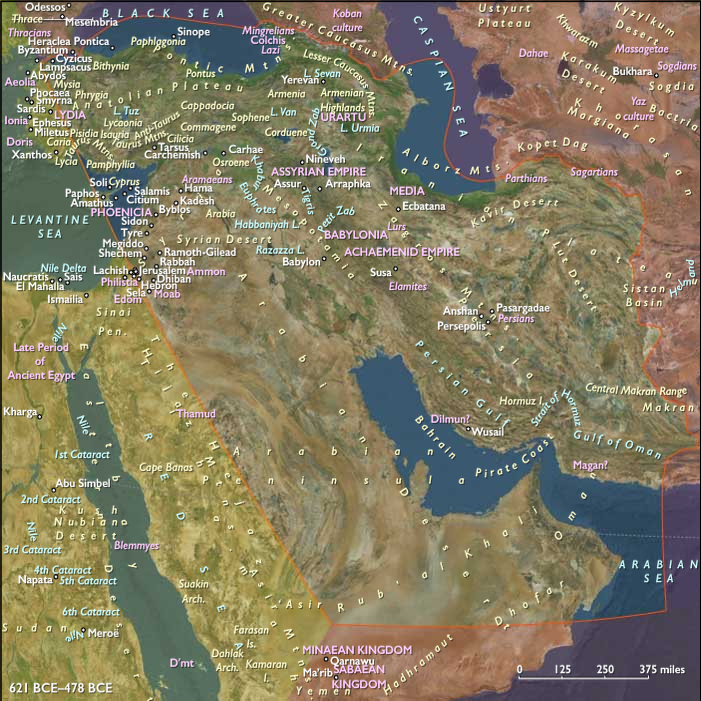
By 537 BCE, Cyrus the Great has vastly expanded the Achaemenid Persian Empire, encompassing territories stretching from the Mediterranean Sea to the northwestern frontiers of India. Following his conquest of Babylonia, Cyrus integrates former Babylonian territories, including Syria, Judah, and parts of Arabia Petraea. His policies toward conquered peoples are relatively tolerant; notably, Cyrus permits the Judahites—who had been exiled to Babylon nearly half a century earlier—to return to their homeland and rebuild their temple in Jerusalem. However, a majority of Judahites choose to remain in the Diaspora, particularly in Babylon, which emerges as a significant center of Jewish cultural and religious life for centuries.
Cultural Influence and Innovations
Under Persian rule, cultural and economic connections flourish across the empire. On Cyprus, the artistic influence of Ionia becomes pronounced during the late Archaic Period, reflected in significant developments such as the introduction of coinage. The first Cypriot coins appear under King Euelthon of Salamis around 560–525 BCE, signaling the island’s growing economic complexity and interaction with broader Mediterranean trade networks.
Transition of Power to Cambyses II
The era witnesses the death of Cyrus the Great in 529 BCE, who is succeeded by his eldest son, Cambyses II. Prior to his death in battle during a campaign in Central Asia, Cyrus had initiated ambitious architectural projects at Pasargadae, which include grand palaces, audience halls, and his tomb—a limestone mausoleum resembling a gabled wooden house atop a stepped plinth. Cambyses continues his father’s expansive policies, maintaining the vast territories and administrative structures established by Cyrus.
This era (537–526 BCE) thus represents a critical period of consolidation and cultural integration within the Persian Empire, setting the stage for further expansion and influence across the Near East.
People
Groups
Subjects
Regions
Subregions
Years: 537BCE - 526BCE
People
Groups
Subjects
Regions
Subregions