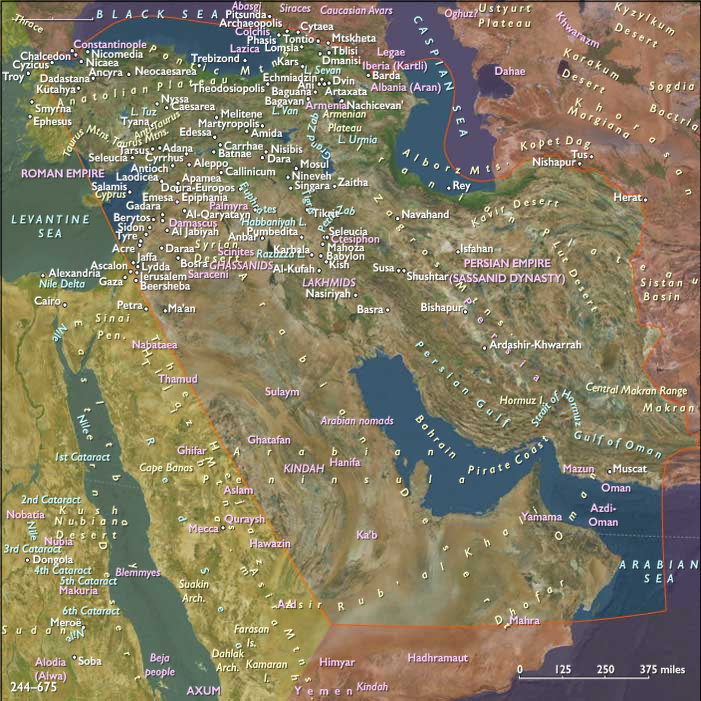
The Middle East: 556–567 CE Cultural …
Years: 556 - 567
The Middle East: 556–567 CE
Cultural Flourishing and Religious Influence
The Lakhmid Court and the Golden Age of al-Hirah
In the period 556 to 567 CE, the Lakhmid kingdom, a vassal state of the Sassanid Persian Empire, experiences a significant cultural and literary renaissance under the reign of 'Amr ibn Hind, son of Al-Mundhir III. A noted patron of Arabic poetry, 'Amr ibn Hind provides support and encouragement to celebrated poets such as Tarafa, whose works are associated with the esteemed poetic collection known as Al-Mu'allaqat ("The Suspended Odes").
Al-Hirah as a Center of Culture and Religion
Situated strategically on the caravan routes connecting Persia and the Arabian Peninsula, the city of al-Hirah thrives as an essential commercial and cultural hub during this era. The Lakhmids, renowned for their architectural endeavors, enrich the city with opulent palaces and fortifications. Tradition credits al-Hirah with playing a pivotal role in developing the Arabic script and influencing Arabic poetry profoundly.
Moreover, al-Hirah emerges as an influential religious center, notably housing a bishopric for Nestorian Christianity. This religious presence significantly impacts religious practices and spreads Christian monotheism into the heart of the Arabian Peninsula, fostering deeper religious and cultural integration.
Literary Influence and Poetic Rivalries
The Lakhmid court attracts some of the greatest poets of pre-Islamic Arabia, including luminaries like Tarafa and Al-Nabigha. Tarafa, after a tumultuous youth in Bahrain, arrives at 'Amr ibn Hind's court with his uncle Al-Mutalammis, also a poet. Although initially favored by the king's brother, Tarafa’s sharp wit eventually leads him into trouble. After ridiculing the king in his verses, Tarafa narrowly escapes execution during a journey orchestrated by 'Amr ibn Hind, marking an infamous incident in pre-Islamic Arabic literary history.
Thus, the years from 556 to 567 CE stand out as a vibrant period of cultural advancement, marked by artistic patronage, poetic genius, and religious influence, significantly enriching the historical tapestry of the Middle East.
Related Events
Showing 10 events out of 57561 total
Years: 556 - 567
People
Groups
- Arab people
- Lakhmid kingdom of al-Hira
- Christians, Eastern (Diophysite, or “Nestorian”) (Church of the East)
Subjects
Regions
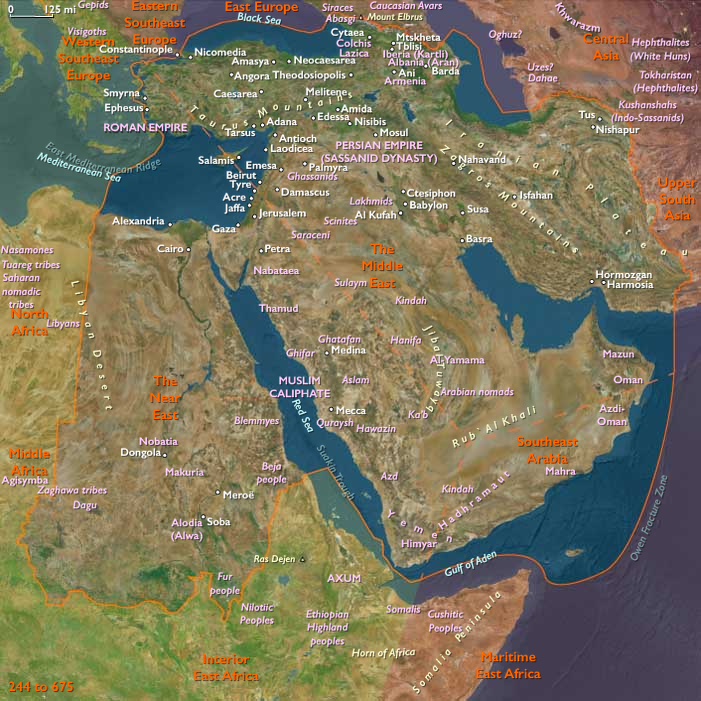
Subregions