
The Middle East: 676–819 CE Islamic …
Years: 676 - 819
The Middle East: 676–819 CE
Islamic Expansion, Cultural Integration, and Dynastic Transformations
Consolidation and Revolts under the Umayyads
Following the establishment of the Umayyad Caliphate (661–750) with its capital in Damascus, the region undergoes significant political and cultural transformations. Muawiyah, founder of the dynasty, cements Umayyad control through administrative reforms, military strength, and religious tolerance, particularly toward Christians. Damascus flourishes, becoming one of the great cities of the eighth century, a hub of Islamic governance, culture, and economic prosperity.
However, succession issues plague the Umayyad dynasty. The violent death of Husayn ibn Ali at the Battle of Karbala (680) creates a profound schism between Sunni and Shia Muslims, deeply influencing Islamic history. The martyrdom of Husayn solidifies Shia identity, with Karbala and the tomb of his father Ali at Najaf becoming central pilgrimage sites.
Sectarian Divisions and Ideological Movements
This era sees the rise of multiple Islamic sects, each interpreting leadership and theology distinctively. The Kharijites, initially rebels from Ali's army, promote strict doctrinal adherence and lead rebellions in Iraq and beyond, notably influencing movements such as the Azraqi Kharijites who rebel in 685. Meanwhile, the rise of the Paulicians in Armenia around 664 introduces a dualistic Christian sect influenced by Gnostic beliefs, opposing the established church and empire.
Abbasid Revolution and Cultural Renaissance
The growing dissatisfaction with Umayyad rule culminates in the Abbasid Revolution led by Abu Muslim, who captures Iraq in 747 and establishes the Abbasid Caliphate in 750 with its capital in Baghdad. The Abbasids, presenting themselves as divine-right rulers, usher in a new era of centralized administration, cultural flourishing, and intellectual expansion, significantly influenced by Persian traditions. The Abbasid caliphs, particularly under Harun ar-Rashid (786–809) and his son Al-Mamun (813–833), preside over a remarkable cultural renaissance, with Baghdad becoming a center for philosophical, scientific, and literary achievements.
Persian Influence and Cultural Integration
Under Abbasid rule, the integration of Persian administrative practices, such as the role of vizier and the bureaucratic institution of the divan, becomes foundational. Persian scholars profoundly impact Islamic sciences, literature, medicine, and philosophy, with Arabic becoming the language of administration in 696 but Persian remaining widely spoken. The Iranian populace, initially slow to adopt Islam, gradually integrates into the Islamic community by the ninth century, significantly contributing to Islamic intellectual traditions.
Regional Shifts and Continued Instability
Despite Abbasid centralization, regional unrest persists. Iraq remains restive under Umayyad and early Abbasid rule, with notable rebellions including the Alid Revolt (762–763), which emphasizes enduring sectarian divisions. Armenia, semi-autonomous under the Bagratid dynasty from 806, continues to serve as a crucial buffer state between Muslim and Byzantine spheres. In 813, Ashot I, a Bagratid prince, consolidates power in Georgia, initiating nearly a millennium of Bagratid rule there.
Religious Developments and Legal Schools
The formation of distinct Sunni legal schools—notably those founded by Malik ibn Anas, Abu Hanifa, Al-Shafi‘i, and Ahmad ibn Hanbal—begins in earnest, shaping Islamic jurisprudence. Shia communities, particularly the Twelve Imams tradition, consolidate around revered figures such as Imam Reza, whose tomb at Mashhad becomes a significant pilgrimage site.
Economic and Social Prosperity
The Abbasids promote extensive economic development, infrastructure projects, and social welfare initiatives. Caliph Al-Walid I (705–715) builds the first major hospital in Damascus, institutes quarantine practices for leprosy patients, and initiates public works including street lighting, irrigation, and welfare programs. The Persian Gulf region experiences prosperity linked to the economic success of Baghdad, revitalizing trade networks.
By 819, the Middle East stands transformed by the profound cultural synthesis of Arab, Persian, and local traditions. This dynamic fusion shapes a vibrant civilization whose influences reverberate across the Islamic world and beyond, laying a foundation for centuries of cultural, scientific, and political achievements.
People
- Abd Allah ibn Ibad al-Tamimi
- Abu Hanifa
- Ahmad ibn Hanbal
- Ali al-Ridha
- Ashot I of Iberia
- Hussein ibn Ali ibn Abi Talib
- Malik ibn Anas
- Yazid I
- al-Ma'mun
- al-Shafi‘i
Groups
- Iranian peoples
- Arab people
- Bedouin
- Iberia, Caucasian (Kartli, Kingdom of)
- Cyprus, Roman
- Muslims, Sunni
- Armenia, Ostikanate of
- Muslims, Kharijite
- Umayyad Caliphate (Damascus)
- Muslims, Shi'a
- Umayyad Caliphate (Harran)
- Abbasid Caliphate (Kufa)
- Abbasid Caliphate (Baghdad)
Topics
Subjects
Regions
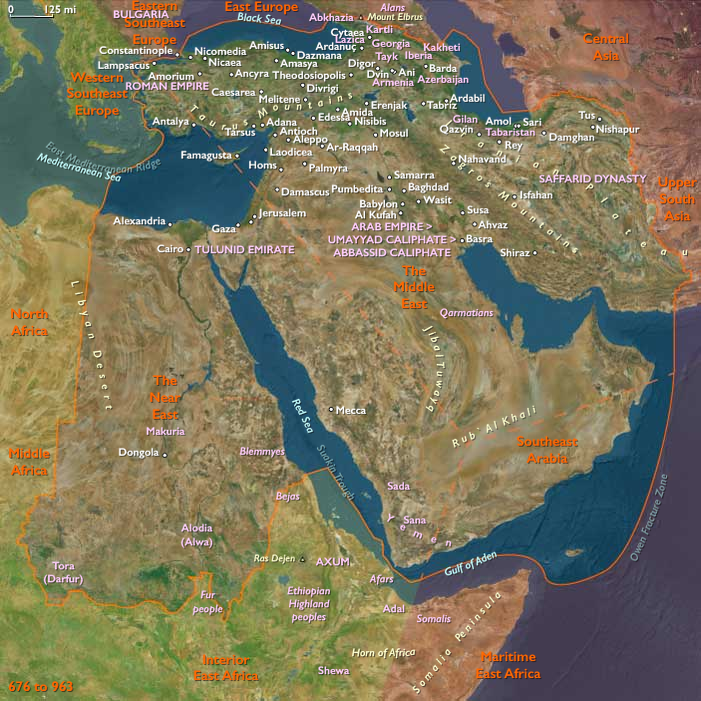
Subregions
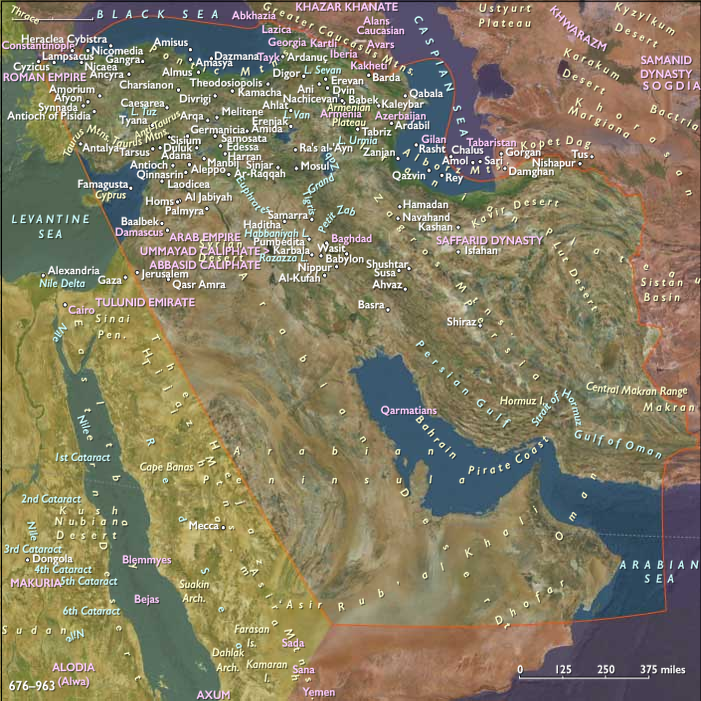
Related Events
Showing 10 events out of 56205 total
Years: 676 - 819
People
- Abd Allah ibn Ibad al-Tamimi
- Abu Hanifa
- Ahmad ibn Hanbal
- Ali al-Ridha
- Ashot I of Iberia
- Hussein ibn Ali ibn Abi Talib
- Malik ibn Anas
- Yazid I
- al-Ma'mun
- al-Shafi‘i
Groups
- Iranian peoples
- Arab people
- Bedouin
- Iberia, Caucasian (Kartli, Kingdom of)
- Cyprus, Roman
- Muslims, Sunni
- Armenia, Ostikanate of
- Muslims, Kharijite
- Umayyad Caliphate (Damascus)
- Muslims, Shi'a
- Umayyad Caliphate (Harran)
- Abbasid Caliphate (Kufa)
- Abbasid Caliphate (Baghdad)
Topics
Subjects
Regions
Subregions