
The Middle East: 388–531 CE Cultural …
Years: 388 - 531
The Middle East: 388–531 CE
Cultural Flourishing and Religious Transformation
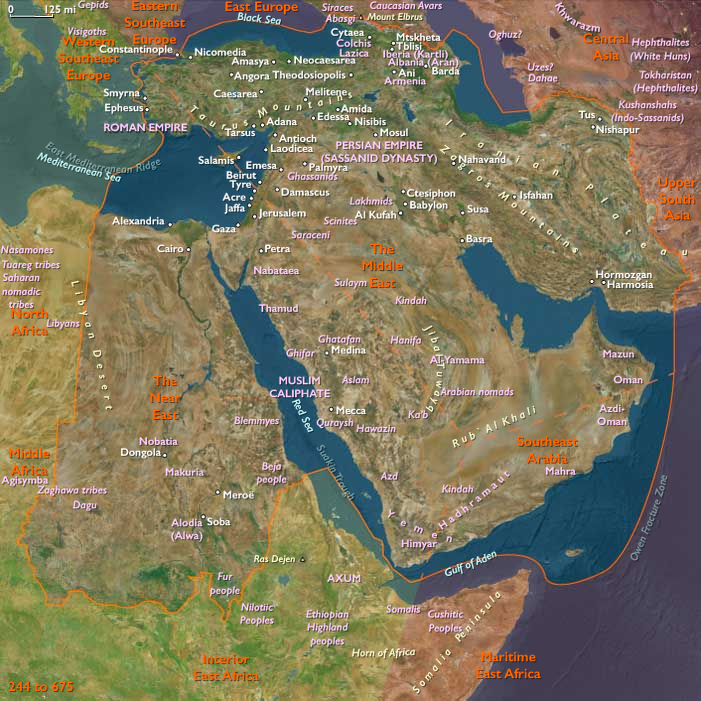
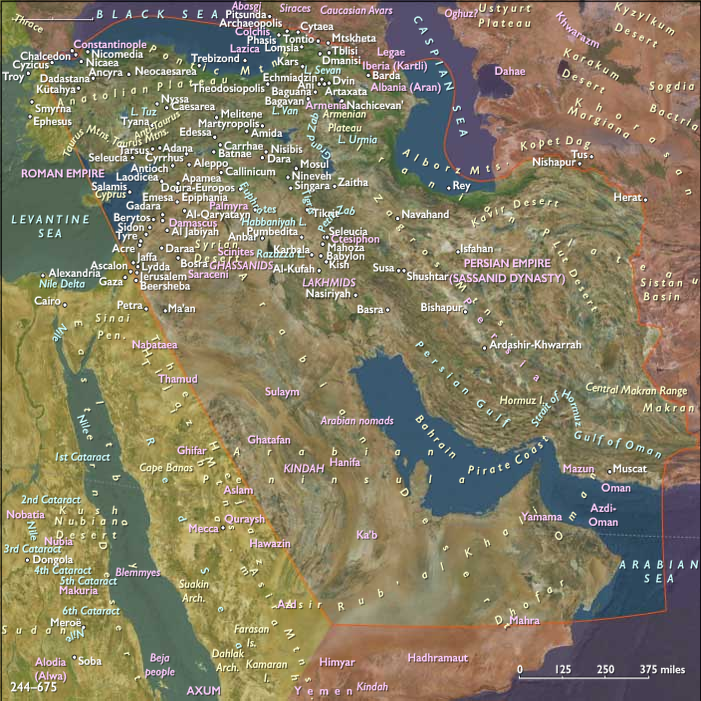
The period from 388 to 531 CE in the Middle East witnesses remarkable cultural achievements alongside profound religious transformations and persistent geopolitical tensions. In Armenia, the early fifth century is distinguished by the achievements of Saint Mesrop (Mashtots), who devises the Armenian alphabet. This cultural milestone facilitates the flourishing of religious and historical literature, significantly bolstering Christianity’s role in Armenian society. The ensuing two centuries, despite political instability, represent the first golden age of Armenian literature and religion.
Armenia's embrace of Christianity as its state religion, traditionally dated to 306 CE, precedes Emperor Constantine's Edict of Milan, symbolizing its pioneering role in the Christianization of the region. This conversion, attributed to the evangelism of Saint Gregory the Illuminator, further deepens Armenia's distinct religious and cultural identity.
Byzantine Administration and Syrian Prosperity
Throughout this era, Byzantine administrative reforms reshape regions such as Cyprus and Syria. Cyprus enjoys relative stability under Byzantine rule, marred only occasionally by theological disputes. Byzantine law codifies social structures, binding tenant farmers as serfs to their land, while administrative centralization ensures imperial control. The wealthy classes maintain privileges, yet the powerful Christian church occasionally advocates for the common people, curbing abuses by authorities. Cyprus witnesses notable prosperity, marked by extensive cathedral constructions during the fifth and sixth centuries, most notably the large basilica in Salamis (renamed Constantia).
Syria, divided by Byzantine governance into multiple administrative units, sees the emergence of two distinct provinces: Phoenicia Prima, with Tyre as its capital, and Phoenicia Secunda, administered from Damascus. The Ghassanids, a prominent Christian Arab dynasty allied to Byzantium, rise to local power, shaping Syrian identity for generations.
Sassanid Persia and Zoroastrian Revival
The Sassanid Empire under rulers like Shapur II and Bahram V exemplifies Persian strength and cultural vitality. Embracing a vigorous national and religious renaissance, the Sassanians revive ancient Iranian traditions, asserting Persian identity against Hellenistic influence. The Zoroastrian priesthood ascends to unprecedented political prominence, with the mobadan mobad (chief priest) emerging as a key figure alongside military and bureaucratic leaders.
Persian society under the Sassanians remains highly stratified, divided among priests, warriors, secretaries, and commoners. The Sassanians’ centralization and agricultural advancements significantly enhance Persia's economic resilience. Cultural activities flourish, particularly in music, with instruments like the lute, mouth organ, and trumpet becoming emblematic of the period.
Persistent Roman–Persian Rivalries
Roman–Persian conflicts recur throughout this era, punctuated by brief periods of uneasy peace. The Iberian War (526–532 CE) exemplifies these tensions, ending in the Treaty of Eternal Peace, which sees Rome paying an annual tribute of gold to Persia while gaining Lazica in exchange for relinquishing Iberia. Additionally, severe natural disasters, notably the catastrophic 526 Antioch earthquake, severely impact the Eastern Roman Empire, killing approximately 250,000 people and devastating the regional infrastructure, including the crucial port of Seleucia Pieria.
Religious Developments and Judaism
Christianity's spread throughout the region reaches Yemen, the Horn of Africa, and Persian borders, profoundly influencing local societies. Concurrently, Jewish communities in Babylonia and Palestine contribute significantly to religious scholarship. Ravina II completes the Babylonian Talmud (Talmud Babli) in 475, solidifying a text central to Jewish law and life.
Thus, from 388 to 531 CE, the Middle East undergoes critical cultural expansions, religious evolutions, and geopolitical upheavals. Despite intermittent disasters and conflicts, the era stands out for its remarkable intellectual, religious, and administrative achievements, significantly shaping subsequent historical trajectories.
People
Groups
- Zoroastrians
- Babylonia, Classical
- Jews
- Iberia, Caucasian (Kartli, Kingdom of)
- Phoenice (Roman province)
- Mesopotamia (Roman province)
- Persian Empire, Sassanid, or Sasanid
- Christians, Armenian Apostolic Orthodox
- Christianity, Nicene
- Roman Empire: Theodosian dynasty (Constantinople)
- Phoenice Lebanensis (Roman province)
- Phoenice (Roman province)
- Christianity, Chalcedonian
- Roman Empire, Eastern: Leonid dynasty
- Roman Empire, Eastern: Justinian dynasty
Topics
Commodoties
Subjects
Regions
Subregions
Years: 388 - 531
People
Groups
- Zoroastrians
- Babylonia, Classical
- Jews
- Iberia, Caucasian (Kartli, Kingdom of)
- Phoenice (Roman province)
- Mesopotamia (Roman province)
- Persian Empire, Sassanid, or Sasanid
- Christians, Armenian Apostolic Orthodox
- Christianity, Nicene
- Roman Empire: Theodosian dynasty (Constantinople)
- Phoenice Lebanensis (Roman province)
- Phoenice (Roman province)
- Christianity, Chalcedonian
- Roman Empire, Eastern: Leonid dynasty
- Roman Empire, Eastern: Justinian dynasty
Topics
Commodoties
Subjects
Regions
Subregions