
The Middle East: 100–243 CE Roman–Parthian …
Years: 100 - 243
The Middle East: 100–243 CE
Roman–Parthian Rivalries and Cultural Transformations
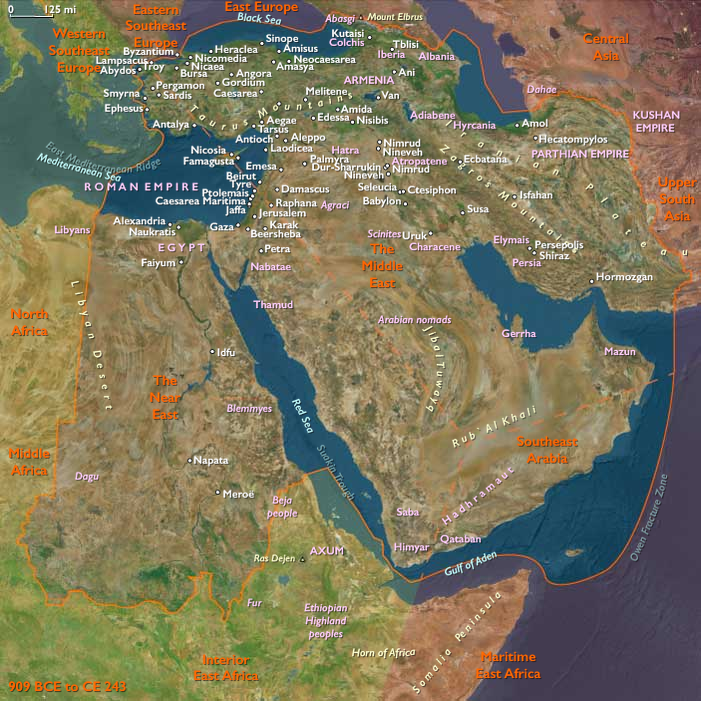
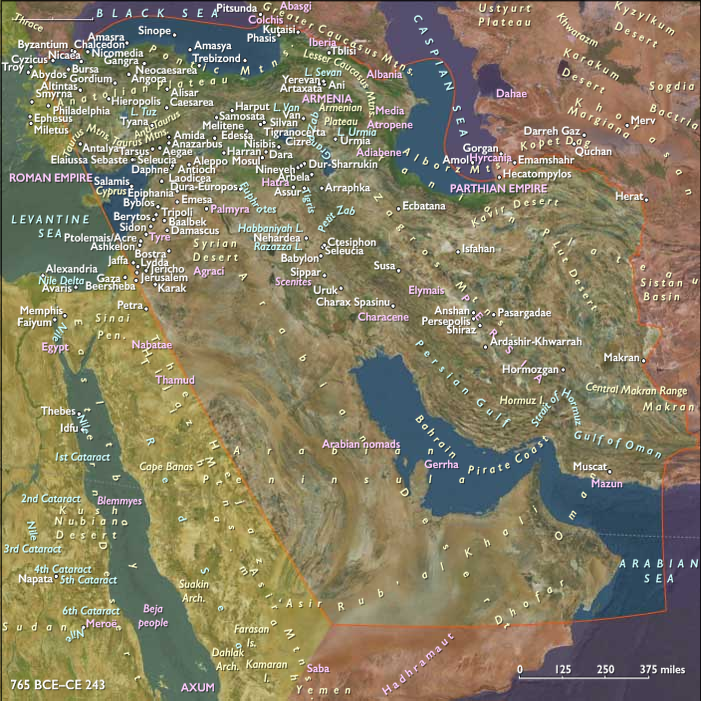
The period from 100 to 243 CE in the Middle East is marked by recurrent conflicts between the Roman Empire and its Iranian counterparts—the Parthians and later, the Sassanids. Emperor Trajan (98–117) significantly expands the Roman Empire's territory in the East, notably annexing regions of Mesopotamia during his campaigns against the Parthian Empire. Trajan’s conquests reach their zenith when he occupies cities such as Seleucia, Babylon, and Ctesiphon, briefly extending Roman control deep into Mesopotamia.
Under Emperor Hadrian (117–138), Syria experiences considerable prosperity, with thriving cities like Damascus, Palmyra (Tadmur), and Busra ash Sham in the fertile Hawran Plateau. Hadrian's systematic land survey establishes a tax system based on agricultural yields that will persist until modern times. Roman architecture enriches Syrian cities with grand buildings, aqueducts, wells, and roads, some of which remain in use to this day.
Religious and Cultural Developments
A significant religious development during this era is the arrival of Christianity in Cyprus. According to tradition, the Apostle Paul lands at Salamis in CE 45, accompanied by Barnabas, a native of Salamis. This marks the beginning of Christianity’s profound influence in the region. Under Roman rule, Cyprus experiences increased prosperity, bolstered by new roads, harbors, and public buildings. Although Paphos becomes the administrative capital, Salamis retains its cultural prominence until it is repeatedly devastated by earthquakes, never regaining its former magnificence.
The Montanist Movement
From 160 to 171 CE, the Middle East witnesses the rise of Montanism, a significant religious movement within Christianity originating in Phrygia. Founded by Montanus and supported by Maximilla and Priscilla (Prisca), Montanists preach an austere lifestyle, anticipating the imminent end of the world. They deny second marriages, question established church authority, and reject forgiveness for post-baptismal sins. The established Church strongly opposes Montanism, excommunicating its adherents, but the movement highlights broader internal tensions regarding spiritual authority and prophecy within early Christianity.
Roman–Parthian Conflicts and Armenian Influence
Throughout the second century, Armenia remains a critical buffer state between Rome and Parthia. In CE 53, under the Parthian king Tiridates, Armenia successfully asserts its autonomy from Roman influence. The Romans, under Emperor Nero, reconcile by officially recognizing Tiridates as king, effectively acknowledging Armenia as a joint client state—a precedent that shapes subsequent Roman–Iranian rivalries.
Roman Emperor Septimius Severus (193–211) conducts significant campaigns against the Parthians, briefly annexing northern Mesopotamia before peace is restored in 202. Later, in 216–217 CE, Emperor Caracalla unsuccessfully campaigns against Parthia, ending with Rome paying large war reparations.
The Rise of the Sassanid Empire
The Parthian Empire faces internal decline, culminating in its overthrow in 224 CE by Ardashir, a governor of the Achaemenian province of Fars. Establishing the Sassanid Empire, Ardashir renews Persian cultural traditions, emphasizing Iranian customs and Zoroastrianism, and reclaims territories once held by the Achaemenids. Ardashir invades Roman territories repeatedly, capturing several cities in Syria and Mesopotamia. Under his successor, Shapur I, Persian–Roman conflicts escalate until Roman victories in 243 CE restore control over contested cities like Carrhae and Nisibis.
Cultural and Demographic Transformations
Throughout this age, the population of Mesopotamia significantly increases due to the influx of Arabs, Iranians, and Aramaeans. Roman conquests in regions such as present-day Azerbaijan, referred to as Albania by the Romans, further reshape the demographic and cultural landscape. Armenia and Georgia, influenced by Greek, Roman, and Persian interactions, continue to be important cultural crossroads, fostering exchanges between Eastern and Western civilizations.
The Middle East from 100 to 243 CE thus stands as a period of intense military confrontation, religious and cultural evolution, and transformative demographic shifts, laying foundational structures for future regional dynamics.
People
Groups
- Cyprus, Archaic
- Iranian peoples
- Aramaeans
- Arab people
- Parthian Empire
- Armenia, Kingdom of Greater
- Cilicia et Cyprus (Roman province)
- Roman Empire (Rome): Nerva-Antonine dynasty
- Roman Empire (Rome): Severan dynasty
- Persian Empire, Sassanid, or Sasanid
- Roman Empire (Rome): Non-dynastic
Commodoties
- Gem materials
- Colorants
- Grains and produce
- Textiles
- Fibers
- Strategic metals
- Slaves
- Beer, wine, and spirits
- Fuels, lubricants and sealants
- Lumber
- Aroma compounds
Subjects
- Architecture
- Watercraft
- Decorative arts
- Conflict
- Government
- Metallurgy
- Medicine
- Mathematics
- Astronomy
Regions
Subregions
Related Events
Showing 10 events out of 61429 total
Years: 100 - 243
People
Groups
- Cyprus, Archaic
- Iranian peoples
- Aramaeans
- Arab people
- Parthian Empire
- Armenia, Kingdom of Greater
- Cilicia et Cyprus (Roman province)
- Roman Empire (Rome): Nerva-Antonine dynasty
- Roman Empire (Rome): Severan dynasty
- Persian Empire, Sassanid, or Sasanid
- Roman Empire (Rome): Non-dynastic
Commodoties
- Gem materials
- Colorants
- Grains and produce
- Textiles
- Fibers
- Strategic metals
- Slaves
- Beer, wine, and spirits
- Fuels, lubricants and sealants
- Lumber
- Aroma compounds
Subjects
- Architecture
- Watercraft
- Decorative arts
- Conflict
- Government
- Metallurgy
- Medicine
- Mathematics
- Astronomy
Regions
Subregions