
The Middle East (3933–3790 BCE): Urbanization, Metallurgy, …
Years: 3933BCE - 3790BCE
The Middle East (3933–3790 BCE): Urbanization, Metallurgy, and Cultural Transitions
Susa and the Uruk Period
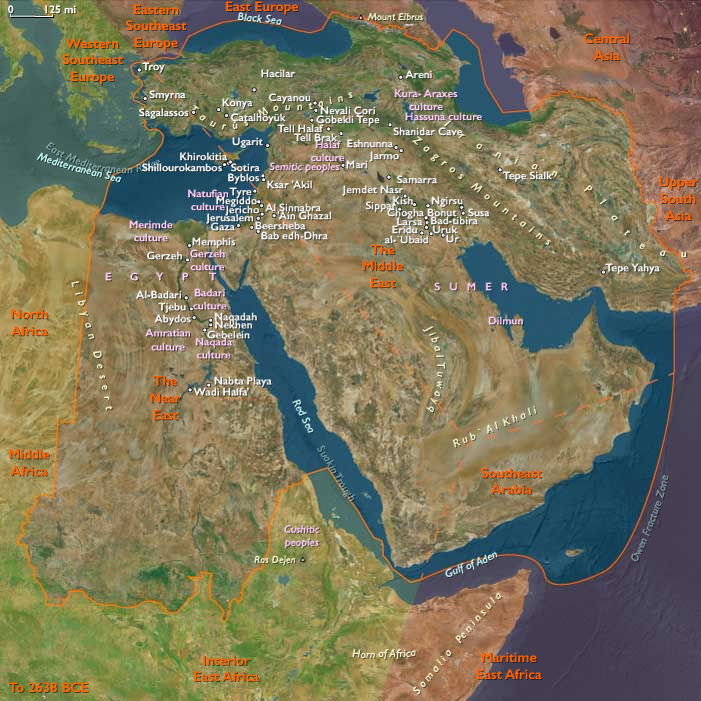
Between 3933 and 3790 BCE, the site of Susa in southwestern Iran became an important urban center during the Uruk period, specifically in its Susa I phase (4000–3700 BCE). Monumental architecture emerged during this era, exemplified by the construction of the "High Terrace," which would later expand substantially during the Susa II phase (3700–3100 BCE) to approximately sixty by forty-five meters. The remarkable artifacts discovered at Susa provide crucial insights into the administrative origins and early writing systems of the Uruk period.
Early Bronze Production
During this era, the earliest known bronze artifacts appeared on the Iranian plateau, notably at Tepe Yahya around 3800 BCE. This early bronze, likely resulting from accidental mixtures of copper with arsenic or antimony, represented a significant technological advancement. Known as "arsenical bronze," such alloys demonstrated superior properties compared to pure copper. While arsenic contamination was common in copper ores, the deliberate creation of arsenical bronze remains a subject of debate, although its presence clearly indicates the technological progression during this period.
Early Settlement at Ur
The city of Ur, at the time located near the mouth of the Euphrates on the Persian Gulf, provides evidence of early occupation dating back to the Ubaid period around 3800 BCE. Early excavations in the 1920s uncovered deep archaeological layers initially interpreted as evidence of the biblical Great Flood. Modern understanding, however, attributes these layers to regular flooding from the Euphrates and Tigris rivers, along with substantial erosion by water and wind. Ur would later flourish as an urban center during the third millennium BCE.
Uruk and Urban Hegemony
The city of Uruk, located east of the modern Euphrates riverbed near As-Samawah, Iraq, became the focal point of the Uruk period, a protohistoric era spanning from about 4000 to 3100 BCE. According to Sumerian mythology, Uruk was founded by Enmerkar, who established kingship and constructed the celebrated Eanna temple dedicated to the goddess Inanna. Around 3800 BCE, Uruk, along with Nippur, emerged as dominant urban centers of approximately twenty hectares each, asserting regional hegemony over surrounding smaller settlements.
Ubaid Art and Social Structure
The Mesopotamian sculpture of the late Ubaid period featured terra cotta statuettes of gods, men, and women. The culture, originating from southern Mesopotamia, maintained clear connections to earlier regional traditions. The Ubaid period notably saw the development of distinct social divisions between agricultural peasants, nomadic pastoralists, and hunter-fisher communities living in reed huts along the Arabian littoral.
Climatic Shifts and Cultural Decline in Arabia
The Arabian Peninsula experienced a significant climatic shift around 3800 BCE, marking the abrupt end of the Arabian Bifacial/Ubaid period in eastern Arabia and the Oman peninsula. The increased aridity, likely linked to the 5.9 kiloyear event at the end of the Older Peron, led to the cessation of semi-desert nomadism and the disappearance of human occupation for nearly a millennium, a period known as the "Dark Millennium."
Areni-1 Cave Discoveries in Armenia
Meanwhile, the cave site Areni-1 in Armenia revealed groundbreaking insights into Bronze Age civilization, showcasing an advanced winemaking enterprise, diverse pottery styles, and numerous Copper Age artifacts dating back approximately six thousand years. These discoveries, including the world’s oldest known winery and leather shoe, reflect sophisticated domestic and agricultural practices, highlighting the broad cultural advancements across the region during this period.
This epoch marks significant developments in urbanization, metallurgy, and sociocultural organization, profoundly shaping subsequent historical trajectories in the ancient Middle East.
Groups
- Ubaid culture
- Eridu, City-state of
- Sumer
- Nippur, city-state of
- Susa, City-state of
- Ur, city-state of
- Uruk, city-state of
Topics
Commodoties
- Weapons
- Hides and feathers
- Glass
- Domestic animals
- Grains and produce
- Ceramics
- Strategic metals
- Beer, wine, and spirits
Subjects
- Architecture
- Painting and Drawing
- Environment
- Decorative arts
- Faith
- Government
- Custom and Law
- Technology
- Metallurgy
Regions
Subregions

Related Events
Showing 10 events out of 28 total
Years: 3933BCE - 3790BCE
Groups
- Ubaid culture
- Eridu, City-state of
- Sumer
- Nippur, city-state of
- Susa, City-state of
- Ur, city-state of
- Uruk, city-state of
Topics
Commodoties
- Weapons
- Hides and feathers
- Glass
- Domestic animals
- Grains and produce
- Ceramics
- Strategic metals
- Beer, wine, and spirits
Subjects
- Architecture
- Painting and Drawing
- Environment
- Decorative arts
- Faith
- Government
- Custom and Law
- Technology
- Metallurgy
Regions
Subregions