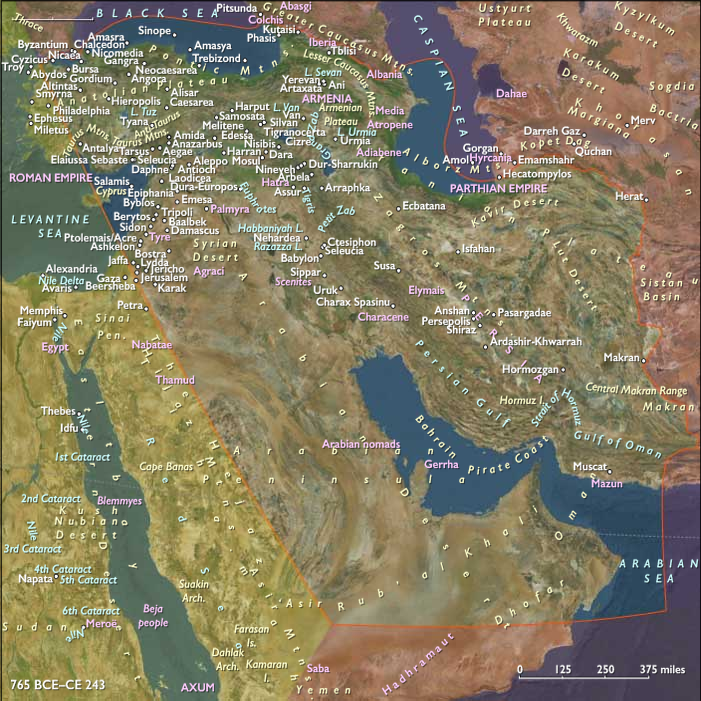
The Middle East: 345–334 BCE Persian …
Years: 345BCE - 334BCE
The Middle East: 345–334 BCE
Persian Decline and the Rise of Alexander the Great
The era from 345 to 334 BCE marks the final years of Persian authority under Artaxerxes III Ochus and his successors, a period characterized by internal instability, palace intrigue, and diminishing imperial cohesion. Artaxerxes III attempts to reverse the gradual weakening of Persian dominance through harsh and often violent methods, including punitive campaigns against rebellious provinces such as Phoenicia and Egypt. In 343 BCE, after a fiercely contested military campaign, he successfully reconquers Egypt, reinstating Persian control after decades of independence.
Artaxerxes III's reign abruptly ends in 338 BCE when he is poisoned by his court eunuch and advisor, Bagoas, who subsequently installs Artaxerxes’s son, Arses, on the throne. However, Arses rules briefly, himself falling victim to assassination orchestrated by Bagoas two years later. In 336 BCE, Bagoas places Darius III Codomannus on the Persian throne. Contrary to Bagoas's expectations, Darius swiftly eliminates the manipulative eunuch, securing power for himself but inheriting a fragile and fractious empire.
This internal turmoil coincides with the rapid ascent of Macedonia under Philip II and, following Philip’s assassination, his son Alexander the Great. By 334 BCE, Alexander commences his historic invasion of Persian territory, crossing the Hellespont into Anatolia. The Persian Empire, weakened by internal conflicts and incapable of mounting an effective defense, faces an unprecedented existential threat as Alexander’s campaign signals the imminent end of centuries-long Persian dominance in the Near East.
Related Events
Filter results
Showing 7 events out of 7 total
Atlantic West Europe (1624–1635): Renewed Conflict, Centralization, and Baroque Cultural Ascendancy
The period 1624–1635 in Atlantic West Europe—comprising northern France, the Low Countries (the Netherlands, Belgium, Luxembourg), and Atlantic-facing regions—was dominated by renewed military conflict, political centralization, economic prosperity coupled with financial stress, and a vivid flourishing of Baroque art and culture. Intensified involvement in the Thirty Years' War significantly impacted political alliances, while culturally, the region embraced vibrant artistic creativity and scientific inquiry.
Political and Military Developments
France: Richelieu and Centralized Authority
-
Cardinal Richelieu rose to prominence as Louis XIII's chief minister (1624), initiating far-reaching reforms aimed at consolidating royal power and diminishing noble influence.
-
Richelieu’s anti-Habsburg policies increasingly drew France into the Thirty Years’ War (1618–1648), supporting Protestant states and weakening Spain and the Austrian Habsburgs. His decisive intervention (1635) openly committed France to war, reshaping European political dynamics.
Dutch Republic: Resumption of Conflict with Spain
-
With the expiration of the Twelve Years' Truce in 1621, hostilities resumed between the Dutch Republic and Spain. During 1624–1635, the Republic reinforced military capabilities, especially naval power, intensifying the war against Spanish forces.
-
Frederick Henry of Orange, Stadtholder (r. 1625–1647), led successful military campaigns, capturing strategic cities such as 's-Hertogenbosch (1629) and Maastricht (1632), significantly consolidating Dutch territorial security.
Spanish Netherlands: Ongoing Military and Religious Pressures
-
The Spanish Netherlands continued as a critical theater in the wider European conflict. Spanish forces under Governor-General Infanta Isabella Clara Eugenia (d.1633) struggled to defend southern provinces from Dutch incursions, maintaining firm Catholic rule through military strength and religious uniformity.
-
Following Isabella’s death (1633), direct rule by the Spanish Crown resumed, intensifying local discontent amid heavy taxation, military demands, and ongoing conflicts.
Economic Developments: Prosperity, Strains, and Maritime Dominance
Dutch Golden Age and Financial Pressures
-
The Dutch Republic maintained economic dynamism, particularly in Amsterdam, Europe's financial and commercial capital, facilitated by the Dutch East India Company (VOC) and the rapidly expanding Dutch West India Company (WIC), established in 1621.
-
However, sustained military campaigns strained Dutch financial resources. Rising public debt became an issue, even amid continued trade prosperity and industrial productivity, highlighting the economic tensions of war financing.
French Economic Expansion and Maritime Trade
-
France, under Richelieu’s guidance, promoted economic growth and maritime expansion. The port cities of Bordeaux, Nantes, Le Havre, and La Rochelle prospered, driven by increased trade in wine, salt, textiles, and colonial products from newly established French overseas territories.
-
Richelieu significantly strengthened naval power, promoting overseas commerce and colonial expansion, particularly in North America and the Caribbean.
Religious and Intellectual Developments
Intensification of Counter-Reformation and Protestant Conflict
-
The renewed war heightened religious tensions. In northern France and the Spanish Netherlands, Counter-Reformation Catholicism intensified through Jesuit-led education and missionary efforts, reinforcing orthodoxy and suppressing Protestantism.
-
In the Dutch Republic, the decisive Calvinist orthodoxy following the Synod of Dort (1619) dominated, marginalizing other Protestant groups but fostering religious cohesion amid external threats.
Growth of Intellectual Inquiry and Scientific Thought
-
Notable advancements occurred in scientific thought and philosophical inquiry. In France, René Descartes pursued groundbreaking philosophical work in the Netherlands, publishing influential works such as Discourse on Method (1637) (just after this era), fostering rationalist philosophy and scientific method development.
-
Dutch and Flemish scholars continued important work in mathematics, optics, navigation, and early experimental science, reflecting broader European scientific advancements.
Cultural and Artistic Developments
Baroque Cultural Flourishing
-
Baroque art and architecture flourished spectacularly. In the Spanish Netherlands, Peter Paul Rubens achieved international prominence, executing large-scale commissions for courts across Europe, significantly influencing Baroque artistic expression.
-
The Dutch Golden Age of painting continued to blossom, with emerging masters like Rembrandt, whose early works in this period solidified his reputation as one of Europe's foremost artists. Other notable figures included Frans Hals, known for vivid, lifelike portraiture, and landscape specialists such as Jan van Goyen.
French Cultural Patronage
-
In France, Richelieu’s patronage bolstered literature, theater, and architecture. Playwrights such as Pierre Corneille began their careers, shaping French drama profoundly. Paris emerged as a vibrant cultural center, increasingly influencing European tastes and artistic standards.
Social and Urban Developments
Urban Growth Amid Economic Prosperity
-
Amsterdam, Antwerp, and Rotterdam continued to expand, driven by maritime trade and economic prosperity. Urban growth facilitated significant demographic changes, increased social mobility, and the emergence of influential urban merchant classes.
-
In France, coastal cities such as Bordeaux and Nantes flourished, while Paris grew significantly as administrative centralization under Richelieu attracted nobles, officials, intellectuals, and artists.
Continued Rural Struggles and Migration
-
Rural areas across northern France and southern Low Countries faced ongoing hardships from warfare, taxation, and poor harvests, prompting widespread migration into expanding urban areas or overseas colonies.
Legacy and Historical Significance
The era 1624–1635 was crucial in shaping Atlantic West Europe’s long-term political, economic, cultural, and social trajectory:
-
Politically, Richelieu’s centralizing reforms fundamentally transformed French governance, positioning France as a dominant European power. The Dutch Republic secured territorial gains but faced increasing economic pressure from sustained warfare.
-
Economically, Amsterdam’s financial dominance and maritime trade success contrasted with increasing fiscal strains, foreshadowing future economic challenges.
-
Religiously, the intensification of Counter-Reformation efforts and entrenched Calvinist orthodoxy further entrenched regional religious identities and divisions.
-
Culturally, the extraordinary artistic productivity of the early Baroque era established lasting legacies in European cultural history, influencing artistic standards for centuries.
Thus, by 1635, Atlantic West Europe had navigated renewed conflict, economic prosperity tempered by growing strains, and remarkable cultural and intellectual innovation, setting essential foundations for the complex developments of the later seventeenth century.
Frederick Henry of Nassau, born six months before his father's assassination on January 29, 1584 in Delft, Holland, Dutch Republic, is the youngest child of William the Silent and Louise de Coligny.
His father William was stadtholder of Holland, Zeeland, Utrecht, and Friesland.
His mother Louise was daughter of the Huguenot leader Gaspard de Coligny, and was the fourth wife of his father.
He is thus the younger half brother of Maurice of Nassau, one of the finest generals of his age, who had trained Frederick Henry to arms.
After Maurice threatens to legitimitize his illegitimate children if he does not marry, Frederick Henry had married Amalia of Solms-Braunfels earlier in 1625.
His illegitimate son by Margaretha Catharina Bruyns (1595-1625), Frederick Nassau de Zuylenstein was born in 1624 before his marriage.
On the death of the 57-year-old Maurice on April 23, 1625, Frederick Henry succeeds him in his paternal dignities and estates, and also in the stadtholderates of the five provinces of Holland, Zeeland, Utrecht, Overijssel and Guelders, and in the important posts of captain and admiral-general of the Union (commander-in-chief of the Dutch States Army and of the Dutch navy).
Frederick Henry is to prove himself almost as good a general as his brother, and a far more capable statesman and politician.
Breda’s governor, Justinus of Nassau, surrenders in June 1625 after a costly eleven-month siege, which only thirty-five hundred Dutchmen and less than six hundred Englishmen have survived.
The sixty-six-year-old governor, the only extramarital child of William of Orange, is allowed to leave for Leiden.
The Siege of Breda, Spinola's greatest success and one of Spain's last major victories in the Eighty Years' War, is part of a plan to isolate the Republic from its hinterland.
La rendición de Breda (English: The Surrender of Breda), also known as El cuadro de las lanzas or Las lanzas, is a painting by Velázquez, painted during the years 1634–35, and inspired while Velázquez was visiting Italy with Spinola.
It is considered one of the Velázquez' best artworks.
Jan Morris has called it "one of the most Spanish of all pictures" (Jan Morris 1964: "Spain", p.29).
Ernst Casimir I of Nassau-Dietz (Dillenburg, December 22, 1573 – Roermond, June 2, 1632) is the eleventh child of John VI, Count of Nassau-Dillenburg and Elisabeth of Leuchtenberg.
After the death of his father, the county of Nassau had been divided among his five living sons, Ernst Casimir following him as Count of Nassau-Dietz and Stadtholder of Friesland; he had been appointed Stadtholder of Groningen and Drenthe in August 1625.
Primarily known as an outstanding military leader, he has served under Maurice in the siege of the cities of Steenwijk and Oldenzaal, and Frederick Henry, Prince of Orange during the Siege of Groenlo (1627) and the Siege of 's-Hertogenbosch.
As Stadholder of Groningen he founds the Nieuweschans fortress in 1628.
Although he owns little in Friesland, he is popular there, and people grant his heir the right to rule after his death.
The portrait of his wife and children, painted in 1621, is unusual in its lack of modesty.
The Netherlands and England sign the Treaty of The Hague on December 9, 1625.
Based on the terms of the treaty, the signatories agree to provide economic aid to Christian IV of Denmark during his military campaigns in Germany.
Atlantic West Europe (1636–1647): War, Economic Strain, and Cultural Resilience
The period 1636–1647 in Atlantic West Europe—comprising northern France, the Low Countries (the Netherlands, Belgium, Luxembourg), and Atlantic-facing regions—was characterized by heightened involvement in the Thirty Years’ War, significant economic disruptions, intensified religious tensions, and enduring cultural vibrancy amid adversity. France emerged decisively as a leading European power, while the Dutch Republic continued its struggle for independence against Spain, profoundly impacting regional stability and development.
Political and Military Developments
France: Direct Involvement in the Thirty Years’ War
-
France formally declared war against Habsburg Spain (1635), initiating a prolonged and taxing military campaign that profoundly impacted northern France and the Low Countries.
-
Cardinal Richelieu’s policies continued vigorously until his death (1642), followed closely by the death of Louis XIII (1643). The regency of Anne of Austria and ministerial leadership of Cardinal Mazarin sustained these war efforts.
-
French victories, such as the decisive Battle of Rocroi (1643), showcased rising French military superiority and marked a pivotal decline in Spanish power.
The Dutch Republic: Persistent Conflict and Political Stability
-
Under Stadtholder Frederick Henry of Orange (r. 1625–1647), the Republic sustained pressure on Spanish territories, notably capturing Breda (1637), consolidating northern control, and weakening Spanish dominance.
-
Peace negotiations initiated at Münster (1646–1648) aimed to secure Dutch independence, reflecting growing war weariness yet underscoring Dutch diplomatic skill and resilience.
Spanish Netherlands: Military Struggles and Internal Tensions
-
The Spanish Netherlands continued enduring heavy military conflict, economic strain, and political uncertainty under Spanish governance. Repeated incursions from France and the Dutch Republic exacerbated economic and social distress.
-
Spanish military defeats, notably at Rocroi, signaled diminished Habsburg capacity to sustain effective control over the region.
Economic Developments: Disruptions Amid Continued Prosperity
Fiscal and Economic Pressures
-
Prolonged warfare severely strained regional economies, especially in northern France and Spanish-controlled Flanders, leading to widespread poverty, agricultural disruption, and economic hardship.
-
Heavy taxation to support military campaigns created significant social unrest, particularly among rural populations in French territories, occasionally sparking local rebellions and uprisings.
Maritime Prosperity and Challenges
-
The Dutch Republic maintained maritime trade dominance, with Amsterdam serving as a pivotal European financial and commercial hub. However, naval warfare and privateering posed increasing threats, prompting enhanced naval defenses.
-
Northern French port cities—Bordeaux, Nantes, and Rouen—continued to thrive economically, benefiting from colonial commerce and the export of wine, salt, textiles, and other goods, despite ongoing warfare disruptions.
Religious and Intellectual Developments
Heightened Religious Polarization
-
The war intensified religious divisions, notably between Catholic-controlled Spanish Netherlands and predominantly Calvinist Dutch provinces. In France, Richelieu’s policies continued suppressing Protestant (Huguenot) political privileges, especially following the Siege of La Rochelle (earlier in 1628), effectively curtailing Protestant political influence through this period.
-
Counter-Reformation Catholicism maintained a vigorous presence, reinforced by Jesuit educational establishments and widespread patronage of Baroque religious art, architecture, and rituals.
Intellectual and Scientific Advances
-
Scientific inquiry continued to progress despite wartime disruptions. René Descartes published his landmark Discourse on Method (1637), influencing European thought profoundly, laying philosophical and methodological foundations of modern rationalism.
-
Universities and scholarly societies flourished in Amsterdam, Leiden, and Paris, significantly advancing knowledge in philosophy, mathematics, medicine, and early natural sciences.
Cultural and Artistic Flourishing Amidst Conflict
Baroque Artistic Golden Age
-
Despite wartime adversities, Baroque art flourished spectacularly. In the Dutch Republic, artists such as Rembrandt van Rijn, Frans Hals, and Jan Lievens produced significant works, reflecting humanism, realism, and deep emotional expression.
-
In the Spanish Netherlands, Peter Paul Rubens continued until his death (1640) as a dominant artistic figure, leaving an enduring legacy influencing European Baroque art profoundly.
French Cultural Patronage and Literary Growth
-
French literature and theater thrived under royal patronage. Notably, playwright Pierre Corneille achieved fame with the influential drama Le Cid (1637), sparking lively intellectual and artistic debate.
-
Paris became increasingly prominent culturally, reflecting French ascendancy in European art, literature, and intellectual circles, despite wartime challenges.
Social and Urban Developments
Urbanization Amid Economic Challenges
-
Amsterdam, Antwerp, Brussels, and French coastal cities (Bordeaux, Nantes, Rouen) continued expanding despite economic strain, demonstrating urban resilience fostered by commercial prosperity and trade networks.
-
The growing urban merchant class continued exerting economic influence, shaping regional economic policies, and contributing to the gradual transition toward mercantile capitalism.
Rural Hardship and Migration
-
Continuous warfare, heavy taxation, and agricultural disruptions significantly impacted rural populations across northern France and the Low Countries, prompting rural-to-urban migration, increasing urban poverty, and social tensions.
Legacy and Historical Significance
The period 1636–1647 in Atlantic West Europe was decisive for shaping European historical trajectories:
-
Politically, French military successes and centralization under Richelieu and Mazarin positioned France as Europe’s leading power, signaling Spain’s decline and shifting regional balances.
-
Economically, despite severe disruptions, maritime commerce, particularly in the Dutch Republic and northern France, demonstrated resilience and adaptability amid wartime challenges.
-
Religiously, intensified polarization and Counter-Reformation rigor entrenched religious divisions deeply, foreshadowing later sectarian conflicts.
-
Culturally, extraordinary Baroque artistic and literary achievements emerged despite warfare, reinforcing the region’s cultural centrality in European intellectual life.
Thus, by 1647, Atlantic West Europe had navigated immense challenges, establishing crucial foundations for subsequent political realignments, economic transformations, and cultural legacies integral to European history.
Atlantic West Europe (1648–1659): The Peace of Westphalia, Economic Recovery, and Cultural Renewal
From 1648 to 1659, Atlantic West Europe—comprising northern France, the Low Countries (modern-day Netherlands, Belgium, Luxembourg), and the Atlantic and Channel-facing regions—entered a critical era of political stabilization, economic recovery, and renewed cultural dynamism following the conclusion of the devastating Thirty Years' War (1618–1648). The Peace of Westphalia (1648) reshaped Europe's political landscape, securing Dutch independence, significantly altering Franco-Spanish relations, and influencing regional economic and cultural trajectories.
Political and Military Developments
The Peace of Westphalia (1648): New Political Order
-
The treaties signed at Münster and Osnabrück in 1648 ended the Thirty Years' War, dramatically reshaping Europe's political order:
-
The Dutch Republic gained full international recognition of its independence from Habsburg Spain, solidifying the northern provinces’ sovereignty and ending eight decades of conflict (Dutch Revolt, 1568–1648).
-
The Spanish Netherlands (modern Belgium and Luxembourg) remained under Habsburg control, but the war left these territories politically weakened, vulnerable, and economically diminished.
-
France: Consolidation under Cardinal Mazarin and Louis XIV
-
Under Cardinal Mazarin's regency for the young Louis XIV (1643–1715), France emerged as a dominant European power, successfully securing territorial gains along its eastern borders through the Peace of Westphalia.
-
The Fronde rebellion (1648–1653), a series of civil conflicts in France driven by noble opposition to Mazarin’s centralized policies and fiscal pressures, posed temporary challenges to royal authority. The ultimate suppression of the Fronde reinforced royal absolutism, paving the way for Louis XIV’s centralized monarchy.
Continued Franco-Spanish Conflict: Treaty of the Pyrenees (1659)
-
Despite Westphalia, France and Spain continued warfare until the Treaty of the Pyrenees (1659) definitively ended hostilities:
-
France obtained significant territorial gains, including Roussillon and Artois, strengthening its geopolitical position.
-
The treaty, cemented by Louis XIV’s marriage to Maria Theresa of Spain, signaled Spain’s diminished European influence and French ascendancy.
-
Economic Developments: Stabilization and Maritime Revival
Dutch Economic Prosperity and Maritime Dominance
-
With independence secure, the Dutch Republic entered its commercial Golden Age, with Amsterdam cementing its status as Europe’s premier financial, trade, and shipping center.
-
The Dutch East India Company (VOC) and West India Company (WIC) expanded global trade networks, enhancing economic prosperity and reinforcing the Netherlands' maritime hegemony.
Northern France: Post-war Economic Recovery
-
Northern French ports—Bordeaux, Nantes, Rouen—rapidly recovered and expanded maritime trade, notably wine exports from Bordeaux, textiles from Rouen, and colonial products from Nantes, enhancing economic prosperity after decades of warfare.
-
Agricultural productivity gradually rebounded, though rural regions experienced slower recovery due to persistent demographic and infrastructural damage from warfare and taxation.
Spanish Netherlands: Economic Struggles and Limited Recovery
-
The southern Low Countries (modern Belgium and Luxembourg) experienced more significant economic hardship post-war due to sustained military occupations, disrupted trade routes, and continued vulnerability to conflict between France and Spain.
-
Cities like Antwerp saw diminished trade prominence compared to Amsterdam, marking an economic shift toward the northern provinces.
Religious and Intellectual Developments
Religious Stability and Consolidation
-
The Peace of Westphalia solidified the principle of territorial religious sovereignty, stabilizing religious divisions but leaving profound Protestant–Catholic divides intact, especially visible between the Calvinist Dutch Republic and Catholic Spanish Netherlands.
-
France continued promoting Catholic orthodoxy while cautiously maintaining internal peace through limited religious tolerance for Huguenots.
Intellectual Flourishing and Scientific Advancement
-
Intellectual activity thrived, particularly in the Dutch Republic and France. René Descartes’ philosophical and scientific ideas continued influencing intellectual circles significantly.
-
Scientific communities in Amsterdam, Leiden, and Paris flourished, fostering early Enlightenment thinking and advancing research in medicine, astronomy, mathematics, and natural philosophy.
Cultural and Artistic Developments
Dutch Golden Age of Painting
-
The post-war Dutch Republic experienced unmatched artistic prosperity, led by artists such as Rembrandt van Rijn, whose mature masterpieces reflected deep psychological insight and remarkable realism, alongside figures like Johannes Vermeer, who began his career in this period.
-
Genre painting, landscapes, still lifes, and portraits became emblematic of Dutch cultural identity, reflecting urban prosperity, mercantile values, and Protestant cultural norms.
French Baroque and Courtly Culture
-
French artistic patronage flourished under Louis XIV’s court, initiating grand architectural projects and gardens at Versailles (begun 1660s), foreshadowing Louis XIV’s later cultural grandeur.
-
Literature and drama thrived, exemplified by playwrights like Pierre Corneille and Jean Racine, whose works established classical standards defining French literary excellence.
Social and Urban Developments
Urban Expansion and Commercial Growth
-
Amsterdam, Rotterdam, Antwerp, Brussels, and northern French port cities experienced significant urban expansion and infrastructural improvements, reflecting increased commercial prosperity.
-
Growing merchant classes wielded substantial influence, fostering social mobility and economic innovation, notably in the Dutch Republic and prosperous French cities.
Rural Recovery and Persistent Social Strains
-
Rural northern France and the southern Netherlands struggled with slower economic recovery, demographic stagnation, and persistent poverty due to long-term wartime devastation, taxation, and agricultural difficulties.
-
Regional disparities intensified, accentuating economic contrasts between prosperous coastal urban centers and struggling rural hinterlands.
Legacy and Historical Significance
The years 1648–1659 marked a decisive transitional era in Atlantic West Europe:
-
Politically, the Peace of Westphalia and Treaty of the Pyrenees reshaped territorial boundaries, cemented Dutch independence, and solidified France’s ascendancy, profoundly influencing European power dynamics.
-
Economically, maritime revival, especially Dutch global trade and French port prosperity, established enduring economic trajectories that shaped early modern European economic leadership.
-
Culturally and intellectually, artistic and scientific achievements during this period left lasting cultural legacies, contributing significantly to European intellectual heritage and Baroque artistic expressions.
By 1659, Atlantic West Europe had substantially overcome wartime challenges, achieving political stabilization, economic revival, and cultural flourishing that established essential foundations for future growth, cultural influence, and geopolitical prominence in European and global contexts.
Years: 345BCE - 334BCE
People
Groups
Subjects
Regions
Subregions