
The Middle East (3357–3214 BCE): Early Writing, …
Years: 3357BCE - 3214BCE
The Middle East (3357–3214 BCE): Early Writing, Sumerian Influence, and Urban Growth
Uruk and the Dawn of Writing
Between 3357 and 3214 BCE, clay tablets discovered at Uruk, inscribed with Sumerian pictorial script, became some of the earliest examples of recorded writing, dating to approximately 3300 BCE. Among these tablets is the renowned Sumerian King List, an essential historical record documenting the kings of early Sumerian civilization.
Arrival and Dominance of the Sumerians
Around 3300 BCE, the Sumerians—a group whose non-Semitic, non-Indo-European language uniquely dominated the region—likely migrated into southern Mesopotamia from areas around Anatolia. Despite their profound influence, the origins and emergence of the Sumerian civilization remain largely mysterious, contributing to ongoing scholarly intrigue.
Uruk’s Cultural and Economic Influence
The Sumerian traders and colonists from Uruk significantly influenced surrounding regions through cultural and economic exchanges, spreading the distinctive Uruk period culture. However, their long-term military control over distant colonies, such as Tell Brak, proved unsustainable, and such dominance gradually diminished.
Urbanization and Social Complexity at Uruk
Uruk itself emerged not only as one of the earliest urban centers but as the driving force behind the urbanization process during the Uruk Period (4000–3200 BCE). Over eight centuries, the city transformed from a cluster of small agricultural villages into a major urban center with established bureaucratic governance, an organized military, and a socially stratified population. Unlike other settlements averaging around ten hectares, Uruk was significantly larger and more complex.
Environmental and Agricultural Foundations
Uruk’s growth was facilitated significantly by its favorable geographic setting in the fertile alluvial plains of southern Mesopotamia along the Euphrates River. The domestication of grains native to the Zagros foothills, coupled with advanced irrigation techniques, supported diverse and productive agriculture, enabling Uruk to develop into the largest and most densely populated Sumerian settlement.
Cultural Expansion and Technological Development
This period also continued witnessing important technological advances, particularly in metallurgy, with increasing sophistication in bronze artifact production, further enhancing the region's economic and cultural dynamism.
This era signifies a transformative stage characterized by the advent of early writing, the consolidation of Sumerian cultural dominance, significant urban expansion, and technological innovation, profoundly shaping the developmental trajectory of ancient Middle Eastern civilization.
Groups
- Ubaid culture
- Eridu, City-state of
- Sumer
- Nippur, city-state of
- Susa, City-state of
- Ur, city-state of
- Uruk, city-state of
Topics
- Younger Peron Transgression during the Neolithic Subpluvial
- Subboreal Period during the Neolithic Subpluvial
Commodoties
- Weapons
- Hides and feathers
- Glass
- Domestic animals
- Grains and produce
- Ceramics
- Strategic metals
- Beer, wine, and spirits
Subjects
- Commerce
- Architecture
- Painting and Drawing
- Environment
- Decorative arts
- Faith
- Government
- Custom and Law
- Technology
- Metallurgy
Regions
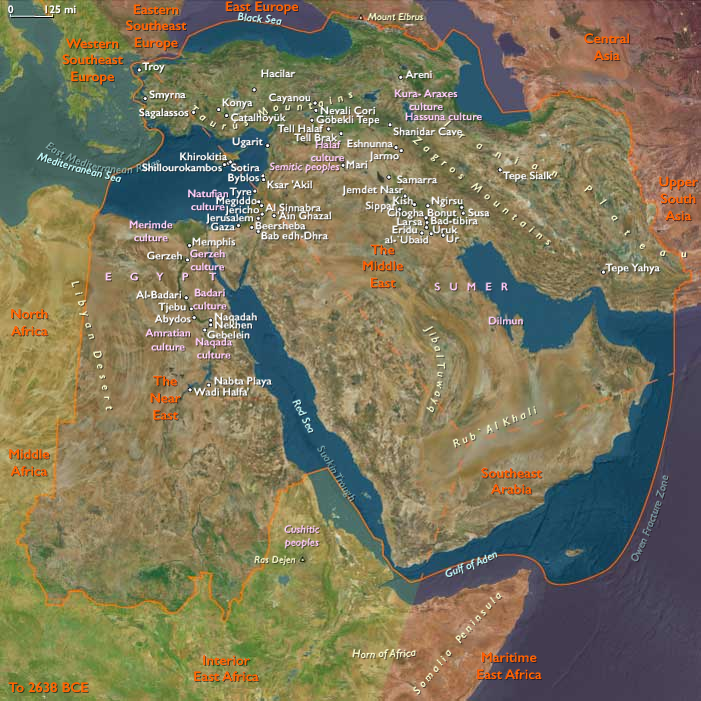
Subregions
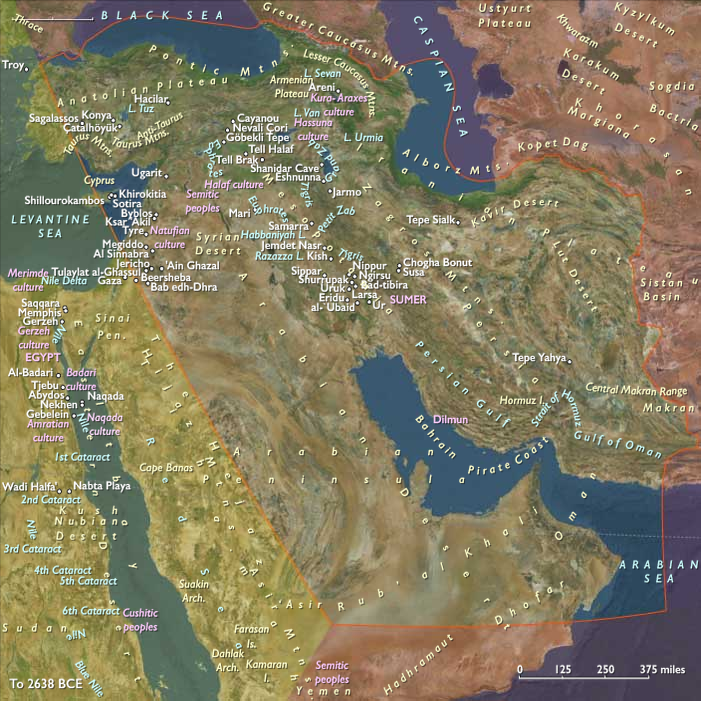
Years: 3357BCE - 3214BCE
Groups
- Ubaid culture
- Eridu, City-state of
- Sumer
- Nippur, city-state of
- Susa, City-state of
- Ur, city-state of
- Uruk, city-state of
Topics
- Younger Peron Transgression during the Neolithic Subpluvial
- Subboreal Period during the Neolithic Subpluvial
Commodoties
- Weapons
- Hides and feathers
- Glass
- Domestic animals
- Grains and produce
- Ceramics
- Strategic metals
- Beer, wine, and spirits
Subjects
- Commerce
- Architecture
- Painting and Drawing
- Environment
- Decorative arts
- Faith
- Government
- Custom and Law
- Technology
- Metallurgy
Regions
Subregions