
The Middle East: 189–46 BCE From …
Years: 189BCE - 46BCE
The Middle East: 189–46 BCE
From Seleucid Decline to Roman-Parthian Rivalry
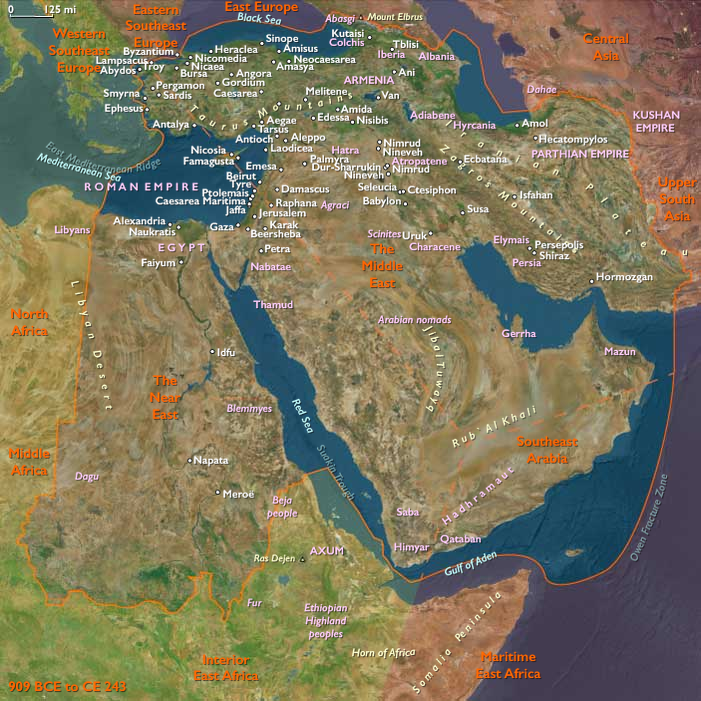
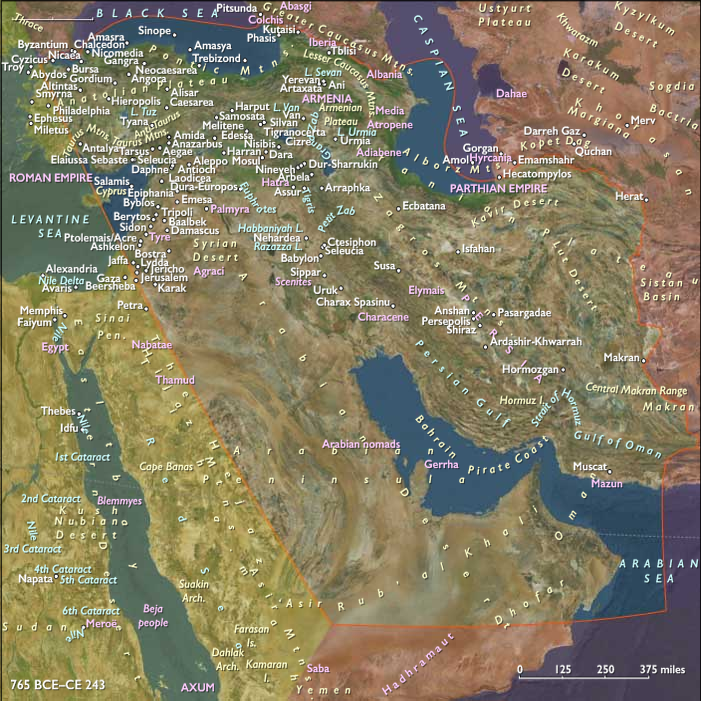
The period from 189 to 46 BCE sees a dramatic reshaping of power dynamics in the Middle East, marked by the disintegration of Seleucid authority, the ascendance of Parthian power, and increasing Roman intervention in the region.
Seleucid Decline and Parthian Ascendancy
Following its defeat by Rome, the Seleucid Empire is severely weakened, as Rome rewards its allies—particularly Pergamon and Rhodes—with territories previously held by Seleucid kings. The Seleucids rapidly lose their grip, exacerbated by internal instability and external pressures. By 141 BCE, all Seleucid lands east of the Euphrates are lost, with the critical eastern capital of Seleucia falling under Parthian control.
Under the dynamic Parthian king Mithridates II (123–87 BCE), Parthian dominion reaches its zenith, stretching from India to Armenia, encompassing Bactria, Babylonia, Susiana, and Media. The Parthians, originally nomadic people from Turkestan, leverage their strategic position to control trade between East and West, greatly enriching Mesopotamia. Despite their dominance, the Parthians govern with minimal interference, often retaining existing social structures and allowing local autonomy, exemplified by their respectful treatment of Seleucia.
Roman and Parthian Rivalries
Roman ambitions clash with Parthian interests in the region. The disastrous Roman campaign led by Marcus Licinius Crassus into Mesopotamia in 53 BCE culminates in a catastrophic defeat at the Battle of Carrhae, marking one of Rome's worst military setbacks since the Battle of Cannae. Crassus’s death at Carrhae precipitates the collapse of Rome's First Triumvirate, igniting internal Roman strife between Julius Caesar and Pompey. Parthian incursions into Syria in 52 BCE further exploit Rome’s weakened stance, although a major Parthian invasion in 51 BCE is repelled near Antigonea.
Mithridatic Wars and Roman Expansion
Concurrently, the region witnesses Rome's persistent campaigns against Mithridates VI of Pontus, whose efforts to resist Roman hegemony result in three protracted Mithridatic Wars (89–63 BCE). Rome’s victories under generals like Lucullus and Pompey further entrench Roman influence in the eastern Mediterranean and the Caucasus, resulting in kingdoms like Armenia and Iberia becoming Roman client states. Armenia, under Tigranes II (95–55 BCE), reaches its greatest territorial extent and becomes a significant buffer state between Rome and Persia, a thriving center of Hellenistic culture.
Cultural and Economic Transformations
Significant cultural exchanges occur during this era, notably between the Greco-Roman and Persian worlds. Greek cultural practices deeply influence Armenia, Cyprus, and Georgia, with Cyprus annexed by Rome in 58 BCE, administratively integrated into Cilicia, and renowned for its copper (Latin aes Cyprium). Georgia (Kartli-Iberia) also becomes a Roman ally and client state following Pompey’s campaign in 65 BCE, reflecting Rome's eastward expansionist policy.
Emergence of New Centers
Cities like Hatra and Dura-Europos rise prominently due to their strategic locations along key trade routes. Hatra becomes an influential religious and commercial hub under Parthian influence, while Dura-Europos flourishes as a multicultural frontier city of the Parthian Empire, reflecting diverse cultural influences including Greek, Latin, Hebrew, Syriac, and Aramaic.
Ethnic and Cultural Developments
The Kurdish people, historically linked to the ancient Medes, become prominent in this period, settling in northern Mesopotamia and the Zagros Mountains. Despite uncertainties about their precise origins, Kurdish tribes solidify their presence as a significant ethnic group in the region.
Thus, the era 189–46 BCE encapsulates profound geopolitical shifts: the definitive decline of the Seleucid Empire, the meteoric rise of Parthian power, and escalating Roman ambitions and rivalries. These transformations fundamentally redefine the political and cultural landscape of the Middle East, setting the stage for centuries of interaction, competition, and exchange between these powerful civilizations.
People
- Julius Caesar
- Lucullus
- Marcus Licinius Crassus
- Mithridates II of Parthia
- Mithridates VI of Pontus
- Pompey
- Tigranes the Great
Groups
- Rhodes, City-States of
- Roman Republic
- Kurdish people
- Cyprus, Hellenistic
- Iberia, Caucasian (Kartli, Kingdom of)
- Pergamon (Pergamum), Kingdom of
- Parthian Empire
- Seleucid Empire
- Armenia, Kingdom of Greater
- Cyprus, Roman
- Armenia, Empire of
- Armenia, Kingdom of Greater
- Cilicia et Cyprus (Roman province)
Topics
- Seleucid–Parthian wars
- Roman-Armenian War of 93-92 BCE
- Roman-Armenian War of 72-66 BCE
- Roman-Parthian War of 55-36 BCE
- Carrhae, Battle of
Commodoties
Subjects
Regions
Subregions
Years: 189BCE - 46BCE
People
- Julius Caesar
- Lucullus
- Marcus Licinius Crassus
- Mithridates II of Parthia
- Mithridates VI of Pontus
- Pompey
- Tigranes the Great
Groups
- Rhodes, City-States of
- Roman Republic
- Kurdish people
- Cyprus, Hellenistic
- Iberia, Caucasian (Kartli, Kingdom of)
- Pergamon (Pergamum), Kingdom of
- Parthian Empire
- Seleucid Empire
- Armenia, Kingdom of Greater
- Cyprus, Roman
- Armenia, Empire of
- Armenia, Kingdom of Greater
- Cilicia et Cyprus (Roman province)
Topics
- Seleucid–Parthian wars
- Roman-Armenian War of 93-92 BCE
- Roman-Armenian War of 72-66 BCE
- Roman-Parthian War of 55-36 BCE
- Carrhae, Battle of
Commodoties
Subjects
Regions
Subregions