
The Middle East: 304–315 CE Persecution, …
Years: 304 - 315
The Middle East: 304–315 CE
Persecution, Toleration, and Regional Realignments
The period from 304 to 315 CE is marked by significant religious and political upheaval throughout the Middle East, coinciding with the latter years of Roman Emperor Diocletian and the rise of Constantine the Great.
Diocletian’s Persecution and its Aftermath
Diocletian initiates one of the most severe persecutions of Christians—the Great Persecution—beginning in 303 CE and continuing into 305 CE. This persecution profoundly affects Christian communities across the Middle East, including Syria, Palestine, Anatolia, and Egypt, resulting in widespread martyrdom, destruction of scriptures, and dismantling of churches. The persecution leaves deep scars on Christian memory and galvanizes communities toward greater solidarity and resilience.
Constantine and Religious Toleration
The abdication of Diocletian in 305 CE sets the stage for a rapid shift in religious policy. Emperor Constantine, who gains prominence during this era, dramatically alters Roman religious policy toward Christianity following his ascent to power. His vision before the Battle of the Milvian Bridge in 312 CE—interpreted as divine intervention—prompts Constantine to embrace Christianity openly. The issuance of the Edict of Milan in 313 CE, co-authored with Emperor Licinius, officially ends Roman persecution and grants Christianity legal status, paving the way for its eventual dominance throughout the empire, including the Middle Eastern provinces.
Armenia and the Consolidation of Christianity
Armenia, under King Tiridates III, continues to solidify its identity as the world's first officially Christian state. Tiridates III actively promotes Christianity throughout Armenia, strengthening its ecclesiastical structure and developing religious institutions and clergy training centers. The kingdom’s Christian alignment significantly influences its diplomatic and cultural relationships with neighboring Rome and Persia, as both powers vie for influence over this strategically located kingdom.
Continued Roman–Sassanid Tensions
Despite shifts toward religious toleration, Roman–Persian tensions persist. The Sassanid Empire, under Shapur II, who comes to the throne in 309 CE as an infant ruler, begins preparations for renewed conflicts with Rome. Although direct large-scale warfare remains limited during Shapur II's early reign, both empires continually fortify their borders and seek strategic alliances. Armenia remains a contentious buffer, caught between competing Roman and Persian ambitions.
Thus, from 304 to 315 CE, the Middle East experiences a profound transition from persecution to religious toleration, amidst ongoing geopolitical rivalry between Rome and Persia, setting the stage for significant religious, cultural, and political developments in the centuries that follow.
People
Groups
- Armenia, Kingdom of
- Persian Empire, Sassanid, or Sasanid
- Roman Empire: Tetrarchy
- Christians, Armenian Apostolic Orthodox
Topics
Subjects
Regions
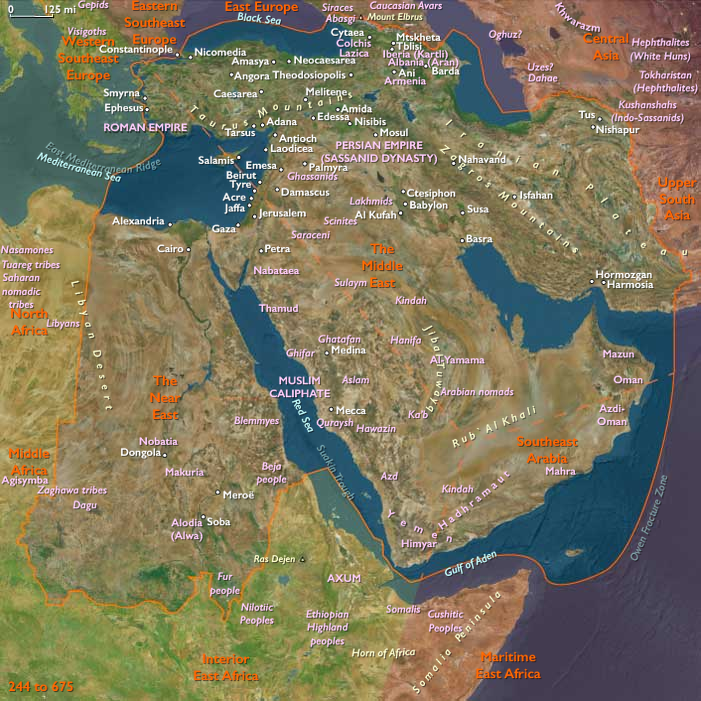
Subregions
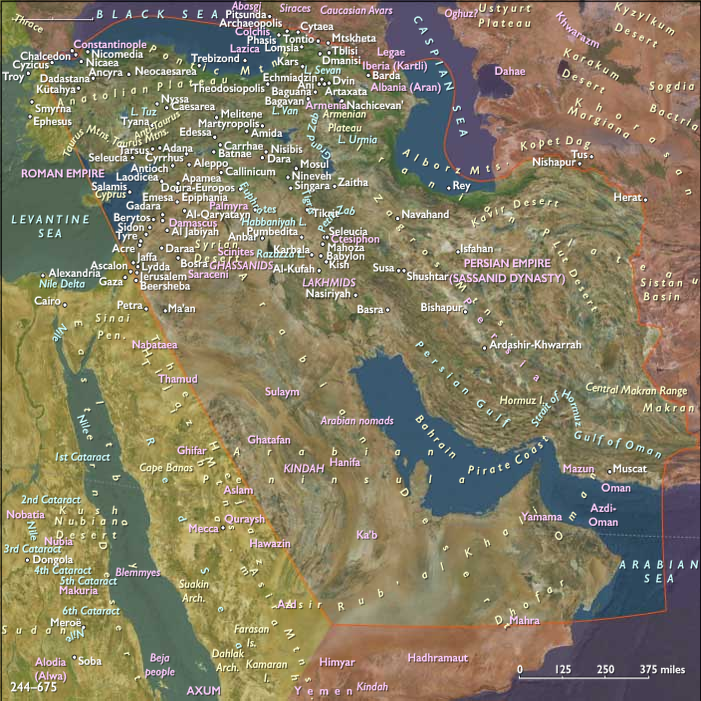
Related Events
Showing 10 events out of 60029 total
Years: 304 - 315
People
Groups
- Armenia, Kingdom of
- Persian Empire, Sassanid, or Sasanid
- Roman Empire: Tetrarchy
- Christians, Armenian Apostolic Orthodox
Topics
Subjects
Regions
Subregions