
The Middle East: 273–262 BCE Hellenistic …
Years: 273BCE - 262BCE
The Middle East: 273–262 BCE
Hellenistic Consolidation and Internal Challenges
Integration and Stability in the Hellenistic World
From 273 to 262 BCE, the Hellenistic conquerors increasingly integrate with the local populations in the three major power centers: Macedonia, Syria, and Egypt. These rulers and their followers, initially foreign conquerors, begin to stabilize their rule through accommodation and cultural integration, laying the groundwork for sustained dynastic control.
Ptolemaic Ascendancy after the First Syrian War
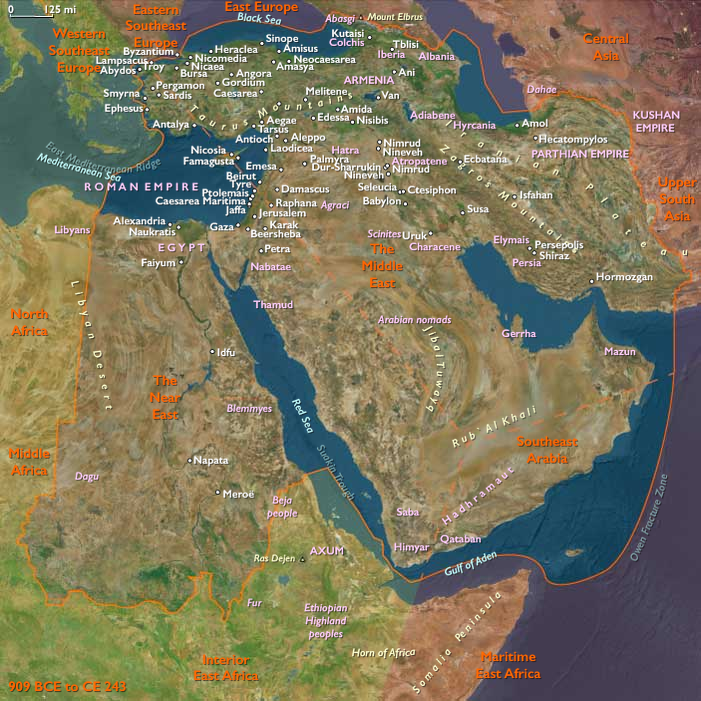
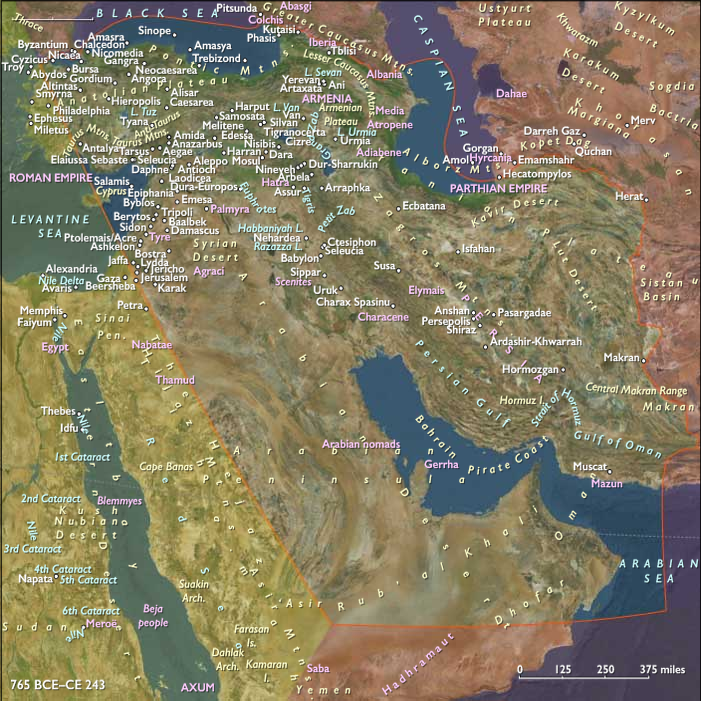
The First Syrian War ends in a significant triumph for Ptolemy II, affirming Egypt’s supremacy in the eastern Mediterranean. Initially, Antiochus I, the Seleucid king, had briefly secured control over key territories in coastal Syria and southern Anatolia. However, by 271 BCE, Ptolemy recaptures these critical regions, pushing his influence northward as far as Caria and dominating most of Cilicia.
Independence of Cyrenaica
While Ptolemy is preoccupied with securing his eastern frontiers, his half-brother, Magas, exploits the opportunity to declare Cyrenaica independent. This region maintains its autonomous status until 250 BCE, at which point it is eventually reincorporated into the Ptolemaic Kingdom.
Continued Rivalries and Dynastic Fragmentation
Despite the temporary stability, Hellenistic monarchies continue to experience internal struggles and ongoing conflicts among themselves. The era remains marked by political maneuvering, shifting alliances, and dynastic rivalries that characterize much of the post-Alexandrian period.
People
Groups
Topics
Commodoties
Subjects
Regions
Subregions
Related Events
Filter results
Showing 10 events out of 63980 total
The Hellenistic conquerors and their followers, their rule not yet secure, integrate with the subject peoples of Macedonia, Syria, and Egypt, the three centers of power in the Hellenistic world of the second quarter of the third century BCE.
The First Syrian War is a major victory for the Ptolemies.
Antiochus, in his initial rush takes the Ptolemaic controlled areas in coastal Syria and southern Anatolia, but Ptolemy reconquers these territories by 271 BCE, extending Ptolemaic rule as far as Caria and into most of Cilicia.
With Ptolemy's eye focused eastward, his half-brother Magas declares his province of Cyrenaica to be independent, a status it will maintain until 250 BCE, when it will be reabsorbed into the Ptolemaic Kingdom.
Bindusara's death in 273 BCE leads to a war over succession to the Maurya throne.
According to Divyavandana, Bindusara wanted his son Sushim to succeed him but Ashoka, viceroy of Taxila and Ujjain, despite having several elder half-brothers from other wives of Bindusāra, is supported by his father's ministers.
A minister named Radhagupta seems to have played an important role.
Ashoka manages to become the king by getting rid of the legitimate heir to the throne through tricking him into entering a pit filled with live coals.
The Dipavansa and Mahavansa refer to Ashoka killing ninety-nine of his brothers, sparing only one, named Tissa, although there is no clear proof about this incident.
The coronation occurs in 269 BCE, four years after his succession to the throne.
Said to have had a wicked nature and bad temper, Ashoka submits his ministers to a test of loyalty and has five hundred of them killed.
He also keeps a harem of around five hundred women.
When a few of these women insult him, he has all of them burnt to death.
He also builds an elaborate and horrific torture chamber that earns him the name of Chand Ashoka (Sanskrit), meaning Ashoka the Fierce.
After ascending the throne, Ashoka spends the next eight years expanding his empire, from the present-day boundaries and regions of Burma–Bangladesh and the state of Assam in India in the east to the territory of present-day Iran and Afghanistan in the west; from the Pamir Knots in the north almost to the peninsular of southern India (i.e.
Tamil Nadu/Andhra Pradesh).
Near East (273–262 BCE): Rivalries and Cultural Consolidation in the Hellenistic World
The Hellenistic Near East remains a theater of intense rivalry among the dominant Macedonian successor states. The First Syrian War (274–271 BCE) between the Seleucid Empire under Antiochus I and Ptolemaic Egypt under Ptolemy II Philadelphus concludes with the consolidation of Ptolemaic authority over southern Syria, notably Palestine and the coastal cities, thereby securing Egypt's strategic interests along the Eastern Mediterranean.
Under the effective governance of Ptolemy II, Egypt experiences continued stability, prosperity, and significant cultural enrichment. Alexandria thrives as a cosmopolitan hub, attracting scholars and artists from across the Mediterranean world. The Library of Alexandria, already established as the preeminent intellectual institution, expands its collections dramatically, solidifying Alexandria’s position as the unrivaled center of Greek learning and culture.
Meanwhile, the Seleucid Empire, despite setbacks in its western provinces, seeks to stabilize its sprawling territories. Antiochus I, though militarily checked by Egypt, still controls a vast domain from Anatolia to Central Asia. He focuses on consolidating his rule internally, fostering urbanization and Greek cultural integration within his diverse territories, a hallmark of the Seleucid approach to imperial administration.
In Anatolia, regions such as Caria and Lycia, under firm Ptolemaic influence, continue to assimilate Greek traditions, evident in architecture, coinage, and civic organization. Local rulers balance loyalty to the Ptolemies with the assertion of regional autonomy, creating a dynamic political landscape marked by both cooperation and subtle rivalry.
Throughout the Near East, this era is defined by relative stability interspersed with diplomatic and military tensions. The great monarchies focus not only on their military fronts but also on embedding Hellenistic culture deeply into the societies under their rule, thereby laying enduring foundations for future cultural and political developments.
The origins of the Chremonidean War lie in the continuing desire of many Greek states, most notably Athens and Sparta, for a restoration of their former independence along with the Ptolemaic desire to stir up discontent within the sphere of influence of its Macedonian rival.
The ambitions of Ptolemy Philadelphus in the Aegean are threatened by Antigonus Gonatas's fleet, so he carefully builds up an anti-Macedonian coalition in Greece.
He especially concentrates on courting Athens, by supplying her with grain.
The anti-Macedonian faction in Athens, led by the stoic Chremonides, takes power and proceeds to declare war on Macedon (possibly as early as the autumn of 268 BE).
The first year of the conflict sees only minor confrontations, though they generally end favorably for the anti-Macedonian coalition.
After the indecisive campaign season of 266 BCE, the war begins to turn against the Greek city-states, and in 265 BCE Antigonus is able to win a decisive and crushing victory outside Corinth, in which the Spartan King Areus I falls.
With the discarding of the old rigid form of social organization characteristic of the polis, Greek towns are now a part of a larger entity, based not on kinship or residence but on power and control.
While a new power elite arises, made wealthy by the conquests of vast new territories and the payment of tribute, peasants suffer greatly from higher levies to support the upper class.
The weakness of the agricultural producers combines with constant warfare among kingdoms to make the Greeks vulnerable to a new Mediterranean power, Rome.
Mediterranean Southwest Europe (273–262 BCE): Rome's Consolidation and Preparation for Wider Conflict
The era 273–262 BCE marks a period of consolidation for Rome following the conclusion of the Pyrrhic War, as Rome secures its dominance over nearly the entire Italian peninsula, excluding only the Po Valley.
Roman Dominance and Integration
By the mid-third century BCE, Rome has effectively integrated the territories and peoples of central and southern Italy. After defeating the Latin League, the Samnites, and the Greek cities of Magna Graecia, Rome has firmly positioned itself as the primary power in the peninsula. Rome employs strategic colonization and the formation of military settlements to secure its newly acquired regions, establishing stability and Roman influence throughout Italy.
Strategic Military and Political Consolidation
Rome utilizes the peace following the Pyrrhic War to strengthen internal cohesion, reorganizing and fortifying its military capabilities. During this period, Rome enhances its strategic road networks, improving the connectivity and responsiveness of its legions across its extensive territories. The creation of additional Roman colonies also reinforces control, particularly in Campania and southern Italy.
Prelude to Punic Conflict
Rome’s emergence as a powerful, unified political and military force increasingly brings it into potential conflict with Carthage, the dominant maritime power in the Western Mediterranean. Roman victories over powerful Hellenistic foes demonstrate to Carthage that Rome is no longer merely a regional concern, but a significant competitor with ambitions extending beyond Italy.
Legacy of the Era
The period from 273–262 BCE sees Rome solidifying its internal structures, setting the stage for future expansion and conflict beyond Italy. Rome’s increased power and territorial consolidation lay crucial foundations for the upcoming Punic Wars, dramatically altering the course of Mediterranean history.
The Romans have secured the whole of the Italian peninsula, except Gallia Cisalpina (the Po Valley), by the mid-third century BCE.
Over the course of the preceding one hundred years, Rome has defeated every rival that stood in the way of her domination of the Italian peninsula.
First the Latin League had been forcibly dissolved during the Latin War, then the power of the Samnites had been broken during the three prolonged Samnite wars, and the Greek cities of Magna Graecia, which had been unified after Pyrrhus of Epirus finally left Italy, had been required submit to Roman authority at the conclusion of the Pyrrhic War.
North Africa (273–262 BCE)
Carthaginian Maritime Dominance and the Onset of the First Punic War
Expansion and Consolidation of Carthaginian Influence
From 273 to 262 BCE, Carthage, originating as a Phoenician colony near modern Tunis, firmly establishes itself as the preeminent naval power in the western Mediterranean. The city's civilization expands its hegemony extensively along the North African coast, deeply into its hinterland, and also encompasses the Balearic Islands, Sardinia, Corsica, southern Spain, and the western half of Sicily.
Economic exchanges and alliances with interior Berber tribes reinforce Carthage's prosperity, securing a steady flow of resources necessary to sustain its extensive network of territories. Prominent coastal trading hubs, particularly Leptisand Oea (modern Tripoli), continue flourishing, deepening economic interdependence with inland Berber communities.
Diplomatic Challenges and the Emergence of Conflict with Rome
Diplomatic tensions culminate in the outbreak of the First Punic War in 264 BCE, triggered by mutual interventions by Rome and Carthage in Messana, Sicily, a strategically located city near the Italian peninsula. This initiates a twenty-year struggle for supremacy primarily over Sicily and its surrounding waters, and to a lesser extent North Africa itself.
Despite the escalating conflict, Carthage strategically navigates alliances with Greek city-states and cautiously maintains diplomatic channels with other Mediterranean powers to safeguard its territorial and economic interests.
Cyrenaica’s Economic Stability Amid Regional Unrest
The Greek Pentapolis—Cyrene, Barce (Al Marj), Euhesperides (Benghazi), Teuchira (Tukrah), and Apollonia (Susah)—maintains economic strength through sustained exports of grain, fruit, horses, and the valuable medicinal plant Silphium. Cyrene continues investing in civic infrastructure and religious institutions, highlighting its economic resilience and political autonomy.
Cyrenaica adeptly manages external pressures, carefully preserving its Greek cultural identity and maintaining independence amidst the broader geopolitical volatility.
Berber Integration and Continued Stability
Berber communities further integrate economically within Carthaginian trade networks, adopting advanced agricultural methods, maritime expertise, and artisanal practices. Coastal cities like Oea (Tripoli) remain vital economic centers, significantly contributing to regional prosperity and stability.
Inland Berber tribes retain their autonomy, preserving traditional governance structures and cultural identities, benefiting indirectly from prosperous coastal trade and the economic stability it brings.
Cultural Syncretism and Artistic Development
Interactions among Berber, Carthaginian, and Greek populations enrich cultural practices, notably in pottery, textiles, and metalwork. Religious syncretism continues to evolve, integrating indigenous Berber traditions harmoniously with Phoenician and Greek religious practices, further enhancing the region's cultural diversity.
Robust Foundations Amid Growing Conflict
By 262 BCE, North Africa maintains considerable political stability and economic vitality, despite the challenges posed by the First Punic War. Carthage’s strategic maritime strength, Cyrenaica’s diplomatic resilience, and cohesive Berber integration collectively ensure the region's continued prominence, even amidst emerging conflicts with Rome.
Carthage, which considers itself the dominant naval power in the western Mediterranean, had originated as a Phoenician colony in Africa, near modern Tunis, and has gradually become the center of a civilization whose hegemony reaches along the North African coast and deep in its hinterland, and also includes the Balearic Islands, Sardinia, Corsica, a limited area in southern Spain, and the western half of Sicily.
The conflict known as the First Punic War begins in 264 BCE, after both Rome and Carthage intervene in Messana, the Sicilian city closest to the Italian peninsula.
In this first of three wars fought between Carthage and the Roman Republic, the two powers will struggle for twenty years for supremacy in the western Mediterranean Sea, primarily on the Mediterranean island of Sicily and its surrounding waters but also to a lesser extent North Africa.
Carthage, located in what is today Tunisia, is the dominant Western Mediterranean power at the beginning of the conflicts.
The series of wars between Rome and Carthage are known to the Romans as the "Punic Wars" because of the Latin name for the Carthaginians: Punici, derived from Phoenici.
The Punici (from Latin punicus, pl. punici) are a group of western Semitic-speaking peoples from Carthage in North Africa who trace their origins to a group of Phoenician settlers, but also to North African Berbers.
Pyrrhus's retreat from Italy proves unlucky for Antigonus II Gonatus of Macedon.
Returning to Epirus with an army of eight thousand foot and five hundred horse, he was in need of money to pay them.
This had encouraged him to look for another war, so the next year, after adding a force of Gallic mercenaries to his army, he invaded Macedonia with the intention of filling his coffers with plunder.
The campaign goes better than expected.
Making himself master of several towns and being joined by two thousand deserters, his hopes start to grow and he goes in search of Antigonus, attacking his army in a narrow pass and throwing it into disorder.
Antigonus's Macedonian troops retreat, but his own body of Gallic mercenaries, who have charge of his elephants, stand firm until Pyrrhus's troops surround them, whereupon they surrender both themselves and the elephants.
Pyrrhus now chases after the rest of Antigonus's army which, demoralized by its earlier defeat, declines to fight.
As the two armies face each other, Pyrrhus calls out to the various officers by name and persuades the whole body of infantry to desert.
Antigonus escapes by concealing his identity.
Pyrrhus now takes control of upper Macedonia and Thessaly while Antigonus holds onto the coastal towns.
Pyrrhus now wastes his victory.
Taking possession of Aegae, the ancient capital of Macedonia, he installs a garrison of Gauls, who greatly offend the Macedonians by digging up the tombs of their kings and leaving the bones scattered about as they search for gold.
He also neglects to finish off his enemy.
Leaving Antigonus in control of the coastal cities, he contents himself with insults.
He calls Antigonus a shameless man for still wearing the purple, but he does little to destroy the remnants of his power.
The two cultures of Poseidonia, Greek and Oscan, appear to have been able to thrive alongside one another after the Lucanian capture of the city, based on the archaeological evidence.
It becomes the Roman city of Paestum in 273 BCE after the Graeco-Italian Poseidonians side with the loser, Pyrrhus, in his war against Rome during the first quarter of the third century BCE.
