
The Middle East: 249–238 BCE Parthian …
Years: 249BCE - 238BCE
The Middle East: 249–238 BCE
Parthian Emergence and Hellenistic Decline
Rise of Arsaces and the Parthian State
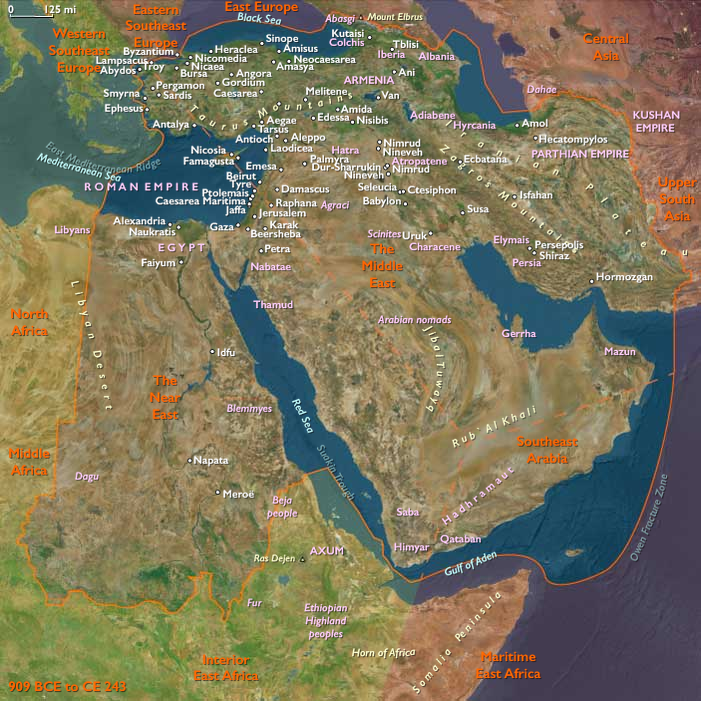
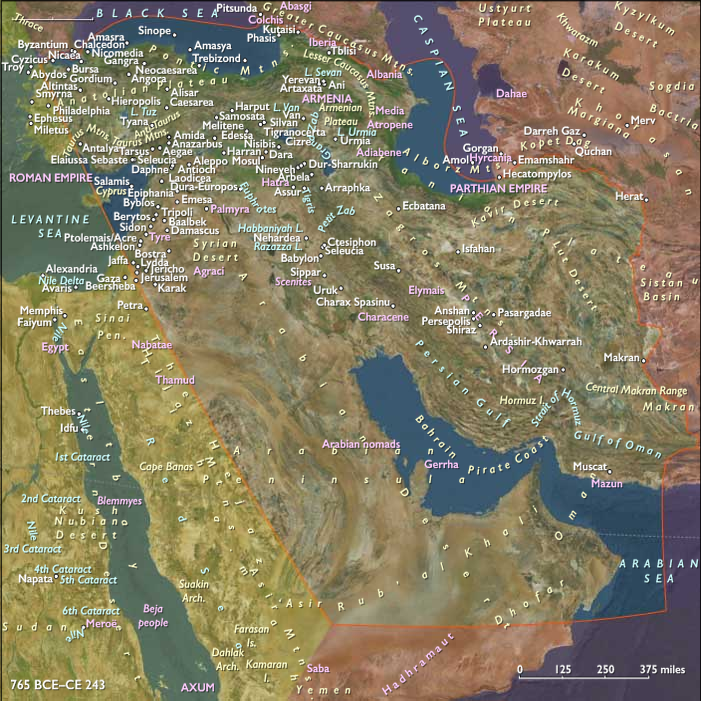
In 247 BCE, following the death of Antiochus II, Seleucid control weakens as their governor (satrap) of Parthia, Andragoras, declares independence amidst the turmoil caused by the seizure of the Seleucid capital Antioch by Ptolemy III. Andragoras struggles to defend his territory without Seleucid military backing.
Around 238 BCE, the situation deteriorates further when Arsaces, a leader of the nomadic Parni tribes of Scythian or Bactrian origin, launches a decisive invasion into Parthia, aided by his brother Tiridates. Quickly capturing Astabene (Astawa) and its capital, Kabuchan (modern Kuchan), the Parni decisively end Andragoras' rule, killing him in the process. The Parni tribes subsequently adopt the name Parthians, derived from the conquered province, marking the birth of a new and influential Persian dynasty.
Advances in Hellenistic Astronomy
Amidst these geopolitical shifts, significant advancements occur in Greek astronomy. Aristarchus of Samos, a prominent student of Strato of Lampsacus, advocates for a revolutionary heliocentric model, asserting that the Sun, not the Earth, is the center of the universe. Aristarchus also conducts pioneering work in determining celestial distances. In his surviving treatise, On the Sizes and Distances of the Sun and Moon, he uses geometric reasoning to calculate that the Sun is approximately twenty times further away and twenty times larger than the Moon. Although his estimates are imprecise due to technological limitations, Aristarchus's methods remain conceptually sound and significantly influence future astronomical thought.
People
- Andragoras (Seleucid satrap)
- Antiochus II Theos
- Aristarchus of Samos
- Arsaces I of Parthia
- Ptolemy III Euergetes
- Tiridates I of Parthia
Groups
Topics
Subjects
Regions
Subregions
Years: 249BCE - 238BCE
People
- Andragoras (Seleucid satrap)
- Antiochus II Theos
- Aristarchus of Samos
- Arsaces I of Parthia
- Ptolemy III Euergetes
- Tiridates I of Parthia
Groups
Topics
Subjects
Regions
Subregions