
The Middle East: 532–675 CE From …
Years: 532 - 675
The Middle East: 532–675 CE
From Sassanid Consolidation to the Islamic Conquests
Sassanid Resurgence and Byzantine Struggles
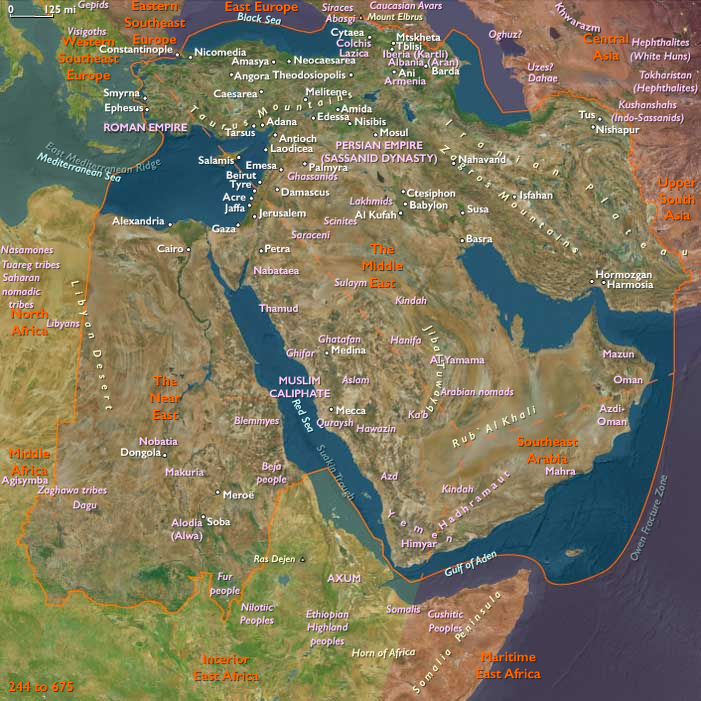
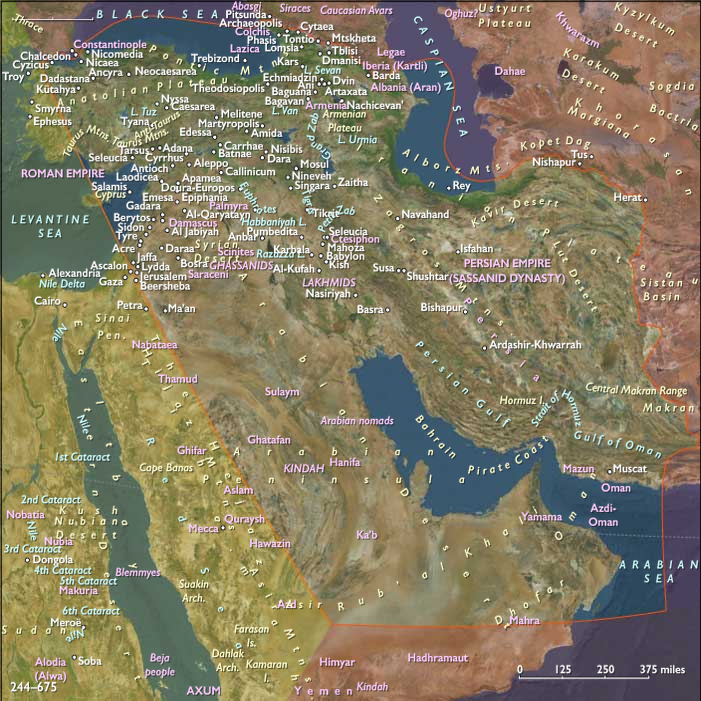
The era begins with the Treaty of Eternal Peace (532), intended to stabilize relations between the Eastern Roman (Byzantine) Empire and the Sassanid Persian Empire. However, by 540, Khosrau I Anushirvan, wary of Byzantine power, breaks the treaty, initiating renewed hostilities. Khosrau fortifies the empire's borders and reorganizes its administration, strengthening central control and promoting a revival of Zoroastrian orthodoxy. His rule, renowned for extensive urban and agricultural development, also ushers in a flourishing cultural period, with translations of Indian texts enriching Persian literature.
The Plague of Justinian and its Devastation
In 541, the devastating Plague of Justinian sweeps through the region, causing immense mortality. Historians John of Ephesus and Evagrius Scholasticus provide vivid firsthand accounts of its catastrophic effects, highlighting the profound social and economic disruptions caused by repeated outbreaks.
Religious and Cultural Flourishing
Despite conflicts, significant cultural and religious developments occur. Saint Mesrop creates the Armenian alphabet in the early fifth century, catalyzing a golden age of Armenian literature and religious thought. Meanwhile, the Lakhmid kingdom of al-Hirah (in present-day southern Iraq) thrives culturally, significantly influencing Arabic poetry, script development, and Christianity in the Arabian Peninsula. Poets like Tarafa and Al-Nabigha frequent the Lakhmid court, enhancing its prestige.
Arab Vassal Kingdoms and Pre-Islamic Conflicts
The Ghassanids and Lakhmids, Arab client kingdoms of Byzantium and Persia respectively, clash frequently, notably around mid-century, significantly impacting regional stability. The Ghassanids notably patronize poets and engage in extensive building programs, though Byzantine suspicion regarding their religious orthodoxy ultimately undermines their autonomy.
Byzantine-Sassanid Wars and the Rise of Islam
Repeated Byzantine-Sassanid conflicts, such as the Lazic War (541–562) and the lengthy war from 572 to 591, exhaust both empires, weakening their defensive capabilities. The final Byzantine-Sassanid war (602–628) proves particularly devastating, initially giving Persia temporary control over Jerusalem and much of Syria, only for Emperor Heraclius to counterattack decisively.
These exhausting conflicts set the stage for the meteoric rise of Islam. The Arabs, under leaders like Khalid ibn al-Walid, swiftly conquer vast territories weakened by Byzantine-Persian warfare, capturing Damascus in 635, Jerusalem and Ctesiphon in 637, and decisively defeating the Sassanians at Nahavand in 642.
The Birth of the Islamic Caliphates
Following the Prophet Muhammad’s death in 632, rapid Islamic expansion transforms the political and religious landscape. Disputes over succession lead to the formation of the two major Islamic sects: the Sunni majority and the minority Shia, supporters of Ali ibn Abu Talib. Muawiyah, initially the governor of Syria, becomes a pivotal figure, establishing the Umayyad Caliphate (661–750) with its capital in Damascus. His reign is marked by military prowess, administrative reform, and religious tolerance, setting the foundation for an enduring Islamic presence in the region.
Cultural Shifts and Religious Developments
Christianity spreads widely during this period, deeply influencing Armenia (officially adopting Christianity around 301 CE), Georgia (330 CE), and Cyprus, despite periodic Arab invasions. Major earthquakes, such as the 526 quake in Antioch, severely damage prominent cities, reshaping regional power dynamics.
By 675 CE, the Middle East stands dramatically transformed. The collapse of the Sassanid Empire, the diminished Byzantine presence, and the rapid Islamic ascendancy mark the dawn of a fundamentally new chapter in the region's long history.
People
- Abu Bakr
- Al-Nabigha
- Ali
- Evagrius Scholasticus
- Heraclius
- John of Ephesus
- Khalid bn al-Walid
- Khosrau I
- Muawiyah I
- Muhammad
- Tarafa
Groups
- Arab people
- Zoroastrians
- Jews
- Iberia, Caucasian (Kartli, Kingdom of)
- Cyprus, Roman
- Armenia, Kingdom of Greater
- Phoenice (Roman province)
- Persian Empire, Sassanid, or Sasanid
- Lakhmid kingdom of al-Hira
- Phoenice Lebanensis (Roman province)
- Phoenice (Roman province)
- Syria Secunda (Roman province)
- Christians, Eastern (Diophysite, or “Nestorian”) (Church of the East)
- Christians, Miaphysite (Oriental Orthodox)
- Ghassan, Kingdom of
- Roman Empire, Eastern: Justinian dynasty
- Roman Empire, Eastern: Non-dynastic
- Roman Empire, Eastern: Heraclian dynasty
- Rashidun Caliphate
- Muslims, Sunni
- Muslims, Kharijite
- Umayyad Caliphate (Damascus)
- Muslims, Shi'a
Topics
- Lazic War
- Byzantine–Sassanid War of 572–591
- Byzantine–Sassanid War of 602–628
- Byzantine-Avarian War of 603-626
- Arab-Byzantine Wars
- Muslim Conquest of Persia
- Muslim Conquest of the Levant
- Muslim Conquest of Armenia
- Nahāvand, Battle of
- Byzantine-Muslim War of 645-56
Subjects
- Symbols
- Architecture
- Environment
- Public health
- Mayhem
- Faith
- Custom and Law
- Catastrophe
- Mathematics
- Astronomy
Regions
Subregions
Years: 532 - 675
People
- Abu Bakr
- Al-Nabigha
- Ali
- Evagrius Scholasticus
- Heraclius
- John of Ephesus
- Khalid bn al-Walid
- Khosrau I
- Muawiyah I
- Muhammad
- Tarafa
Groups
- Arab people
- Zoroastrians
- Jews
- Iberia, Caucasian (Kartli, Kingdom of)
- Cyprus, Roman
- Armenia, Kingdom of Greater
- Phoenice (Roman province)
- Persian Empire, Sassanid, or Sasanid
- Lakhmid kingdom of al-Hira
- Phoenice Lebanensis (Roman province)
- Phoenice (Roman province)
- Syria Secunda (Roman province)
- Christians, Eastern (Diophysite, or “Nestorian”) (Church of the East)
- Christians, Miaphysite (Oriental Orthodox)
- Ghassan, Kingdom of
- Roman Empire, Eastern: Justinian dynasty
- Roman Empire, Eastern: Non-dynastic
- Roman Empire, Eastern: Heraclian dynasty
- Rashidun Caliphate
- Muslims, Sunni
- Muslims, Kharijite
- Umayyad Caliphate (Damascus)
- Muslims, Shi'a
Topics
- Lazic War
- Byzantine–Sassanid War of 572–591
- Byzantine–Sassanid War of 602–628
- Byzantine-Avarian War of 603-626
- Arab-Byzantine Wars
- Muslim Conquest of Persia
- Muslim Conquest of the Levant
- Muslim Conquest of Armenia
- Nahāvand, Battle of
- Byzantine-Muslim War of 645-56
Subjects
- Symbols
- Architecture
- Environment
- Public health
- Mayhem
- Faith
- Custom and Law
- Catastrophe
- Mathematics
- Astronomy
Regions
Subregions