
The Middle East: 9 BCE–CE 3 …
Years: 9BCE - 3
The Middle East: 9 BCE–CE 3
Diplomatic Compromise and Continued Rivalry
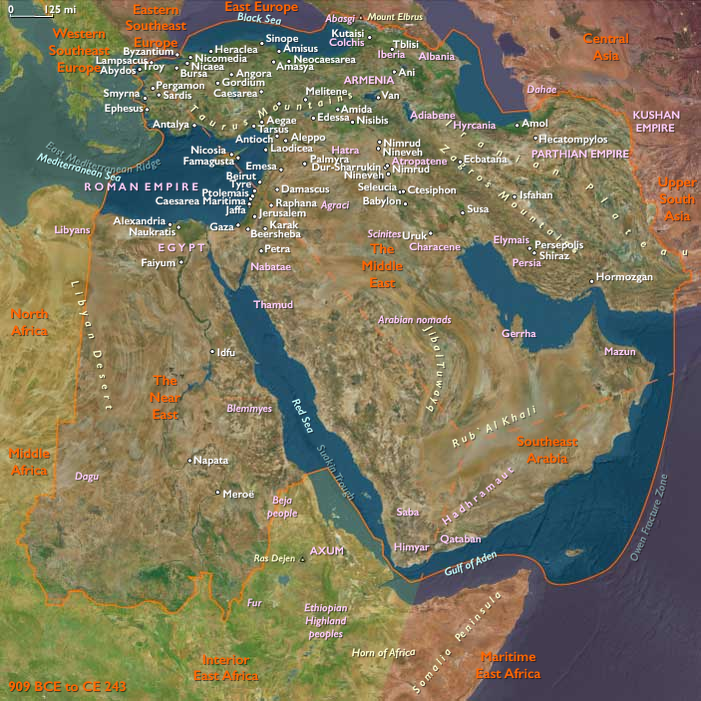
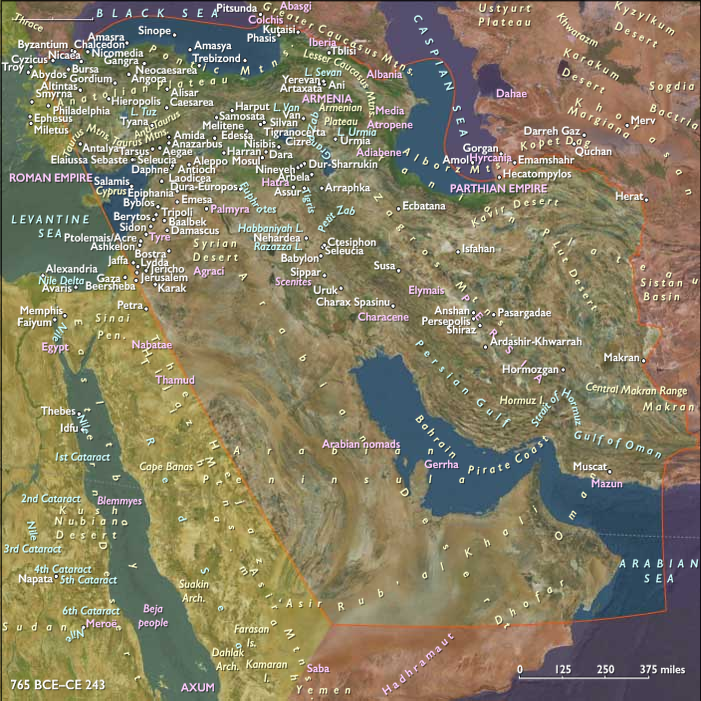
Tensions between Rome and Parthia threaten renewed hostilities until a diplomatic compromise is reached in CE 1. Phraates V of Parthia negotiates with Gaius Caesar, the adopted son and heir apparent of Emperor Augustus, securing a crucial agreement. Under this accord, Parthia commits to withdrawing its military forces from Armenia and acknowledges a de facto Roman protectorate over the strategically vital region.
Despite this diplomatic resolution, the rivalry between Rome and Parthia over Armenia remains intense. The kingdom continues to serve as a critical buffer state, pivotal to both powers' ambitions for regional dominance and influence. This arrangement thus does little to ease long-term geopolitical tensions, as Roman-Parthian competition for influence in Armenia is set to continue unabated for decades to come.
Throughout this era, Roman diplomacy and military strategy in the broader Middle East are marked by caution combined with assertiveness. Rather than seeking direct military confrontations, Rome reinforces its regional dominance through a system of client states and carefully brokered treaties. This nuanced diplomatic approach aims at securing regional stability and protecting Rome’s eastern frontier, highlighting a period defined by strategic diplomacy amid persistent underlying rivalries.
People
Groups
Topics
Subjects
Regions
Subregions
Related Events
Filter results
Showing 10 events out of 62125 total
Tensions between Rome and Parthia threaten renewed war until Phraates V of Parthia works out a compromise with Gaius Caesar, the adopted son of Emperor Augustus, in CE 1.
According to the agreement, Parthia undertakes to withdraw its forces from Armenia and to recognize a de facto Roman protectorate there, but Roman–Persian rivalry over control and influence in Armenia will continue unabated for the next several decades.
Near East (9 BCE–CE 3): Consolidation Under Rome and Herodian Rule
The Near East in this era remains firmly within the Roman imperial orbit, as Augustus Caesar continues to consolidate his vast territorial dominions. Egypt, now securely established as a critical Roman province, remains the Empire’s essential breadbasket, supplying Rome with grain shipments vital for urban stability and imperial control.
In Judea, Herod the Great, Rome’s influential and powerful client king, continues his extensive construction projects, further reshaping the region’s landscape and infrastructure. The Second Temple in Jerusalem, whose reconstruction Herod had initiated around 20 BCE, progresses toward completion, becoming a spectacular architectural and religious monument symbolic of Jewish identity and Herod’s political ambitions.
Herod also maintains diplomatic relations with Augustus and seeks to strengthen his regime through marriages and political alliances among the various ethnic and religious communities under his rule. Despite these efforts, his reign is marked by family intrigues, paranoia, and ruthless suppression of potential rivals, leading to growing tensions among his subjects.
Around 4 BCE, following Herod’s death, Judea becomes embroiled in succession struggles among his sons, eventually resulting in the division of his kingdom. Rome intervenes directly, appointing Herod’s son Herod Archelaus as ethnarch over Judea, Samaria, and Idumea, while dividing the remainder of Herod’s territories among other sons such as Herod Antipas and Philip the Tetrarch.
Legacy of the Era
The period from 9 BCE to CE 3 solidifies Rome’s administrative and cultural influence in the Near East, marked prominently by Herodian building projects and political structures. The death of Herod the Great and subsequent political fragmentation significantly impact the region, setting the stage for further Roman intervention and administration, and ultimately shaping the socio-political context into which early Christianity would soon emerge.
Mediterranean Southwest Europe (9 BCE–CE 3): Consolidation of the Pax Romana and Augustan Reforms
The era from 9 BCE to CE 3 marks continued stabilization and administrative consolidation under Augustus, epitomizing the Pax Romana—an unprecedented period of peace and prosperity throughout the Roman Empire.
Expansion and Stabilization
During this era, Augustus continues efforts to consolidate Roman authority, strengthening administrative efficiency and extending infrastructure throughout the provinces, including the Mediterranean Southwest. The extensive network of roads and provincial governance established by Augustus significantly enhances communication, trade, and military responsiveness.
Augustan Reforms and Governance
Augustus implements further social, administrative, and legal reforms designed to fortify the stability and integrity of the empire. His policies support traditional Roman values, including legislation encouraging marriage and family life, aimed at stabilizing society through moral regulation.
A major administrative development during this period is Augustus’s restructuring of Rome’s municipal system, granting varying degrees of autonomy to cities across the Mediterranean. This reform not only enhances local governance but also integrates provincial territories more tightly into the Roman state apparatus.
Cultural Patronage and Imperial Propaganda
Augustus continues to promote an imperial ideology emphasizing stability, prosperity, and moral virtue. Cultural projects flourish under his patronage, producing enduring literary works and architectural landmarks. Significant cultural figures, such as poets and historians, continue to articulate and reinforce the legitimacy of Augustus's reign through their works.
Infrastructure and Economic Prosperity
Infrastructure investments, including roads, aqueducts, and public buildings, continue to drive economic prosperity across the region. These improvements not only facilitate commerce and connectivity but also symbolize Roman power and civilization, reinforcing Rome's dominant cultural identity across the Mediterranean.
Legacy of the Era
The period from 9 BCE to CE 3 epitomizes the success of Augustus's policies in securing peace, stability, and prosperity. The profound transformation of governance, infrastructure, and cultural ideology during these years firmly establishes the foundations of the Roman Empire, setting precedents for centuries to come.
North Africa (9 BCE–CE 3)
Roman Provincial Consolidation, Continued Mauretanian Prosperity, Cyrenaic Stability, Berber Integration, and Saharan Connectivity
Roman Administrative Strengthening and Economic Growth
From 9 BCE to CE 3, Roman control over Africa Proconsularis continues to strengthen through further administrative refinements, infrastructure investments, and urban enhancements. Major cities such as Utica continue thriving as administrative and commercial centers, solidifying North Africa's position within Rome’s extensive Mediterranean economic and political sphere. Agricultural productivity and commerce flourish, contributing to sustained provincial prosperity.
Numidia: Ongoing Stability and Economic Integration
Numidia maintains stability and economic vitality under consistent Roman governance. The province benefits from ongoing investments in agricultural improvements, enhanced trade routes, and effective administrative practices. While deeply integrated into Rome’s provincial structure, Numidian society continues to uphold distinctive local traditions, contributing to the cultural diversity and stability of the broader region.
Mauretania: Flourishing under Juba II and Cleopatra Selene
Mauretania remains exceptionally prosperous under the cultured leadership of King Juba II and Queen Cleopatra Selene II. Caesarea (modern Cherchell) grows increasingly vibrant culturally and economically, benefiting from extensive public works and construction projects initiated by Juba II. Their continued emphasis on blending Egyptian, Greek, and Roman architectural styles attracts scholars, artisans, and merchants from across the Mediterranean.
The fertile lands of Mauretania continue to produce and export valuable commodities such as grain and olive oil, further enhancing the kingdom’s prosperity and status as a pivotal Roman client-state.
Cyrenaica: Economic Stability and Intellectual Vitality
Cyrenaica maintains its robust economic and cultural prosperity. The Greek Pentapolis—Cyrene, Barce (Al Marj), Euhesperides (Benghazi), Teuchira (Tukrah), and Apollonia (Susah)—remains economically productive, notably through the continued trade of grain, wine, wool, livestock, and the prized medicinal herb Silphium.
Cyrene continues to thrive as a center of intellectual activity, attracting renowned scholars, philosophers, and medical experts, thus reinforcing its prominent role within broader Mediterranean cultural and academic networks.
Berber Communities: Sustained Integration and Cultural Continuity
Berber populations remain deeply involved in regional trade networks, sustaining economic prosperity through active engagement with coastal hubs such as Oea (Tripoli). Coastal commerce indirectly supports inland Berber tribes, who retain traditional governance structures and cultural practices. This enduring interaction ensures ongoing regional stability, economic resilience, and cultural vitality.
Garamantes: Continued Saharan Trade Influence
The Garamantes continue to play an essential role in facilitating trans-Saharan trade, connecting sub-Saharan Africa with Mediterranean economies. Their sophisticated agricultural practices and efficient control of caravan routes ensure sustained regional trade prosperity, significantly contributing to North Africa’s interconnected economic landscape.
Musulami, Gaetulians, Mauri (Moors), and Saharan Pastoral Nomads
The Musulami, inhabiting areas between Numidia and the Sahara, actively engage in agricultural and pastoral pursuits, maintaining regular commercial and cultural interactions with Roman and Numidian communities.
The Gaetulians continue their semi-nomadic pastoral lifestyle, facilitating trade and cultural exchange across inland and coastal regions, thereby bolstering economic cohesion and cultural exchanges.
The Mauri (Moors) in western North Africa sustain their regional importance through diplomatic initiatives and commercial exchanges, reinforcing local stability and prosperity.
Saharan pastoral nomads persist as vital connectors between diverse ecological and economic zones. Their movements enhance trade, cultural interaction, and the transmission of ideas and technologies across vast territories.
Cultural Syncretism and Dynamic Interaction
Cultural exchanges among Berber, Roman, Greek, Garamantian, Musulami, Gaetulian, Mauri, and Saharan pastoral communities enrich regional traditions in arts, crafts, and artisanal practices. Religious syncretism continues to thrive, blending indigenous Berber beliefs with Roman, Greek, Phoenician, and Saharan religious traditions, significantly enhancing North Africa’s cultural diversity and richness.
Stable Foundations and Enduring Regional Prosperity
By CE 3, North Africa demonstrates ongoing regional prosperity, underpinned by effective Roman provincial governance, Juba II and Cleopatra Selene’s flourishing Mauretania, sustained Cyrenaic economic and intellectual vitality, resilient Berber communities, and dynamic Saharan trade and pastoral networks. Together, these interconnected elements affirm North Africa's enduring strategic importance within the Mediterranean geopolitical context.
Atlantic Southwest Europe (9 BCE–3 CE): Provincial Stability and Cultural Integration Under Roman Rule
Between 9 BCE and 3 CE, Atlantic Southwest Europe—including northern and central Portugal, Galicia, Asturias, Cantabria, and northern Spain south of the Franco-Spanish border (43.05548° N, 1.22924° W)—experienced sustained peace and administrative stability following Augustus’s successful conclusion of the Cantabrian Wars. This era marked the region's definitive incorporation into Roman provincial governance, characterized by extensive economic prosperity, increased reliance on slavery, significant infrastructural advancements, and dynamic cultural adaptation. Despite Roman dominance, local identities and traditions remained resilient, adjusting effectively within an integrated provincial context.
Political and Military Developments
Full Roman Provincial Stabilization
-
Roman administrative structures, systematically organized by Augustus, became fully entrenched, significantly reducing regional tensions. Roman authority expanded extensively through fortified settlements, permanent military garrisons, administrative towns, and sophisticated road networks, securing stable governance throughout the province.
-
Local tribal elites actively collaborated with Roman administrators, reinforcing regional stability and fostering sustained peace and administrative efficiency.
Northern Tribal Adaptation
-
Northern tribes previously resistant—particularly the Gallaeci, Astures, and Cantabri—largely transitioned toward cautious accommodation, increasingly cooperating with Roman provincial authority. Although sporadic tensions remained, substantial resistance diminished.
-
The Vascones continued effective diplomatic neutrality, successfully preserving territorial integrity, cultural distinctiveness, and internal stability within the new provincial environment.
Economic and Technological Developments
Deepening Mediterranean Economic Integration
-
Regional economic integration into Roman-controlled Mediterranean networks expanded notably. Exports of metals (silver, copper, tin), agricultural products, timber, livestock goods, textiles, salt, and especially slaves flourished. Imports from Mediterranean markets included luxury items, fine ceramics, wine, olive oil, and advanced iron products.
-
Tribal elites and newly established provincial classes economically benefited significantly, reinforcing social stratification, specialization, and regional dependency on Roman trade networks.
Sustained Reliance on Slave Labor
-
Slavery remained fundamental within regional economic structures, extensively employed in mining operations, agriculture, domestic labor, artisanal production, and infrastructure projects. The vibrant slave trade further embedded slavery within regional societal structures, economic practices, and hierarchies.
Technological and Infrastructure Advancements
-
Continued improvements in metallurgy, especially ironworking, significantly enhanced agricultural productivity, artisanal craftsmanship, and regional economic specialization. Skilled artisans across the region produced sophisticated iron weapons, tools, armor, and decorative objects, integrating local traditions with Roman techniques.
-
Extensive Roman infrastructure—roads, bridges, aqueducts, urban centers—facilitated efficient governance, rapid troop movement, trade, and provincial cohesion.
Cultural and Religious Developments
Cultural Resilience and Artistic Integration
-
Material culture reflected a dynamic synthesis of indigenous Iberian, Celtic, and strong Roman artistic influences. Artistic expressions, including elaborate metalwork, decorative jewelry, pottery, ceremonial artifacts, and household objects, underscored robust regional cultural identities and pride.
-
Despite comprehensive Roman provincial authority, local tribal identities—especially among Lusitanians, Gallaeci, Astures, Cantabri, and Vascones—remained culturally distinct, adapting creatively within the Roman provincial context.
Ritual Continuity and Religious Adaptations
-
Ritual practices persisted, blending indigenous Iberian, Celtic, and Roman religious elements. Prominent sacred sites, landscapes, and communal ceremonies reinforced communal cohesion, cultural continuity, and tribal identities.
-
Ancestral ceremonies, warrior traditions, and regional festivals continued actively, providing social solidarity, cultural resilience, and regional identity amidst stable Roman governance.
Notable Tribal Groups and Settlements
-
Lusitanians: Fully integrated into the Roman provincial framework, enjoying sustained economic prosperity and cultural continuity under stable governance.
-
Vettones and Vaccaei: Maintained territorial integrity, economic prosperity, and local autonomy through strategic diplomatic cooperation with Rome.
-
Gallaeci, Astures, Cantabri: Transitioned from active resistance to accommodation, increasingly engaging diplomatically and economically with Roman authorities while preserving local traditions.
-
Vascones: Continued diplomatic neutrality and autonomy, successfully maintaining territorial integrity, cultural distinctiveness, and internal stability.
Long-Term Significance and Legacy
Between 9 BCE and 3 CE, Atlantic Southwest Europe:
-
Achieved comprehensive stabilization under Roman provincial governance, profoundly influencing regional political, economic, and social developments for centuries.
-
Experienced peak economic integration within Mediterranean trade networks, solidifying the centrality of slavery in regional economies.
-
Demonstrated enduring cultural resilience and robust local identities, dynamically adapting regional traditions within the stable, integrated context of Roman provincial rule.
This period definitively marked the full provincial integration of Atlantic Southwest Europe into the Roman Empire, setting enduring foundations for subsequent centuries of regional stability, cultural evolution, and economic prosperity under Roman imperial administration.
Atlantic West Europe (9 BCE–CE 3): Stability, Urban Expansion, and Consolidation of Roman Influence
Between 9 BCE and CE 3, Atlantic West Europe—including Aquitaine, the Atlantic coast, northern and central France, Alsace, and the Low Countries—experienced sustained stability and prosperity under Augustus's rule, benefiting greatly from the Pax Romana. This era witnessed extensive economic growth, urban development, and cultural integration into the Roman imperial framework.
Political and Military Developments
Pax Romana and Regional Stability
-
Augustus maintained peace, focusing Roman military activities on internal security rather than expansion.
-
Local elites cooperated increasingly with Roman administration, leading to a smooth integration of indigenous leadership into imperial governance.
Administrative Strengthening
-
Augustus’s provincial reforms standardized taxation and streamlined local governance, bringing uniformity to administration across the region.
-
Key urban centers such as Burdigala (Bordeaux), Durocortorum (Reims), and Lutetia (Paris) expanded significantly, becoming focal points of Roman administration and civic life.
Economic and Social Developments
Expansion of Trade and Industry
-
Aquitaine, especially around Burdigala, saw its wine production flourish, becoming a cornerstone of the regional economy and an important commodity across the empire.
-
Northern Gaul and the Low Countries expanded their economic base through increased production and exportation of textiles, ceramics, metal goods, and agricultural surplus, reinforcing their regional economic prominence.
Urbanization and Romanization
-
Major towns such as Gesoriacum (Boulogne-sur-Mer) and Lutetia saw significant population increases and civic development, adopting Roman-style urban planning with forums, public baths, amphitheaters, and temples.
-
Roman roads facilitated communication, military movement, and commerce, further integrating the region into the imperial economic system.
Cultural and Religious Developments
Integration of Roman and Local Traditions
-
The Roman Imperial Cult continued to grow in prominence, reinforcing provincial loyalty to Augustus and imperial ideals.
-
Local religious customs blended with Roman practices, resulting in a distinct, hybridized Gallo-Roman culture that characterized the region's identity.
Education and Linguistic Development
-
The spread of Latin education among the provincial elite fostered deeper Romanization, creating an educated, Latin-speaking class influential in regional governance and culture.
-
This linguistic integration established a strong foundation for later medieval and early modern European languages.
Key Figures and Events
-
Augustus Caesar: His rule significantly shaped Atlantic West Europe’s political stability, economic prosperity, and cultural integration within the Roman Empire.
-
Local Gallic Elites: Played a critical role in smoothly bridging Roman authority and local customs, facilitating effective provincial governance.
Long-Term Significance
By CE 3, Atlantic West Europe had firmly established itself as a stable and prosperous region deeply integrated into the Roman Empire:
-
The Pax Romana fostered urban growth, economic prosperity, and enhanced trade networks.
-
Cultural and linguistic Romanization formed the basis of enduring Gallo-Roman identity.
-
The region’s stability and wealth positioned it as a core part of the empire’s northwestern territories, laying foundations for its influential historical role in the centuries to come.
Many of the Boii tribe, after defeat at Roman hands in the late second century BCE, had fled north across the Alps from northern Italy into an area called Boihaemum by the Romans, which includes the southern part of present-day Bohemia.
The western half is conquered and settled from the first century BCE by Germanic (probably Suebic) peoples including the Marcomanni; the elite of some Boii then migrate west to modern Switzerland and southeastern Gaul.
Those Boii that remain in the eastern part will eventually be absorbed by the Marcomanni.
Marbod or Maroboduus, king of the Marcomanni and the first historical ruler of Bohemia, organizes a confederation of several Germanic tribes in in what are now Silesia and Saxony to deal with the threat of Roman expansion into the Rhine-Danube basin in about 9 BCE.
The Marcomanni are a Germanic tribe, probably related to the Suebi or Suevi.
Scholars believe their name derives from one of two possible sources: (1) old Germanic forms of "march" ("frontier") and "men"; or (2) the name of a Roman captain, Marcus Romanus, who had deserted Drusus' legions during his German campaign in about 13 BCE and is thought to have banded together a ragtag group of Germanic tribes into a cohesive fighting force.
Born into a noble family of the Marcomanni, Maroboduus had as a young man he lived in Italy and enjoyed the favor of the Emperor Augustus.
The Marcomanni had been beaten utterly by the Romans in 10 BCE.
Maroboduus returns to Germany in about 9 BCE and becomes ruler of his people.
To deal with the threat of Roman expansion into the Rhine-Danube basin he leads the Marcomanni to the area later known as Bohemia to be outside the range of the Roman influence.
Here he takes the title of a king and organizes a confederation of several neighboring Germanic tribes.
He is the first historical ruler of Bohemia.
It is possible that during his younger years, Maroboduus may have served as a prefect of auxiliaries in the Roman Army.
This could explain the formidability of the disciplined Marcomanni army during his reign.
Caesarea Maritima, a fast-growing port city built between 25 and 13 BCE by Herod the Great of Judea, is in 9 BCE inaugurated with a festival that is a spectacle of marvels.
Herod, called “the Great,” has ruled the Roman client-kingdom for thirty-six years, during which period Jerusalem has reached its peak of greatness, growing in wealth and expanding even beyond the new double line of walls.
Toward the end of Herod's life, the complex demands of a vast family, involving at least nine wives, have led him into difficulties regarding the succession, and it is now that he develops into the gruesome and vicious figure that Christian tradition has made so familiar in the Gospel according to Matthew.
Owing to the course of the war against the Nabataeans initiated the previous year, Herod has fallen into disgrace with the Roman emperor Augustus.
Herod again suspects murderous intentions on the part of Alexander, the eldest of his two surviving sons by Mariamne I, whose execution he had ordered, on a trumped-up charge of adultery, twenty years earlier.
Years: 9BCE - 3
People
Groups
Topics
Subjects
Regions
Subregions