
The Middle East (1984–1995): Shifting Alliances and …
Years: 1984 - 1995
The Middle East (1984–1995): Shifting Alliances and New Confrontations
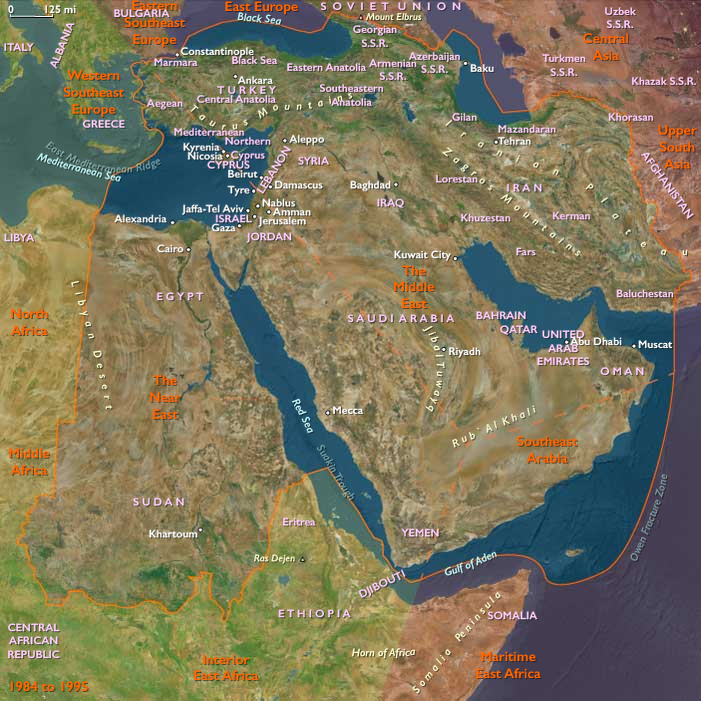
Between 1984 and 1995, the Middle East undergoes significant geopolitical shifts shaped by regional rivalries, superpower retrenchment following the Cold War, and changing internal dynamics within states. The era is defined by protracted conflict, evolving alliances, and critical peace initiatives.
The End of the Iran-Iraq War
The devastating Iran-Iraq War continues until 1988, concluding only after inflicting enormous human, economic, and environmental destruction on both sides. In August 1988, Ayatollah Ruhollah Khomeini reluctantly accepts UN Resolution 598, which mandates an immediate ceasefire. Neither country achieves its strategic objectives, leaving unresolved territorial disputes and lingering bitterness.
The conflict leaves Iraq heavily indebted, particularly to its Gulf Arab neighbors who had financed its war effort, creating tensions that quickly erupt into open hostility. Meanwhile, Iran remains politically isolated yet more resolutely committed to exporting its revolutionary ideals.
The Gulf War and its Aftermath
In August 1990, Iraqi President Saddam Hussein, seeking relief from economic pressures and claiming historical rights, invades and occupies Kuwait, prompting global condemnation. The United Nations swiftly imposes sanctions, and a U.S.-led international coalition assembles to reverse the occupation.
The Gulf War (Operation Desert Storm) begins in January 1991, resulting in the swift liberation of Kuwait and the decisive defeat of Iraqi forces. Iraq retreats, leaving catastrophic destruction behind, including widespread oil fires and environmental damage in Kuwait.
Despite Iraq's defeat, Saddam Hussein retains power, brutally suppressing Kurdish and Shi’a rebellions encouraged by the international community yet receiving limited external support. Subsequently, Iraq remains isolated, crippled by stringent international sanctions enforced under UN resolutions.
Rise of American Influence and the New Middle East Order
Following the collapse of the Soviet Union in 1991, American influence in the Middle East reaches unprecedented levels. The United States strengthens military alliances with Gulf Cooperation Council (GCC) countries, notably Saudi Arabia, Kuwait, Qatar, and the UAE, establishing permanent military bases to maintain regional stability and secure oil supplies.
However, the presence of American troops, especially in Saudi Arabia—home to Islam's holiest sites—provokes increasing resentment among local populations, fueling Islamist extremism that will later emerge violently in global politics.
Lebanon: The Taif Accord and a Fragile Peace
The protracted Lebanese Civil War, ongoing since 1975, reaches a negotiated resolution with the Taif Accord in 1989. Brokered with Saudi support, the accord redistributes political power, reducing Christian dominance, and increasing the political representation of Lebanon’s Muslim communities, especially Sunnis and Shi’as.
The accord, while ending major hostilities, institutionalizes Syrian influence, permitting a large Syrian military presence in Lebanon. Despite nominal peace, Lebanon remains politically fragmented, with Hezbollah consolidating influence in the Shi’a south and central government authority remaining weak.
Israeli-Palestinian Peace Efforts: Madrid and Oslo
In 1991, the United States and the Soviet Union convene the Madrid Conference, initiating direct negotiations between Israel and its Arab neighbors, including Palestinians. Although immediate results are limited, Madrid sets the stage for the historic breakthrough in 1993.
In 1993, Israel and the Palestine Liberation Organization (PLO) sign the Oslo Accords, leading to mutual recognition and the establishment of the Palestinian Authority in parts of the West Bank and Gaza. Yasser Arafat returns to Palestinian territory in 1994 as the head of the Palestinian Authority, symbolizing a historic step toward self-governance. However, unresolved issues—including the status of Jerusalem, refugees, and settlements—quickly stall momentum.
Jordan also formally ends its state of war with Israel, signing a peace treaty in October 1994, thereby significantly reshaping regional dynamics.
Iran after Khomeini: Pragmatism and Continued Revolution
Following the death of Ayatollah Khomeini in 1989, Iran undergoes a subtle internal realignment. Ayatollah Ali Khamenei succeeds Khomeini as Supreme Leader, while Akbar Hashemi Rafsanjani becomes president, advocating pragmatic economic policies and cautious international engagement. Despite Rafsanjani’s moderation, Iran remains ideologically committed to revolutionary Shi’a Islam, supporting Hezbollah in Lebanon, Palestinian militants, and various Shi’a factions throughout the Gulf.
Syria: Assad’s Grip Tightens
In Syria, President Hafez al-Assad remains a key regional player, especially in Lebanon and Palestinian affairs. Assad maintains stability through a ruthless security apparatus and continues to balance relationships with the West and Russia, skillfully navigating the post-Cold War diplomatic landscape.
Turkey’s Continued Evolution and Kurdish Conflict
In Turkey, political instability accompanies economic liberalization and rapid urbanization. Throughout the 1980s and early 1990s, Turkey grapples with the Kurdistan Workers' Party (PKK) insurgency, a conflict rooted in long-standing ethnic tensions and grievances. Despite harsh military responses, Kurdish demands for cultural and political rights intensify, influencing Turkish domestic politics and regional relations profoundly.
Caucasus: Georgia, Armenia, and Azerbaijan Post-Soviet Independence
With the collapse of the Soviet Union in 1991, Georgia, Armenia, and Azerbaijan achieve independence, facing significant internal and external challenges.
-
Georgia struggles with separatist conflicts in Abkhazia and South Ossetia, resulting in civil unrest and weak governance throughout the 1990s.
-
Armenia and Azerbaijan engage in a bitter conflict over Nagorno-Karabakh, an ethnic Armenian enclave inside Azerbaijan. A full-scale war erupts in 1988 and intensifies dramatically after independence. A ceasefire agreement in 1994 leaves Armenian forces in control of Nagorno-Karabakh and surrounding Azerbaijani territory, creating unresolved territorial disputes and animosity lasting decades.
These conflicts profoundly influence regional geopolitics, drawing in neighboring countries and global powers, complicating diplomatic efforts.
Legacy of Conflict, Diplomacy, and Transition (1984–1995)
The period from 1984 to 1995 significantly reshapes the Middle Eastern geopolitical landscape. The Gulf War realigns regional and global alliances, placing the United States as a preeminent external power with deepening involvement in Gulf security, a role bringing both stability and unintended consequences.
Peace efforts like the Oslo Accords raise hopes for an enduring Israeli-Palestinian settlement, yet unresolved core issues leave lasting uncertainty and frustration. Similarly, Lebanon’s Taif Accord achieves peace on paper but institutionalizes internal divisions and external influence.
Finally, the emergence of newly independent states in the Caucasus introduces fresh instability into the Middle East periphery, highlighting ethnic nationalism and territorial disputes that remain unresolved. Collectively, these events establish lasting dynamics that shape regional politics well into the 21st century.
People
- Akbar Hashemi Rafsanjani
- Ali Khamenei
- Hafez al- Assad
- Ruhollah Khomeini
- Saddam Hussein
- Yasser Arafat
Groups
- Georgians
- Armenian people
- Jews
- Kurdish people
- Abkhaz people
- Christians, Armenian Apostolic Orthodox
- Christians, Maronite
- Muslims, Sunni
- Muslims, Shi'a
- Muslims, Ibadi
- Oman, First Imamate of
- Alawites
- Ossetians
- Druze, or Druse, the
- Wahhabism
- Kuwait, Sheikhdom of
- Umm al-Qaywayn, or Umm al-Quwain, Emirate of
- United States of America (US, USA) (Washington DC)
- Armenia, Soviet Socialist Republic of
- Union of Soviet Socialist Republics (USSR), or Soviet Union
- Britain (United Kingdom of Great Britain and Northern Ireland)
- Muslim Brotherhood, the
- Saudi Arabia, Kingdom of
- Georgian Soviet Socialist Republic
- Azerbaijan Soviet Socialist Republic
- Lebanon, Republic of
- United Nations, The (U.N.)
- Arab League, or League of Arab States
- Syria, or Syrian Arab Republic
- Israel
- Jordan, Hashemite Kingdom of
- Iraq, First Republic of
- Cyprus, Republic of
- PLO (Palestine Liberation Organization)
- Oman, Sultanate of
- Bahrain
- Qatar, State of
- United Arab Emirates (U.A.E.)
- Greece (Hellenic Republic)
- PKK (Partiya Karkerên Kurdistan or Kurdistan Workers Party, aka KADEK and Kongra-Gel)
- Gulf Cooperation Council (GCC)
- Cyprus, Northern, Turkish Republic of
- Armenia, Republic of
- Russian Federation
- Georgia, Republic of
- Azerbaijan (Azerbaijani Republic)
- Palestinian National Authority
Topics
- Cold War
- Iran-Iraq War of 1980-88 (Persian Gulf War of 1980-88)
- Nagorno-Karabakh War
- Georgian-Ossetian conflict
- Persian Gulf War of 1990-91
- South Ossetian Rebellion
- South Ossetia, War in
- Abkhazia, War in (1992 and 1994)
Subjects
Regions
Subregions
Years: 1984 - 1995
People
- Akbar Hashemi Rafsanjani
- Ali Khamenei
- Hafez al- Assad
- Ruhollah Khomeini
- Saddam Hussein
- Yasser Arafat
Groups
- Georgians
- Armenian people
- Jews
- Kurdish people
- Abkhaz people
- Christians, Armenian Apostolic Orthodox
- Christians, Maronite
- Muslims, Sunni
- Muslims, Shi'a
- Muslims, Ibadi
- Oman, First Imamate of
- Alawites
- Ossetians
- Druze, or Druse, the
- Wahhabism
- Kuwait, Sheikhdom of
- Umm al-Qaywayn, or Umm al-Quwain, Emirate of
- United States of America (US, USA) (Washington DC)
- Armenia, Soviet Socialist Republic of
- Union of Soviet Socialist Republics (USSR), or Soviet Union
- Britain (United Kingdom of Great Britain and Northern Ireland)
- Muslim Brotherhood, the
- Saudi Arabia, Kingdom of
- Georgian Soviet Socialist Republic
- Azerbaijan Soviet Socialist Republic
- Lebanon, Republic of
- United Nations, The (U.N.)
- Arab League, or League of Arab States
- Syria, or Syrian Arab Republic
- Israel
- Jordan, Hashemite Kingdom of
- Iraq, First Republic of
- Cyprus, Republic of
- PLO (Palestine Liberation Organization)
- Oman, Sultanate of
- Bahrain
- Qatar, State of
- United Arab Emirates (U.A.E.)
- Greece (Hellenic Republic)
- PKK (Partiya Karkerên Kurdistan or Kurdistan Workers Party, aka KADEK and Kongra-Gel)
- Gulf Cooperation Council (GCC)
- Cyprus, Northern, Turkish Republic of
- Armenia, Republic of
- Russian Federation
- Georgia, Republic of
- Azerbaijan (Azerbaijani Republic)
- Palestinian National Authority
Topics
- Cold War
- Iran-Iraq War of 1980-88 (Persian Gulf War of 1980-88)
- Nagorno-Karabakh War
- Georgian-Ossetian conflict
- Persian Gulf War of 1990-91
- South Ossetian Rebellion
- South Ossetia, War in
- Abkhazia, War in (1992 and 1994)
Subjects
Regions
Subregions