
The Middle East (1948–1959): Independence, Conflict, and …
Years: 1948 - 1959
The Middle East (1948–1959): Independence, Conflict, and Cold War Alignments
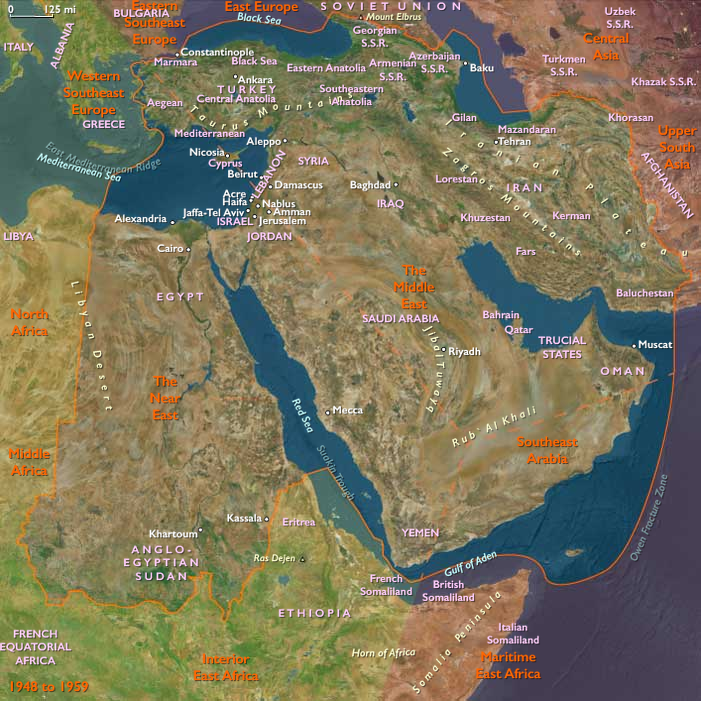
The era from 1948 to 1959 dramatically reshapes the political landscape of the Middle East, marked by the establishment of new states, the eruption of intense conflicts, and the region’s growing strategic importance amid Cold War rivalries. This period sees the founding of Israel, a surge in Arab nationalism, and major shifts in geopolitical alliances, all of which have profound long-term consequences.
Establishment of Israel and the Arab-Israeli Conflict
In 1947, the United Nations proposes partitioning British-mandated Palestine into separate Jewish and Arab states, igniting fierce Arab opposition. On May 14, 1948, the State of Israel declares independence, immediately triggering the 1948 Arab-Israeli War, as neighboring Arab states—including Egypt, Syria, Jordan, Iraq, and Lebanon—launch attacks aiming to prevent Israel's establishment.
Despite initial setbacks, Israel emerges victorious, expanding its territory beyond the original UN partition boundaries. Jordan takes control of the West Bank and East Jerusalem, while Egypt occupies the Gaza Strip. The conflict results in the mass displacement of over 700,000 Palestinian Arabs, marking the beginning of the Palestinian refugee crisis.
Armistice agreements in 1949 do not lead to peace; instead, a fragile ceasefire prevails. Tensions persist, shaping Arab-Israeli relations for decades.
Egypt and the Rise of Nasser
The early 1950s see a nationalist revolution in Egypt. In July 1952, a military coup led by Colonel Gamal Abdel Nasser overthrows King Farouk, abolishing Egypt’s monarchy and establishing a republic in 1953. Nasser rapidly rises as Egypt's foremost leader, championing Arab nationalism, anti-imperialism, and economic reform.
In 1956, Nasser nationalizes the Suez Canal, previously controlled by British and French interests, to finance the construction of the Aswan High Dam. Britain, France, and Israel respond with the Suez Crisis (1956), launching a coordinated invasion to retake control. International pressure, particularly from the United States and Soviet Union, forces the invading powers to withdraw, dramatically elevating Nasser’s prestige as a symbol of Arab resistance against colonialism and Western interference.
Syria and Lebanon: Political Instability and Emerging Nationalism
In Syria, the early independence period is turbulent, with frequent military coups and shifting governments. Syrian politics become increasingly radicalized, influenced by Arab nationalism, socialism, and a growing alignment with the Soviet Union. In 1958, Syria briefly unites with Egypt to form the United Arab Republic (UAR) under Nasser’s leadership, reflecting widespread Arab nationalist aspirations. However, the union proves short-lived due to internal disagreements, eventually dissolving in 1961.
In contrast, Lebanon experiences relative stability in the early 1950s but faces rising internal tensions by the decade’s end. The influx of Palestinian refugees after 1948 alters Lebanon’s delicate sectarian balance, increasing internal strain. President Camille Chamoun’s pro-Western stance in the late 1950s triggers unrest, culminating in the 1958 Lebanese crisis. U.S. Marines intervene militarily to support Chamoun, stabilizing the situation temporarily but highlighting Lebanon’s vulnerability to regional and sectarian pressures.
Iraq: Monarchy, Revolution, and the Emergence of the Republic
Iraq initially remains a conservative monarchy closely aligned with Britain. However, growing dissatisfaction with economic inequalities, British influence, and the monarchy’s pro-Western policies lead to mounting nationalist agitation.
In July 1958, a military coup led by General Abd al-Karim Qasim overthrows the Hashemite monarchy, brutally killing King Faisal II and his family. Iraq becomes a republic under Qasim, who institutes land reform, expands social welfare, and distances Iraq from Western alliances. Although initially popular, Qasim faces fierce internal struggles between Arab nationalist factions (including Ba'athists) and communists, foreshadowing further turmoil.
Iran: Mossadegh, Oil Nationalization, and the 1953 Coup
Iran in the early 1950s is dominated by nationalist leader Prime Minister Mohammad Mossadegh, who in 1951 nationalizes the British-owned Anglo-Iranian Oil Company, sparking a severe international crisis. Britain and the United States, concerned by Mossadegh’s increasingly independent policies and potential Soviet influence, orchestrate a covert operation (Operation Ajax) in 1953, removing Mossadegh and reinstating Shah Mohammad Reza Pahlavi’s autocratic rule.
The Shah consolidates his power, aligning firmly with Western interests, especially the United States. Though initially stabilizing Iran’s economy and securing Western support, this event sows deep resentment, fueling anti-Western sentiment and laying groundwork for future revolutionary movements.
Turkey and NATO Membership
Amid increasing Cold War tensions, Turkey moves decisively toward the West, joining the North Atlantic Treaty Organization (NATO) in 1952. This strategic alignment provides Turkey with military security and substantial U.S. economic aid. NATO membership firmly places Turkey as a critical Western ally bordering the Soviet Union, influencing regional dynamics significantly during the Cold War.
Saudi Arabia and the Gulf States: Rising Oil Revenues
The Arabian Peninsula experiences profound economic transformations during this era due to oil discoveries and exports. Saudi Arabia, under King Saud (1953–1964), rapidly expands infrastructure and development projects financed by burgeoning oil revenues. Saudi Arabia's geopolitical importance rises dramatically, becoming a key Western ally and an influential voice in Arab politics.
Smaller Gulf states such as Kuwait, Qatar, and Bahrain also benefit from increased oil revenues, transforming from impoverished sheikhdoms into wealthy states. These countries continue under British protection, maintaining traditional tribal governance structures but modernizing their economies rapidly.
Jordan: Consolidation under King Hussein
Jordan, having annexed the West Bank after the 1948 war, faces a significant Palestinian population and rising nationalist sentiment. King Hussein, ascending the throne in 1952, stabilizes his rule by balancing British and American support with domestic political reforms, carefully navigating regional tensions. Despite persistent challenges, Jordan emerges as a relatively stable monarchy in a volatile region.
Legacy of the Era (1948–1959)
The years between 1948 and 1959 leave an enduring legacy on Middle Eastern geopolitics. The establishment of Israel and subsequent Arab-Israeli conflict define regional hostilities for decades. The rise of assertive Arab nationalism, particularly under Nasser, reshapes political ideologies throughout the Arab world, challenging Western dominance. Iran’s pivotal 1953 coup plants seeds of future revolutionary upheaval, while oil wealth transforms the Arabian Peninsula into a global economic center. Amid Cold War dynamics, Turkey’s NATO membership and strategic alignments further polarize regional politics, embedding global tensions within local conflicts. The complex interplay of nationalism, colonial legacies, and superpower rivalry profoundly reshapes the Middle East, influencing regional and global politics for generations.
People
- Camille Chamoun
- Faisal II
- Farouk of Egypt
- Gamal Abdel Nasser
- Hussein of Jordan
- Mohammad Mosaddeq
- Mohammad Reza Pahlavi
- Saud of Saudi Arabia
Groups
- Arab people
- Armenian people
- Christians, Maronite
- Muslims, Sunni
- Muslims, Shi'a
- Muslims, Ibadi
- Azerbaijani people (Azeris)
- Druze, or Druse, the
- Christians, Eastern Orthodox
- Wahhabism
- Saud, House of
- United States of America (US, USA) (Washington DC)
- Britain (United Kingdom of Great Britain and Ireland)
- Trucial States
- Greece, Kingdom of
- Muscat and Oman
- Bahrain, British protectorate of
- Arab nationalism
- France (French republic); the Third Republic
- Kuwait, British protectorate of
- Qatar, British Protectorate of
- Syria, French Mandate of
- Armenia, Soviet Socialist Republic of
- Transcaucasian Socialist Federative Soviet Republic
- Union of Soviet Socialist Republics (USSR), or Soviet Union
- Egypt, Kingdom of (British Protectorate)
- Turkey, Republic of
- Britain (United Kingdom of Great Britain and Northern Ireland)
- Irgun (Irgun Tsvai Leumi; Hebrew: "National Military Organization", or Etzel)
- Saudi Arabia, Kingdom of
- Germany, Third Reich
- Lehi (Lohamei Herut Israel, "Fighters for the Freedom of Israel", aka the Stern Gang)
- Lebanon, Republic of
- Arabian-American Oil Company (Aramco)
- United Nations, The (U.N.)
- Syria, or Syrian Arab Republic
- Israel
- Gaza Strip
- West Bank
- NATO (North Atlantic Treaty Organization)
- Iraq, First Republic of
- Hashemite Arab Federation
- United Arab Republic
- United Arab Republic (U.A.R.; Arab Republics of Egypt and Syria)
Topics
Commodoties
Subjects
Regions
Subregions
Years: 1948 - 1959
People
- Camille Chamoun
- Faisal II
- Farouk of Egypt
- Gamal Abdel Nasser
- Hussein of Jordan
- Mohammad Mosaddeq
- Mohammad Reza Pahlavi
- Saud of Saudi Arabia
Groups
- Arab people
- Armenian people
- Christians, Maronite
- Muslims, Sunni
- Muslims, Shi'a
- Muslims, Ibadi
- Azerbaijani people (Azeris)
- Druze, or Druse, the
- Christians, Eastern Orthodox
- Wahhabism
- Saud, House of
- United States of America (US, USA) (Washington DC)
- Britain (United Kingdom of Great Britain and Ireland)
- Trucial States
- Greece, Kingdom of
- Muscat and Oman
- Bahrain, British protectorate of
- Arab nationalism
- France (French republic); the Third Republic
- Kuwait, British protectorate of
- Qatar, British Protectorate of
- Syria, French Mandate of
- Armenia, Soviet Socialist Republic of
- Transcaucasian Socialist Federative Soviet Republic
- Union of Soviet Socialist Republics (USSR), or Soviet Union
- Egypt, Kingdom of (British Protectorate)
- Turkey, Republic of
- Britain (United Kingdom of Great Britain and Northern Ireland)
- Irgun (Irgun Tsvai Leumi; Hebrew: "National Military Organization", or Etzel)
- Saudi Arabia, Kingdom of
- Germany, Third Reich
- Lehi (Lohamei Herut Israel, "Fighters for the Freedom of Israel", aka the Stern Gang)
- Lebanon, Republic of
- Arabian-American Oil Company (Aramco)
- United Nations, The (U.N.)
- Syria, or Syrian Arab Republic
- Israel
- Gaza Strip
- West Bank
- NATO (North Atlantic Treaty Organization)
- Iraq, First Republic of
- Hashemite Arab Federation
- United Arab Republic
- United Arab Republic (U.A.R.; Arab Republics of Egypt and Syria)
Topics
Commodoties
Subjects
Regions
Subregions