
The Middle East (1912–1923): The Collapse of …
Years: 1912 - 1923
The Middle East (1912–1923): The Collapse of Ottoman Authority and the Rise of Nationalism
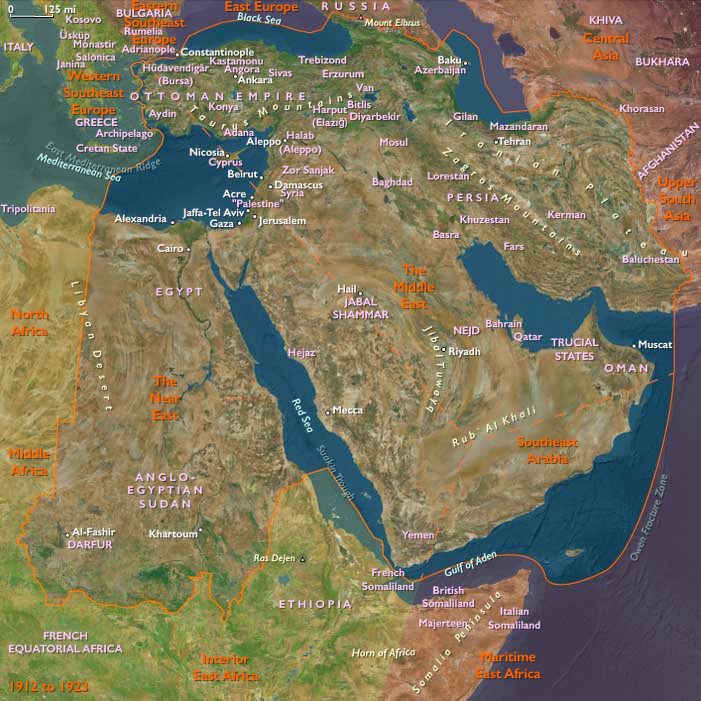
The period from 1912 to 1923 marks a transformative era in the history of the Middle East, characterized by the collapse of the Ottoman Empire, intensified European intervention, and the emergence of nationalist movements striving to define modern nation-states from the ruins of imperial rule. Iraq, Armenia, Syria, Lebanon, and Arabia witness profound social, political, and economic upheaval that reshapes the region for the rest of the twentieth century.
Collapse of Ottoman Control and the First World War
Ottoman rule in the Middle East, weakened by decades of internal fragmentation, nationalist movements, and increasing European intervention, crumbles under the strain of the First World War (1914–1918). Ottoman Turkey sides with the Central Powers (Germany and Austria-Hungary), a decision that will lead directly to the empire's demise. The Middle East becomes one of the primary battlegrounds of the war, with devastating consequences for the region.
The British, seeking to secure routes to their empire in India and protect strategic resources, launch major offensives in Mesopotamia (Iraq) and Palestine, capturing key cities like Baghdad (1917) and Jerusalem (1917). Meanwhile, Arab nationalists, encouraged by British promises of post-war independence, revolt against Ottoman authority, notably in the Arab Revolt (1916–1918), spearheaded by Sharif Hussein ibn Ali of Mecca and assisted by British officer T.E. Lawrence ("Lawrence of Arabia"). These combined pressures accelerate Ottoman collapse, leaving behind a vacuum that Western powers eagerly exploit.
Arab Nationalism and the Emergence of Iraq
In Iraq, the Ottoman decline accelerates preexisting social and political fragmentation. The Ottoman legacy of decentralized governance leaves Iraq divided between tribes, cities, and religious groups, with a nascent but vocal intelligentsia advocating for nationalism. Influenced by the earlier reforms of the Young Turks—which alienated many Arabs through forced "Turkification"—Iraqi intellectuals and army officers form secret nationalist groups, notably Al Ahd (the Covenant), whose membership swells to several thousand by the war’s outbreak.
During the war, British forces quickly overwhelm Ottoman troops in Mesopotamia, capturing Basra (1914) and Baghdad (1917), placing the entire territory under British control by 1918. Post-war, Britain receives a League of Nations mandate over Iraq, combining Mosul, Baghdad, and Basra into one administrative entity despite considerable cultural, ethnic, and sectarian differences. This artificial unity generates lasting internal tensions. Iraqi nationalists, disappointed by broken British promises of independence, begin demanding full sovereignty, setting the stage for persistent anti-colonial resistance.
Armenian Genocide and National Tragedy
In eastern Anatolia, the Armenian genocide (1915–1923) unfolds as one of the most tragic events of the era. Fearing Armenian sympathies with Russia during wartime, the Ottoman government initiates mass deportations and systematic massacres of the Armenian population. Approximately 1.5 million Armenians perish, and hundreds of thousands more flee to Russian Armenia, Lebanon, Syria, and elsewhere. This devastating genocide permanently alters the demographic and cultural landscape of Anatolia, deeply traumatizing the surviving Armenian diaspora and profoundly shaping Armenian national identity.
Following the war, Armenian survivors briefly establish the independent Republic of Armenia (1918–1920), but it succumbs quickly to Soviet conquest, becoming the Armenian Soviet Socialist Republic in 1920.
Rise of Mustafa Kemal and the Turkish Republic
In Anatolia, Ottoman defeat leads directly to the rise of Turkish nationalism under Mustafa Kemal (Atatürk). Rejecting the harsh terms imposed by the post-war Treaty of Sèvres (1920)—which partitions Anatolia among European powers and proposes independent Armenian and Kurdish states—Mustafa Kemal organizes armed resistance, culminating in victory during the Turkish War of Independence (1919–1922). Kemal’s forces defeat Greek armies occupying western Anatolia, forcing the Allies to negotiate a new settlement.
The resulting Treaty of Lausanne (1923) recognizes the sovereignty of the new Republic of Turkey, abolishes the Ottoman Sultanate, and ends centuries of Ottoman rule. Mustafa Kemal, now Turkey’s first president, institutes sweeping secular reforms, Westernizes Turkish society, and moves the capital from Istanbul to Ankara, definitively ending the Ottoman era.
Mandate States: Syria and Lebanon
The dismantling of Ottoman Syria leads to the establishment of French mandates in Syria and Lebanon. Under the Sykes-Picot Agreement (1916), Britain and France had secretly agreed to partition Ottoman territories after the war, ignoring promises made to Arab nationalists. Syria’s nationalists resist French control, resulting in the proclamation of a short-lived Arab Kingdom of Syria under King Faisal I in 1920. France quickly suppresses this state, imposing direct colonial administration, which fuels resentment and nationalist agitation.
In Lebanon, France creates "Greater Lebanon" in 1920 by merging Mount Lebanon with coastal cities, the Beqaa Valley, and predominantly Muslim areas in the south and north. The new entity, intended to establish a friendly Christian-majority state, nevertheless sows seeds of sectarian conflict that will plague Lebanon throughout the twentieth century.
Arabia and the Consolidation of Al Saud
In Arabia, Abdulaziz ibn Saud capitalizes on Ottoman decline and regional instability. From his base in Najd, Abdulaziz unites disparate tribes and, with support from the conservative Wahhabi religious movement, gradually conquers much of the Arabian Peninsula. By 1921, Abdulaziz secures control over much of the Najd region and begins to threaten British-protected Gulf sheikhdoms and the Hashemite rulers of the Hejaz, foreshadowing the eventual establishment of Saudi Arabia.
Persia’s Continued Struggle for Sovereignty
In Persia (Iran), the Qajar dynasty remains vulnerable to foreign influence and internal instability. Despite the 1906 Constitutional Revolution, Russia and Britain continue to dominate Iranian politics and economy, dividing the nation into spheres of influence. Widespread resentment of foreign exploitation and government corruption leads to nationalist discontent, setting the stage for future internal upheaval and the eventual rise of the Pahlavi dynasty under Reza Shah.
Legacy of the Era (1912–1923)
The collapse of the Ottoman Empire and the tumultuous aftermath of World War I fundamentally reshape the Middle East, creating the modern geopolitical framework. New states and borders drawn arbitrarily by European powers, along with imposed national identities, sow the seeds of future instability. Nationalist movements emerge with force, driven by resistance to colonial domination, laying the foundation for independence struggles that will define the subsequent decades. Conflicts and resentments arising in this era—sectarian, ethnic, and nationalist—persist, profoundly influencing the historical trajectory of the region through the twentieth century and beyond.
People
- Abdulaziz Ibn Saud
- Faisal I of Iraq and Syria
- Hussein ibn Ali al-Hashimi
- Mozaffar ad-Din Shah Qajar
- Mustafa Kemal Atatürk
- Reza Shah
- T. E. Lawrence
Groups
- Arab people
- Armenian people
- Christians, Maronite
- Muslims, Sunni
- Muslims, Shi'a
- Muslims, Ibadi
- Azerbaijani people (Azeris)
- Druze, or Druse, the
- Christians, Eastern Orthodox
- Russians (East Slavs)
- Ottoman Empire
- Russian Empire
- Wahhabism
- Kuwait, Sheikhdom of
- Saud, House of
- United States of America (US, USA) (Washington DC)
- Britain (United Kingdom of Great Britain and Ireland)
- Trucial States
- Armenia, Russian
- Muscat and Oman
- Mount Lebanon Mutasarrifate
- Bahrain, British protectorate of
- Austria-Hungary
- Qatar, Emirate of
- German Empire (“Second Reich”)
- France (French republic); the Third Republic
- Kuwait, British protectorate of
- Young Turks
- Armenia, Democratic Republic of
- Turkey, provisional revolutionary
- League of Nations, The
- Syria, French Mandate of
- Armenia, Soviet Socialist Republic of
- Union of Soviet Socialist Republics (USSR), or Soviet Union
- Turkey, Republic of
Topics
- First World War in Mesopotamia
- World War, First (World War I)
- Armenian genocide
- Armenian Massacres of 1915
- First World War in Palestine
- Turkish War of Independence
- Turkish-Armenian War
Commodoties
Subjects
Regions
Subregions
Related Events
Showing 10 events out of 7966 total
Years: 1912 - 1923
People
- Abdulaziz Ibn Saud
- Faisal I of Iraq and Syria
- Hussein ibn Ali al-Hashimi
- Mozaffar ad-Din Shah Qajar
- Mustafa Kemal Atatürk
- Reza Shah
- T. E. Lawrence
Groups
- Arab people
- Armenian people
- Christians, Maronite
- Muslims, Sunni
- Muslims, Shi'a
- Muslims, Ibadi
- Azerbaijani people (Azeris)
- Druze, or Druse, the
- Christians, Eastern Orthodox
- Russians (East Slavs)
- Ottoman Empire
- Russian Empire
- Wahhabism
- Kuwait, Sheikhdom of
- Saud, House of
- United States of America (US, USA) (Washington DC)
- Britain (United Kingdom of Great Britain and Ireland)
- Trucial States
- Armenia, Russian
- Muscat and Oman
- Mount Lebanon Mutasarrifate
- Bahrain, British protectorate of
- Austria-Hungary
- Qatar, Emirate of
- German Empire (“Second Reich”)
- France (French republic); the Third Republic
- Kuwait, British protectorate of
- Young Turks
- Armenia, Democratic Republic of
- Turkey, provisional revolutionary
- League of Nations, The
- Syria, French Mandate of
- Armenia, Soviet Socialist Republic of
- Union of Soviet Socialist Republics (USSR), or Soviet Union
- Turkey, Republic of
Topics
- First World War in Mesopotamia
- World War, First (World War I)
- Armenian genocide
- Armenian Massacres of 1915
- First World War in Palestine
- Turkish War of Independence
- Turkish-Armenian War
Commodoties
Subjects
Regions
Subregions