
The Middle East: 1888–1899 CE Ottoman …
Years: 1888 - 1899
The Middle East: 1888–1899 CE
Ottoman Stagnation and Armenian Unrest
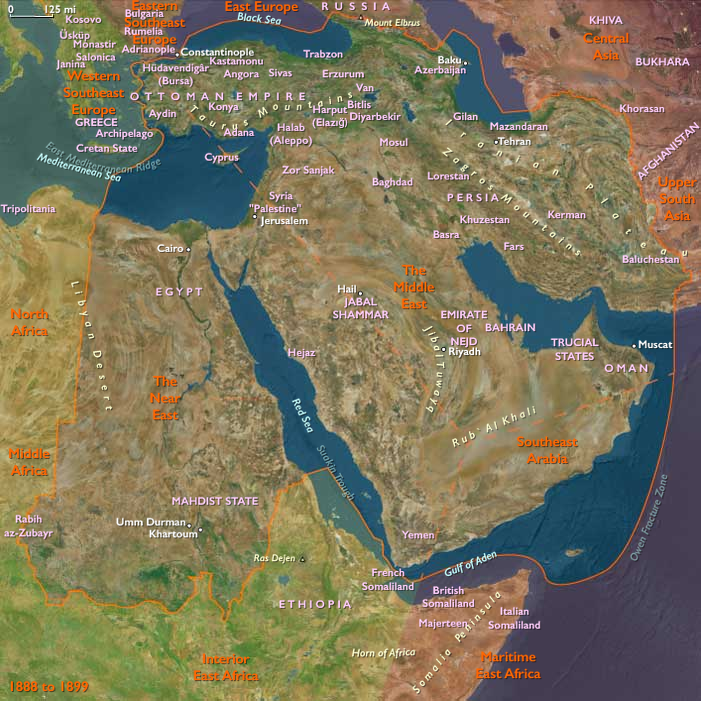
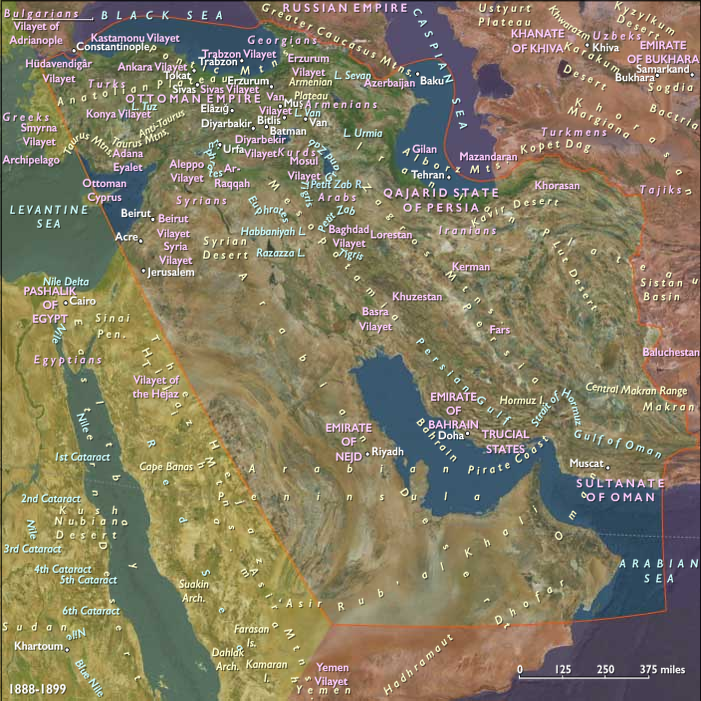
From 1888 to 1899, the Ottoman Empire experiences deepening stagnation under Sultan Abdul Hamid II, whose autocratic rule continues to suppress constitutional reform and centralize power. Armenian unrest significantly intensifies as nationalist movements demand greater autonomy and protection from Ottoman abuses. This unrest culminates in severe atrocities against Armenians, notably the Hamidian Massacres (1894–1896), during which approximately three hundred thousand Armenians are killed on direct orders from the Ottoman government. These atrocities provoke international condemnation, notably from Russia and Britain, highlighting the empire’s vulnerabilities and further eroding its international standing. Armenian revolutionary groups, particularly the Armenian Revolutionary Federation (Dashnak), grow stronger, advocating autonomy within both the Russian and Ottoman empires. Ethnic tensions are exacerbated by the rapid growth of the Kurdish population in Anatolia and the immigration of Muslims from the Balkans and Caucasus, making Armenians increasingly endangered.
Lebanese Cultural Renaissance and Political Ambivalence
Lebanon continues its intellectual and cultural renaissance, marked by the influential American University of Beirut (founded 1866) and St. Joseph’s University (1875). Lebanese intellectual and literary circles flourish, significantly impacting broader Arab intellectual movements. Despite these cultural advances, Lebanon’s political landscape remains fragmented. Sectarian tensions resurface, exacerbated by the harsh rule of Abdul Hamid II, prompting Arab nationalists in Beirut and Damascus to form clandestine political groups. Maronite Christians debate secession, Greek Orthodox Christians advocate integration within an independent Syria, Sunni Muslims uphold Ottoman unity, and Druze and Shia communities cautiously favor neutrality or independence. This period of political ambivalence sees no clear consensus emerge, setting the stage for future instability.
Al Saud Struggles and the Rise of Al Rashid
Internal dissension continues to weaken the Al Saud control over central Arabia. The rival Al Rashid family from Jabal Shammar capitalizes on this instability, displacing the Al Saud from Riyadh in 1891. Abd ar Rahman ibn Faisal, the last effective leader of the second Saudi state, flees with his family, including his son Abdul Aziz ibn Saud, to Kuwait. This marks a significant setback for the Al Saud, creating conditions that eventually enable their later resurgence and the formation of modern Saudi Arabia.
Persian Concessions and Nationalist Frustration
Under Naser ad-Din Shah, Persia experiences increasing frustration due to extensive foreign concessions. In 1888, the shah opens the Karun River in Khuzestan Province to foreign shipping and allows Baron von Reuter to establish Iran’s first bank, the Imperial Bank of Persia. In 1890, the shah grants a tobacco monopoly to British businessman G.F. Talbot, sparking the widespread Tobacco Protest (1891–1892). Clerics, merchants, and ordinary citizens unite against the concession, with a religious fatwa by cleric Mirza Hasan Shirazi leading to a successful boycott. The shah is forced to rescind the concession in 1892, significantly bolstering Iranian nationalism and the political influence of the clergy, though at considerable cost to an already depleted treasury.
British Influence and Maritime Stability in Oman
Under Faisal ibn Turki Al Sa'id, who succeeds peacefully as ruler, Oman continues to prosper under British protection, enjoying maritime stability and strengthened trade connections across the Indian Ocean. The separation between Muscat, Oman, and Zanzibar remains effective, with British naval power reinforcing regional security. Despite periodic tribal uprisings led by the Ibadi imamate, notably in 1895, the British effectively sustain the Al Bu Sa'id dynasty’s authority, preventing internal dissension from significantly disrupting commerce and governance.
Economic Prosperity in the Persian Gulf
Qatar and Abu Dhabi benefit economically from regional pearling and trade, sustained under stable rule by the Al Thani and Al Nahyan families. British maritime protection ensures continued prosperity and internal stability, allowing these emirates to consolidate their authority. Qatar remains culturally distinct due to its alignment with Wahhabism, setting it apart from neighboring emirates, while both states lay strong economic and political foundations for their eventual modern nationhood.
Iraq’s Integration into the Global Economy
Iraq continues its socioeconomic advancement, driven by ongoing infrastructure developments, including telegraph expansion, improved transportation networks, and trade facilitated by the Suez Canal. The implementation of the TAPU land laws strengthens tribal landlords, altering Iraq's socioeconomic landscape significantly. Secular education expands, fostering a burgeoning class of Western-educated Iraqis. Under the governorship of reform-minded leaders like Midhat Pasha, Iraq experiences enhanced urbanization and centralized administration, firmly integrating into global commerce.
Nationalist Awakening in the Caucasus
Nationalist sentiments among Armenians, Georgians, and Azerbaijanis intensify under Russian rule. Armenians, galvanized by the Hamidian Massacres, increasingly internationalize their cause, gaining global support. Armenian revolutionary parties, such as the Armenian Revolutionary Federation (Dashnak), send organizers to Turkey and advocate autonomy. In Azerbaijan, ethnic Russians dominate Baku's rapidly growing oil industry, dramatically altering its demographic and economic character. Armenians also gain prominence in commerce and local administration. Baku becomes the largest city in the Caucasus by 1897, with significant Russian and Armenian populations. Georgian resistance to Russification intensifies as local nobility declines, and Armenian merchant influence grows, prompting Russia to assert direct control over Armenian religious and political institutions by the end of the century.
Legacy of the Era
From 1888 to 1899, transformative developments significantly reshape the Middle East. The Ottoman Empire's internal weaknesses and atrocities against Armenians draw international condemnation; Lebanese cultural and intellectual advances contrast sharply with political instability; the Al Saud suffer major setbacks; Persian nationalism emerges strongly in response to foreign concessions; Persian Gulf emirates enjoy sustained economic prosperity; Iraq integrates deeply into the global economy; and nationalist fervor escalates across the Caucasus. Collectively, these developments profoundly influence the region's subsequent political, cultural, and economic trajectories.
People
- Abdul Hamid II
- Abdul Rahman bin Faisal
- Abdulaziz Ibn Saud
- Faisal bin Turki
- Paul Reuter
- Naser al-Din Shah Qajar
Groups
- Georgians
- Arab people
- Armenian people
- Christians, Maronite
- Muslims, Sunni
- Muslims, Shi'a
- Muslims, Ibadi
- Azerbaijani people (Azeris)
- Druze, or Druse, the
- Christians, Eastern Orthodox
- Russians (East Slavs)
- Ottoman Empire
- Thani, House of
- Al Nahayan family
- Abu Dhabi, Emirate of
- Prussia, Kingdom of
- Russian Empire
- Wahhabism
- Kuwait, Sheikhdom of
- United States of America (US, USA) (Washington DC)
- Georgia within the Russian Empire
- Britain (United Kingdom of Great Britain and Ireland)
- Armenia, Russian
- Muscat and Oman
- Zanzibar, Omani Sultanate of
- Mount Lebanon Mutasarrifate
- Qatar, Emirate of
- Zanzibar, (British) Protectorate of
- Kuwait, British protectorate of
Topics
Commodoties
Subjects
Regions
Subregions
Related Events
Showing 10 events out of 10660 total
Years: 1888 - 1899
People
- Abdul Hamid II
- Abdul Rahman bin Faisal
- Abdulaziz Ibn Saud
- Faisal bin Turki
- Paul Reuter
- Naser al-Din Shah Qajar
Groups
- Georgians
- Arab people
- Armenian people
- Christians, Maronite
- Muslims, Sunni
- Muslims, Shi'a
- Muslims, Ibadi
- Azerbaijani people (Azeris)
- Druze, or Druse, the
- Christians, Eastern Orthodox
- Russians (East Slavs)
- Ottoman Empire
- Thani, House of
- Al Nahayan family
- Abu Dhabi, Emirate of
- Prussia, Kingdom of
- Russian Empire
- Wahhabism
- Kuwait, Sheikhdom of
- United States of America (US, USA) (Washington DC)
- Georgia within the Russian Empire
- Britain (United Kingdom of Great Britain and Ireland)
- Armenia, Russian
- Muscat and Oman
- Zanzibar, Omani Sultanate of
- Mount Lebanon Mutasarrifate
- Qatar, Emirate of
- Zanzibar, (British) Protectorate of
- Kuwait, British protectorate of
Topics
Commodoties
Subjects
Regions
Subregions