
The Near and Middle East (1828–1971 CE) …
Years: 1828 - 1971
The Near and Middle East (1828–1971 CE)
Empires in Decline, Nations in Transition, and Oil in Ascendancy
Geography & Environmental Context
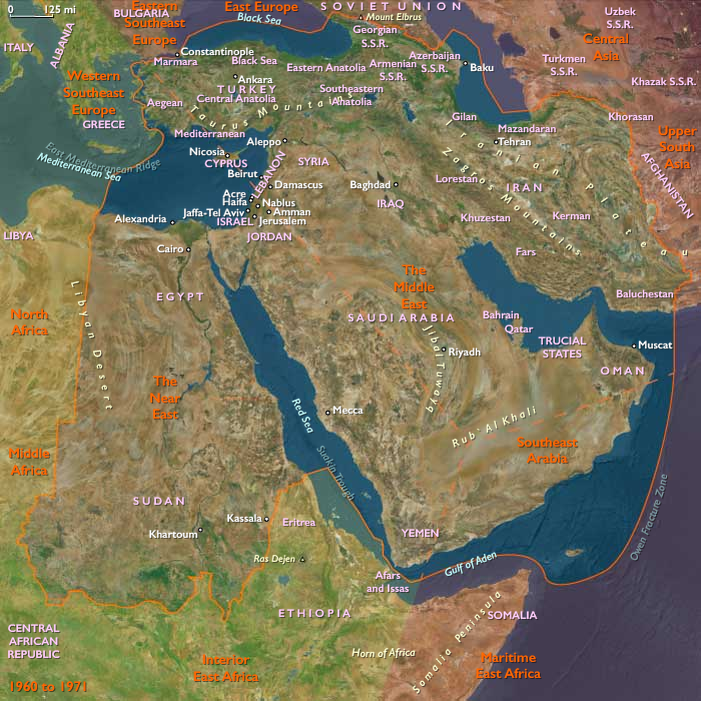
The Near and Middle East includes three fixed subregions:
-
The Near East — Israel, Egypt, Sudan, western Saudi Arabia, Yemen, Jordan, southwestern Turkey, and southwestern Cyprus.
-
The Middle East — Iraq, Iran, Syria, Armenia, Georgia, Azerbaijan, Qatar, Bahrain, the United Arab Emirates, eastern Jordan, eastern Saudi Arabia, and northern Oman.
-
Southeast Arabia — southern Oman, eastern Yemen, and the island of Socotra.
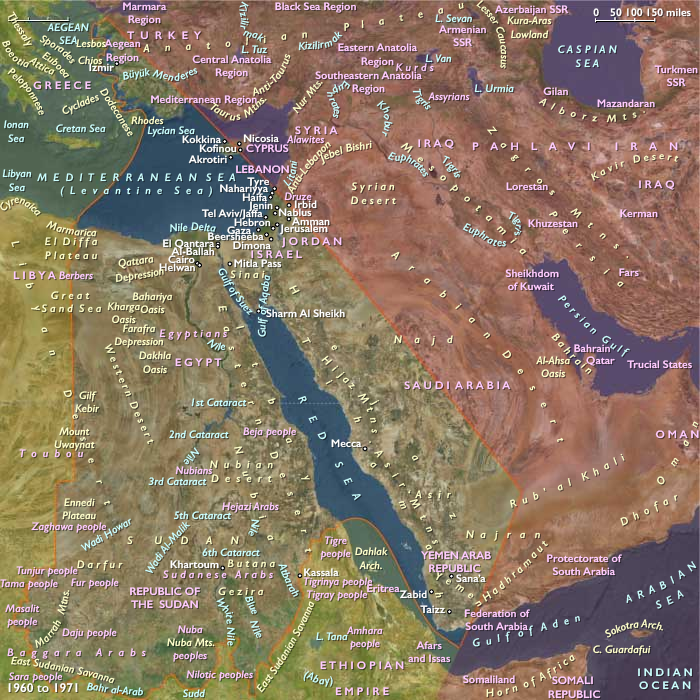
This vast region links the Mediterranean, Red Sea, Persian Gulf, and Caspian Basin, bridging Africa, Europe, and Asia. It is dominated by deserts and highlands, punctuated by fertile river valleys (the Nile, Tigris, and Euphrates) and strategic straits — the Suez Canal, the Bab el-Mandeb, and the Strait of Hormuz — that define global trade and geopolitics.
Climate & Environmental Shifts
Aridity remained the defining condition. The 19th century brought episodes of famine and epidemic following droughts in Egypt, Iran, and the Arabian Peninsula. Irrigation schemes and canal building, such as the Suez Canal (opened 1869) and the Assiut Barrage (1902), transformed riverine agriculture. Petroleum exploration and urban expansion in the 20th century accelerated desertification and water demand. Monsoon moisture sustained oases in Oman and Yemen, while seasonal Nile floods continued until the Aswan High Dam (1960–70) reshaped the river’s ecology.
Subsistence & Settlement
-
Agrarian bases persisted in the Nile Valley, the Fertile Crescent, and the Iranian Plateau, producing wheat, cotton, dates, and fruits.
-
Nomadic and pastoral tribes in Arabia, the Levant, and Sudan maintained camel and sheep herding, adapting to modern markets.
-
Urbanization surged in Cairo, Istanbul, Tehran, Baghdad, Beirut, and Jeddah, intensified by European trade and oil wealth.
-
Port cities—Aden, Basra, Kuwait City, Manama, and Doha—grew into nodes of global commerce.
Technology & Material Culture
European imperial penetration introduced telegraphs, railways (notably the Hejaz Railway, 1908), and modern weaponry. In the 20th century, oil extraction and refining brought pipelines, tankers, and industrial zones. Traditional crafts—carpets, calligraphy, metalwork, and ceramics—remained vital symbols of identity. Concrete architecture and Western education transformed cities, while mosques and bazaars continued as cultural anchors.
Movement & Interaction Corridors
-
Trade routes: The Suez Canal reoriented world shipping; the Persian Gulf became an oil artery.
-
Pilgrimage: The Hajj connected Muslims globally through Mecca and Medina.
-
Migration: Rural–urban drift filled cities; labor migration later linked Yemenis, Egyptians, and Iranians to Gulf oil fields.
-
Military corridors: The Near and Middle East served as theaters of imperial rivalries—British in the Gulf and Egypt, Russians in the Caucasus, Ottomans across Anatolia and Arabia.
Cultural & Symbolic Expressions
-
Religion and reform: Islamic modernists such as Jamal al-Din al-Afghani and Muhammad Abduh sought synthesis of faith and reason; Christian minorities in Lebanon and Armenia fostered education and journalism.
-
Literature and art: The Nahda (Arab Renaissance) revived Arabic prose and poetry; Persian and Turkish writers blended realism with nationalism.
-
Architecture: Cairo’s modern boulevards, Tehran’s avenues, and oil-era Gulf skylines redefined urban form while domed mosques and minarets remained emblems of continuity.
-
Music and media: Radio and cinema from Cairo, Tehran, and Istanbul spread popular culture across linguistic and sectarian boundaries.
Environmental Adaptation & Resilience
Desert agriculture expanded through artesian wells and canals; the introduction of cash crops like cotton in Egypt and tobacco in Iran restructured rural economies. Oases sustained date-palm and grain cultivation, while pastoralists adjusted routes to motor transport and border restrictions. In coastal cities, desalination and modern infrastructure emerged to offset water scarcity.
Political & Military Shocks
-
Imperial decline and reform:
-
The Ottoman Empire weakened, culminating in its dissolution after World War I.
-
Egypt’s Muhammad Ali dynasty modernized administration and industry but fell under British occupation (1882).
-
Iran’s Qajar dynasty faced constitutional revolution (1905–11) and later Pahlavi modernization (from 1925).
-
-
World Wars and mandates: British and French mandates carved up former Ottoman territories; Iraq, Syria, Lebanon, Transjordan, and Palestine emerged under European oversight.
-
Nationalism and revolution:
-
Turkey’s Republic (1923) under Mustafa Kemal Atatürk secularized and industrialized Anatolia.
-
Arab nationalism surged—Nasser’s Egypt championed anti-imperial unity.
-
Iran underwent the 1951 oil nationalization crisis and the White Revolution (1963).
-
The Zionist movement culminated in the creation of Israel (1948) and successive Arab–Israeli wars (1948, 1956, 1967).
-
-
Oil and Cold War: The discovery of major oil fields (Iran 1908; Iraq 1927; Saudi Arabia 1938; Kuwait 1938) made the region central to global power politics. U.S. and Soviet rivalry deepened through alliances and arms races.
Transition
Between 1828 and 1971, the Near and Middle East transformed from imperial provinces and desert sultanates into a mosaic of nation-states, revolutionary republics, and monarchies bound by oil and ideology. The collapse of Ottoman and colonial empires unleashed nationalist movements, while petroleum wealth and Cold War geopolitics redefined economies and alliances. In the deserts of Arabia and the deltas of the Nile and Tigris-Euphrates, modernization coexisted with faith, and cities like Cairo, Tehran, and Riyadh became centers of a region poised between deep tradition and global transformation
People
- Gamal Abdel Nasser
- Jamal al-Din al-Afghani
- Muhammad Ali of Egypt
- Muhammad Abduh
- Mustafa Kemal Atatürk
Groups
- Georgians
- Arab people
- Omanis
- Persian people
- Armenian people
- Jews
- Christians, Armenian Apostolic Orthodox
- Christians, Maronite
- Islam
- Muslims, Sunni
- Muslims, Shi'a
- Muslims, Ibadi
- Druze, or Druse, the
- Palestine, Ottoman
- Mount Lebanon Emirate
- Cyprus, Ottoman
- Omani Empire
- Al Qasimi (Adnani Arabian tribe)
- Abu Dhabi, Emirate of
- Ra's al-Khaymah, or Ras al-Khaimah, Emirate of
- Russian Empire
- Sharjah (ash-Shariqah), Emirate of
- Wahhabism
- Oman, Sultanate of
- Ajman, or 'Ujman, Emirate of
- Kuwait, Sheikhdom of
- Saud, House of
- Umm al-Qaywayn, or Umm al-Quwain, Emirate of
- Persia, Qajarid Kingdom of
- Dubai, Emirate of
- al-Fujayrah, or Fujairah, Emirate of
- Britain (United Kingdom of Great Britain and Ireland)
- Georgia within the Russian Empire
- Bahrain, Emirate of
- Trucial States
- Armenia, Russian
- Yemen, Ottoman eyalet of
- Mount Lebanon Mutasarrifate
- Muscat and Oman
- Bahrain, British protectorate of
- Arab nationalism
- Syria, Ottoman viyalet of
- Qatar, Emirate of
- Cyprus, Ottoman viyalet of
- Mount Lebanon, Ottoman mutasarrifate of Beirut, or
- Cyprus, British
- Hovevei Zion
- ZO (Zionist Organization)
- Kuwait, British protectorate of
- Qatar, British Protectorate of
- Azerbaijan Democratic Republic
- Armenia, Democratic Republic of
- Georgia, Democratic Republic of
- Yemen, Mutawakkilite Kingdom of (North Yemen)
- Palestine and Trans-Jordan
- Armenia, Soviet Socialist Republic of
- Syria, French Mandate of
- Persia, Pahlavid Kingdom of
- Iraq, Hashemite Kingdom of
- Jewish Agency for Palestine
- Betar (World Zionist Youth Movement)
- Turkey, Republic of
- Palestine, British Mandate of
- Cyprus, British Crown Colony of
- Britain (United Kingdom of Great Britain and Northern Ireland)
- Saudi Arabia, Kingdom of
- Iran, Pahlavid Kingdom of
- Azerbaijan Soviet Socialist Republic
- Georgian Soviet Socialist Republic
- Lebanon, Republic of
- Arab League, or League of Arab States
- France (French republic); the Fourth Republic
- Syria, or Syrian Arab Republic
- Palestinians
- United Arab Republic
- United Arab Republic (U.A.R.; Arab Republics of Egypt and Syria)
- Iraq, First Republic of
- France (French republic); the Fifth Republic
- PLF (Palestine Liberation Front)
- Cyprus, Republic of
- WZO (World Zionist Organization)
- Kuwait
- United Arab Republic (U.A.R.; Arab Republic of Egypt)
- North Yemen (Yemen Arab Republic)
- Yemen Arab Republic (North Yemen)
- PLO (Palestine Liberation Organization)
- PFLP (Popular Front for the Liberation of Palestine)
- South Yemen
- Iraq, Ba'athist
- PFLP-GC (Popular Front for the Liberation of Palestine-General Command)
- PDFLP (Popular Democratic Front for the Liberation of Palestine)
- Oman, Sultanate of
- Yemen, People's Democratic Republic of (South Yemen)
- United Arab Emirates (U.A.E.)
- Bahrain
- Qatar, State of
Topics
- Saudi Civil Wars of 1818-1843
- Sudan Conquest
- Turco-Egyptian War, First
- Syrian Peasant Revolt
- Egypt: Famine of 1835
- Arabian War
- Tanzimat
- Egyptian–Ottoman War, Second
- Nahda, the, or Arab Enlightenment
- 1860 Mount Lebanon civil war
- Lebanon, Battle of
- Ethio-Egyptian War
- Zionism and the First Aliyah; 1876-1899
- Anti-European Rioting: Egypt
- Anglo-Egyptian War (1882)
- Sudan: Famine of 1888
- Hamidian massacres
- British Reconquest of Sudan
- Sudanese War of 1896-99
- Saudi Arabia, Unification of
- Saudi-Rashidi War, First
- Anglo-Ottoman Border Dispute
- Iranian Constitutional Revolution or Persian Revolution
- Armenian Massacres of 1909
- Saudi-Ottoman War
- First World War in Mesopotamia
- World War, First (World War I)
- First World War in Egypt
- Mount Lebanon: Famine of 1914-1918
- Armenian Massacres of 1915
- Armenian genocide
- Anglo-Egyptian Darfur Expedition
- Arab Revolt
- First World War in Palestine
- Georgian-Ossetian conflict
- Georgian-Armenian War
- Armenian-Azerbaijani War
- Saudi-Sharif War, First
- Egyptian Revolution
- Milner Mission to Egypt
- Britons in Egypt, Assassination of
- Saudi-Rashdi War, Second
- Arab-Jewish Rioting in Palestine
- Kurdistan Occupation Revolt
- Georgia, August Uprising in
- Saudi-Sharif War, Second
- Kurdish Rebellion in Turkey
- Syrian Revolution, or Druse Rebellion of 1925-27
- Kurdish Rebellion of 1927-30
- Muslim Brotherhood in Egypt
- Palestine riots of 1929
- Kurdish Rebellion in Iran
- Kurdish Rebellion in Iraq
- Kurdish Rebellion in Iraq
- Young Egypt Party (1933)
- Saudi-Yemeni War
- Palestinian Rebellion, the Holocaust, and the Partition of Palestine; 1936-47
- Anglo-Egyptian Treaty Protests
- World War, Second (World War II)
- Zionist Revolution
- Stern Gang in Palestine
- Kurdish Mahabad Republic
- Cold War
- Arab-Israeli War of 1948
- Bulldozing Incident in Egypt
- Free Officers' Coup in Egypt
- "Enosis" Campaign in Cyprus
- Egyptian Police Militancy
- Textile Workers' Strike in Egypt
- Maronite Coup in Lebanon
- Iranian Military Coup
- Anglo-American Plot: Iran
- Sudanese Civil War, First
- Israeli Raid on Gaza
- Cyprus Emergency
- Suez Crisis, or Sinai War
- Syrian War
- Turco-Syrian Border Incidents
- Lebanese Crisis of 1958
- Sudanese Military Coup
- Palestinian Guerilla Raids
- Syrian Revolt
- Dhofar Rebellion
- White Revolution
- Syrian Nasserite Coup
- Syrian Urban Unrest
- Officials' Plot: Egypt
- Israeli Raid on Beirut
- Sentencing Demonstrations: Egypt
- Reform Demonstrations: Egypt
- Palestinian-Lebanese Hostility
- Sudanese Military Coup
- Syrian Military Coup
- Iranian Plot: Iraq
- Black September in Jordan
- Syrian Sponsored Terrorism
- Lebanese-Palestinian Clashes
- Lebanese-Palestinian Violence
- Sudanese coup d'état
- Corrective Revolution: Egypt
Commodoties
- Water
- Weapons
- Grains and produce
- Textiles
- Fibers
- Ceramics
- Strategic metals
- Fuels, lubricants and sealants
Subjects
Regions
Subregions


Years: 1828 - 1971
People
- Gamal Abdel Nasser
- Jamal al-Din al-Afghani
- Muhammad Ali of Egypt
- Muhammad Abduh
- Mustafa Kemal Atatürk
Groups
- Georgians
- Arab people
- Omanis
- Persian people
- Armenian people
- Jews
- Christians, Armenian Apostolic Orthodox
- Christians, Maronite
- Islam
- Muslims, Sunni
- Muslims, Shi'a
- Muslims, Ibadi
- Druze, or Druse, the
- Palestine, Ottoman
- Mount Lebanon Emirate
- Cyprus, Ottoman
- Omani Empire
- Al Qasimi (Adnani Arabian tribe)
- Abu Dhabi, Emirate of
- Ra's al-Khaymah, or Ras al-Khaimah, Emirate of
- Russian Empire
- Sharjah (ash-Shariqah), Emirate of
- Wahhabism
- Oman, Sultanate of
- Ajman, or 'Ujman, Emirate of
- Kuwait, Sheikhdom of
- Saud, House of
- Umm al-Qaywayn, or Umm al-Quwain, Emirate of
- Persia, Qajarid Kingdom of
- Dubai, Emirate of
- al-Fujayrah, or Fujairah, Emirate of
- Britain (United Kingdom of Great Britain and Ireland)
- Georgia within the Russian Empire
- Bahrain, Emirate of
- Trucial States
- Armenia, Russian
- Yemen, Ottoman eyalet of
- Mount Lebanon Mutasarrifate
- Muscat and Oman
- Bahrain, British protectorate of
- Arab nationalism
- Syria, Ottoman viyalet of
- Qatar, Emirate of
- Cyprus, Ottoman viyalet of
- Mount Lebanon, Ottoman mutasarrifate of Beirut, or
- Cyprus, British
- Hovevei Zion
- ZO (Zionist Organization)
- Kuwait, British protectorate of
- Qatar, British Protectorate of
- Azerbaijan Democratic Republic
- Armenia, Democratic Republic of
- Georgia, Democratic Republic of
- Yemen, Mutawakkilite Kingdom of (North Yemen)
- Palestine and Trans-Jordan
- Armenia, Soviet Socialist Republic of
- Syria, French Mandate of
- Persia, Pahlavid Kingdom of
- Iraq, Hashemite Kingdom of
- Jewish Agency for Palestine
- Betar (World Zionist Youth Movement)
- Turkey, Republic of
- Palestine, British Mandate of
- Cyprus, British Crown Colony of
- Britain (United Kingdom of Great Britain and Northern Ireland)
- Saudi Arabia, Kingdom of
- Iran, Pahlavid Kingdom of
- Azerbaijan Soviet Socialist Republic
- Georgian Soviet Socialist Republic
- Lebanon, Republic of
- Arab League, or League of Arab States
- France (French republic); the Fourth Republic
- Syria, or Syrian Arab Republic
- Palestinians
- United Arab Republic
- United Arab Republic (U.A.R.; Arab Republics of Egypt and Syria)
- Iraq, First Republic of
- France (French republic); the Fifth Republic
- PLF (Palestine Liberation Front)
- Cyprus, Republic of
- WZO (World Zionist Organization)
- Kuwait
- United Arab Republic (U.A.R.; Arab Republic of Egypt)
- North Yemen (Yemen Arab Republic)
- Yemen Arab Republic (North Yemen)
- PLO (Palestine Liberation Organization)
- PFLP (Popular Front for the Liberation of Palestine)
- South Yemen
- Iraq, Ba'athist
- PFLP-GC (Popular Front for the Liberation of Palestine-General Command)
- PDFLP (Popular Democratic Front for the Liberation of Palestine)
- Oman, Sultanate of
- Yemen, People's Democratic Republic of (South Yemen)
- United Arab Emirates (U.A.E.)
- Bahrain
- Qatar, State of
Topics
- Saudi Civil Wars of 1818-1843
- Sudan Conquest
- Turco-Egyptian War, First
- Syrian Peasant Revolt
- Egypt: Famine of 1835
- Arabian War
- Tanzimat
- Egyptian–Ottoman War, Second
- Nahda, the, or Arab Enlightenment
- 1860 Mount Lebanon civil war
- Lebanon, Battle of
- Ethio-Egyptian War
- Zionism and the First Aliyah; 1876-1899
- Anti-European Rioting: Egypt
- Anglo-Egyptian War (1882)
- Sudan: Famine of 1888
- Hamidian massacres
- British Reconquest of Sudan
- Sudanese War of 1896-99
- Saudi Arabia, Unification of
- Saudi-Rashidi War, First
- Anglo-Ottoman Border Dispute
- Iranian Constitutional Revolution or Persian Revolution
- Armenian Massacres of 1909
- Saudi-Ottoman War
- First World War in Mesopotamia
- World War, First (World War I)
- First World War in Egypt
- Mount Lebanon: Famine of 1914-1918
- Armenian Massacres of 1915
- Armenian genocide
- Anglo-Egyptian Darfur Expedition
- Arab Revolt
- First World War in Palestine
- Georgian-Ossetian conflict
- Georgian-Armenian War
- Armenian-Azerbaijani War
- Saudi-Sharif War, First
- Egyptian Revolution
- Milner Mission to Egypt
- Britons in Egypt, Assassination of
- Saudi-Rashdi War, Second
- Arab-Jewish Rioting in Palestine
- Kurdistan Occupation Revolt
- Georgia, August Uprising in
- Saudi-Sharif War, Second
- Kurdish Rebellion in Turkey
- Syrian Revolution, or Druse Rebellion of 1925-27
- Kurdish Rebellion of 1927-30
- Muslim Brotherhood in Egypt
- Palestine riots of 1929
- Kurdish Rebellion in Iran
- Kurdish Rebellion in Iraq
- Kurdish Rebellion in Iraq
- Young Egypt Party (1933)
- Saudi-Yemeni War
- Palestinian Rebellion, the Holocaust, and the Partition of Palestine; 1936-47
- Anglo-Egyptian Treaty Protests
- World War, Second (World War II)
- Zionist Revolution
- Stern Gang in Palestine
- Kurdish Mahabad Republic
- Cold War
- Arab-Israeli War of 1948
- Bulldozing Incident in Egypt
- Free Officers' Coup in Egypt
- "Enosis" Campaign in Cyprus
- Egyptian Police Militancy
- Textile Workers' Strike in Egypt
- Maronite Coup in Lebanon
- Iranian Military Coup
- Anglo-American Plot: Iran
- Sudanese Civil War, First
- Israeli Raid on Gaza
- Cyprus Emergency
- Suez Crisis, or Sinai War
- Syrian War
- Turco-Syrian Border Incidents
- Lebanese Crisis of 1958
- Sudanese Military Coup
- Palestinian Guerilla Raids
- Syrian Revolt
- Dhofar Rebellion
- White Revolution
- Syrian Nasserite Coup
- Syrian Urban Unrest
- Officials' Plot: Egypt
- Israeli Raid on Beirut
- Sentencing Demonstrations: Egypt
- Reform Demonstrations: Egypt
- Palestinian-Lebanese Hostility
- Sudanese Military Coup
- Syrian Military Coup
- Iranian Plot: Iraq
- Black September in Jordan
- Syrian Sponsored Terrorism
- Lebanese-Palestinian Clashes
- Lebanese-Palestinian Violence
- Sudanese coup d'état
- Corrective Revolution: Egypt
Commodoties
- Water
- Weapons
- Grains and produce
- Textiles
- Fibers
- Ceramics
- Strategic metals
- Fuels, lubricants and sealants
Subjects
Regions
Subregions