
The Middle East: 1629–1486 BCE Migration, …
Years: 1629BCE - 1486BCE
The Middle East: 1629–1486 BCE
Migration, Conquest, and Cultural Realignment
Semitic Settlements and the Arrival of the Hebrews
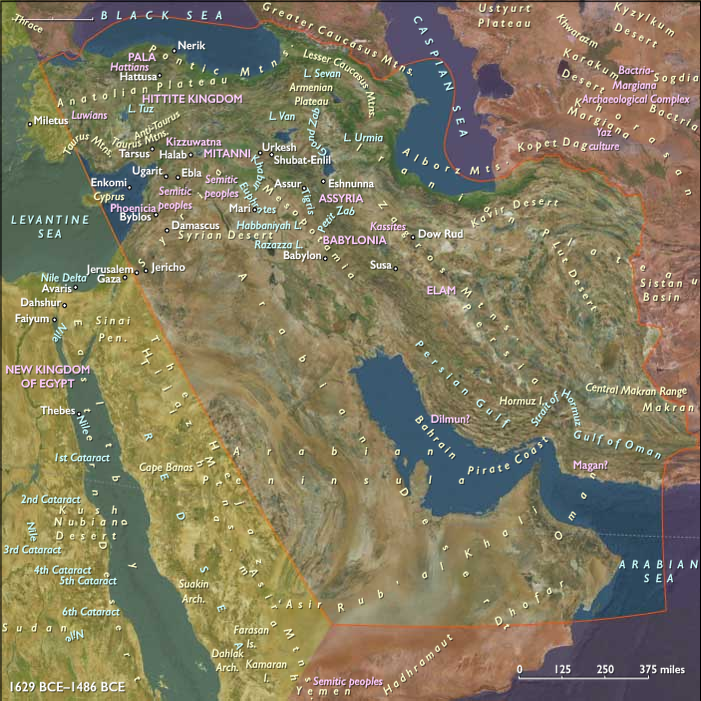
By the middle of the second millennium BCE, Semitic nomadic groups have increasingly settled in the Jordan Valley, gradually assimilating local populations and transforming the region into a predominantly Semitic linguistic area. The nomadic western Semitic group known as the Habiru, meaning wanderers or outsiders, includes the ancestral figure Abraham (Ibrahim), whose household enters the region from Mesopotamia. This movement marks the earliest identifiable presence of what will become the Hebrew people.
Hyksos Invasion and Egyptian Reconfiguration
The abrupt arrival of the Hyksos, a Semitic people from the north, dramatically reshapes the region as they invade Egypt via Canaan around 1600 BCE. Their rule over Egypt (c. 1600–1570 BCE) temporarily disrupts Egyptian influence, but the liberation war led by Ahmose I (1570–1545 BCE) restores native Egyptian control, reshaping geopolitical dynamics across the Levant.
Indo-European Expansion and Hittite-Kassite Alliance
Around 1600 BCE, Indo-European-speaking tribes initiate a period of widespread migration and settlement. One group, the Hittites, allies with the Kassites, a mountain people of uncertain origins, to conquer and destroy Babylon. The fall of Amorite power coincides with increased Egyptian dominance over Syria, further reshuffling regional power structures.
Hittite Ascendancy in Anatolia
The Hittite conquest of Anatolia accelerates during this period, with key victories such as the conquest of Aleppo (Yamhad) by the Hittite king Hattusili I. The Hittites introduce the chariot into warfare and establish a constitutional monarchy, evidenced by surviving legal tablets. Their legal system demonstrates a remarkable aversion to capital punishment, favoring reparations or forced labor instead.
Hurrian Expansion and the Rise of Mitanni
The Hurrians, whose original homeland lies in the Khabur River valley, significantly expand their territory westward into northern Syria and southern Anatolia by 1725 BCE, notably influencing cities such as Alalakh (Tell Atchana). Following the collapse of Babylon after its sacking by the Hittite king Mursili I, the Hurrian states coalesce into the powerful kingdom of Mitanni, filling a regional power vacuum.
Kassite Dynasty and Babylonian Continuity
The Kassite dynasty emerges in Babylon around 1531 BCE, inaugurating over four centuries of rule. Though culturally distinct and speaking a language isolate, the Kassites continue Babylon's religious and administrative traditions, maintaining Babylon (Kar-Duniash) as a significant regional center. Notably, Kassite kings do not adopt the divine attributes previously common among Babylonian rulers.
Economic and Cultural Networks
Strategic cities such as Ugarit and Byblos remain economically significant, maintaining connections despite disruptions caused by the Hyksos presence. Cyprus (Alashiya) emerges as a major copper supplier, fostering trade relationships with Ugarit and Egypt. Technological innovations, including improved plowshares in northern Mesopotamia around 1600 BCE and advancements in pottery and metallurgy, facilitate sustained economic development.
Religious and Cultural Developments
In religious contexts, significant deities such as El, Asherah, and Baal dominate in Levantine cities like Ugarit, reflecting Canaanite religious practices. The prominence of temples, such as the architecturally sophisticated temple at Tepe Gawra, underscores continued religious significance in civic life. Additionally, the era witnesses early developments in iron metallurgy attributed to peoples of the Caucasus and eastern Anatolia.
Elamite Resurgence and Ebla’s Decline
In southern Iran, the Elamite capital Susa thrives briefly under the later Epartid dynasty, though its influence diminishes following the Kassite consolidation in Babylon. Meanwhile, Ebla experiences its final destruction around 1575–1525 BCE, likely due to Hittite military campaigns, effectively ending its historical prominence.
Urban and Architectural Innovation
New architectural forms emerge, such as the megaron house, a structural innovation originating in northern Mesopotamia around 1800 BCE. This period also marks advancements in urban planning, with monumental temple complexes and fortified urban centers reflecting a sophisticated approach to city-building and defense.
This era encompasses significant migrations, military conquests, cultural integrations, and technological innovations, collectively reshaping the Middle Eastern geopolitical and cultural landscape profoundly.
People
Groups
- Polytheism (“paganism”)
- Semites
- Larsa, city-state of
- Dilmun (Bahrain?)
- Elam, (Old) Kingdom of
- Cyprus, Archaic
- Canaanite culture, ancient
- Hurrians
- Isin, city-state of
- Amorites
- Ebla, Kingdom of
- Erbil (Arbil, Irbil), city-state of
- Nineveh, city-state of
- Ugarit, Kingdom of
- Alalakh, city-state of
- Kassites
- Yamhad, or Yamkhad, Kingdom of
- Hapiru, or Habiru
- Babylonian Empire
- Sealand, or Marsh, Kingdom
- Egypt (Ancient), Second Intermediate Period of
- Hyksos, Kingdom of
- Egypt (Ancient), New Kingdom of
- Babylonian Kingdom of the Kassites
- Mitanni (Hanigalbat), Kingdom of
- Elam, (Middle) Kingdom of
Commodoties
- Weapons
- Hides and feathers
- Glass
- Domestic animals
- Grains and produce
- Ceramics
- Strategic metals
- Beer, wine, and spirits
Subjects
- Commerce
- Writing
- Architecture
- Sculpture
- Painting and Drawing
- Environment
- Decorative arts
- Conflict
- Mayhem
- Faith
- Government
- Custom and Law
- Technology
- Metallurgy
Regions
Subregions
Related Events
Showing 10 events out of 55 total
Years: 1629BCE - 1486BCE
People
Groups
- Polytheism (“paganism”)
- Semites
- Larsa, city-state of
- Dilmun (Bahrain?)
- Elam, (Old) Kingdom of
- Cyprus, Archaic
- Canaanite culture, ancient
- Hurrians
- Isin, city-state of
- Amorites
- Ebla, Kingdom of
- Erbil (Arbil, Irbil), city-state of
- Nineveh, city-state of
- Ugarit, Kingdom of
- Alalakh, city-state of
- Kassites
- Yamhad, or Yamkhad, Kingdom of
- Hapiru, or Habiru
- Babylonian Empire
- Sealand, or Marsh, Kingdom
- Egypt (Ancient), Second Intermediate Period of
- Hyksos, Kingdom of
- Egypt (Ancient), New Kingdom of
- Babylonian Kingdom of the Kassites
- Mitanni (Hanigalbat), Kingdom of
- Elam, (Middle) Kingdom of
Commodoties
- Weapons
- Hides and feathers
- Glass
- Domestic animals
- Grains and produce
- Ceramics
- Strategic metals
- Beer, wine, and spirits
Subjects
- Commerce
- Writing
- Architecture
- Sculpture
- Painting and Drawing
- Environment
- Decorative arts
- Conflict
- Mayhem
- Faith
- Government
- Custom and Law
- Technology
- Metallurgy
Regions
Subregions