
The Middle East: 1732–1743 CE The …
Years: 1732 - 1743
The Middle East: 1732–1743 CE
The Rise of Wahhabism and Al Saud
This era witnesses the foundational developments of Wahhabism, profoundly shaping future Arabian politics. Muhammad ibn Abd al Wahhab returns from scholarly travels across the Middle East to Najd, advocating a reformist Islamic doctrine aimed at purifying the faith from practices he perceives as idolatrous, particularly those prevalent among the Shia and local tribal traditions. Initially settling in Huraymila and then in Uyaynah, Muhammad ibn Abd al Wahhab gains initial support from local leaders but faces resistance due to his anti-Shia stance, especially from influential Shia centers like Al Hufuf. Forced to leave Uyaynah due to local pressures, he eventually settles in Ad Diriyah, establishing a crucial alliance with local ruler Muhammad ibn Saud, thereby laying the foundation for the future Saudi state.
Muhammad ibn Abd al Wahhab’s teachings, influenced by strict Hanbali principles and earlier reformist scholars such as Ibn Taymiyah, denounce popular Islamic practices like shrine visitation and the veneration of natural objects, branding them polytheistic. His followers identify themselves as Muwahhidun (Unitarians), although opponents label them derogatorily as Wahhabis. This ideological alliance between Abd al Wahhab and Muhammad ibn Saud significantly reshapes the religious and political landscape of the Arabian Peninsula.
Omani Instability and Persian Intervention
In Oman, internal strife continues to undermine Yarubid authority. Saif bin Sultan II, facing significant opposition from his cousin and rival Bal'arab bin Himyar, Imam of the Omani interior, seeks external aid to consolidate power. In 1737, Persian forces under Nader Shah, invited by Saif, decisively defeat Bal'arab bin Himyar in Az Zahirah, briefly restoring Saif bin Sultan II's rule. However, Saif's indulgent lifestyle and poor governance quickly alienate tribal leaders once again.
In 1742, Sultan bin Murshid, another Yaruba family member, emerges as a political figure, leading a rebellion that forces Saif to request further Persian aid. The Persians exploit this instability, capturing strategic forts around Muscat and Sohar. Saif bin Sultan II, betrayed by his Persian allies, dies in 1743, and Sultan bin Murshid is mortally wounded under the walls of Sohar. Bal'arab bin Himyar once again emerges as Imam amidst continuing factional conflict.
Persian Ascendancy under Nader Shah
This period marks significant military and political expansion by Nader Shah of Persia, profoundly reshaping regional dynamics. In 1736, Nader Shah formally ascends to the throne of Persia, initiating a series of aggressive campaigns aimed at restoring Persian dominance across its historical territories. In 1738, Persian forces recapture the vital city of Baghdad, briefly restoring Persian rule over the region and dramatically altering the power balance between Persia and the Ottoman Empire. However, intense conflict and resistance eventually force a Persian withdrawal, stabilizing Ottoman control once again by 1743.
Nader Shah's expansionist ambitions are not confined to Iraq alone. His strategic engagements in the Persian Gulf and Oman reflect broader geopolitical goals of securing trade routes and asserting Persian influence. His incursions significantly impact Omani internal politics and further weaken Ottoman authority throughout the Middle East.
Ottoman Administration and Tribal Power Dynamics
The period sees continued decentralization within Ottoman territories, notably evident in the rising autonomy of tribal groups in Iraq and the Arabian Peninsula. Ottoman central authority in these regions weakens considerably, creating an environment in which tribal confederations and local dynasties, such as the Muntafiq and Bani Lam in Iraq and the Kurdish Baban Dynasty in the north, wield significant power. Tribal authority dominates, exacerbated by the influx of Bedouin tribes like the Shammar and 'Anazzah. This tribal fragmentation continues to challenge Ottoman control and contributes to the overall weakening of centralized governance.
Legacy of the Era
Between 1732 and 1743, critical ideological foundations of the future Saudi state are established through the Wahhabi-Saudi alliance. Simultaneously, Oman experiences prolonged internal conflict and Persian intervention, marking the decline of Yarubid rule. Nader Shah’s brief occupation of Baghdad underscores the shifting balance of power between Persia and the Ottoman Empire. Meanwhile, tribal autonomy increases across Ottoman territories, setting the stage for a fragmented political landscape that will characterize the region in subsequent decades.
People
Groups
- Bedouin
- Anazzah
- Shammar
- Muslims, Sunni
- Muslims, Shi'a
- Banu Lam
- Al-Muntafiq
- Ottoman Empire
- Persia, Safavid Kingdom of
- Yaruba dynasty
- Oman, Second Imamate of
- Baban
- Omani Empire
- Wahhabism
- Persia, Afsharid Kingdom of
Topics
Subjects
Regions
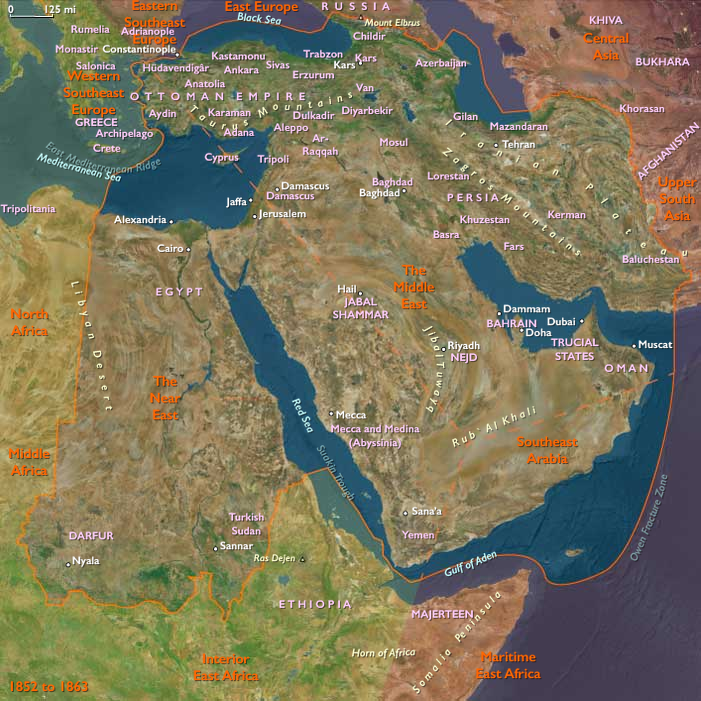
Subregions
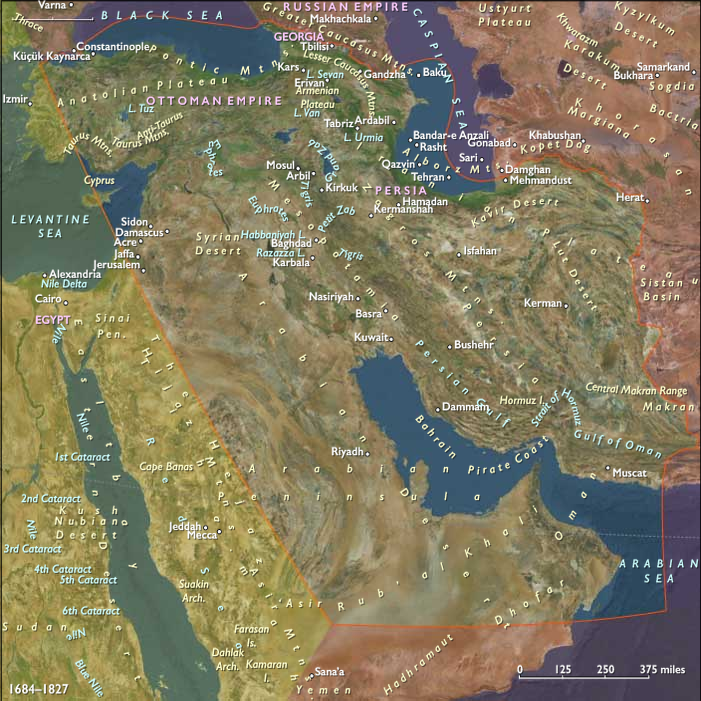
Years: 1732 - 1743
People
Groups
- Bedouin
- Anazzah
- Shammar
- Muslims, Sunni
- Muslims, Shi'a
- Banu Lam
- Al-Muntafiq
- Ottoman Empire
- Persia, Safavid Kingdom of
- Yaruba dynasty
- Oman, Second Imamate of
- Baban
- Omani Empire
- Wahhabism
- Persia, Afsharid Kingdom of
Topics
Subjects
Regions
Subregions